Mar 05, 2026

In many industrial fluid control systems, the globe valve is widely used for precise flow control and reliable shut-off. Traditional industrial globe valve designs typically use a straight pattern structure where the fluid must change direction twice inside the valve body. This internal flow path forms an S-shaped channel, which creates significant resistance and pressure loss.
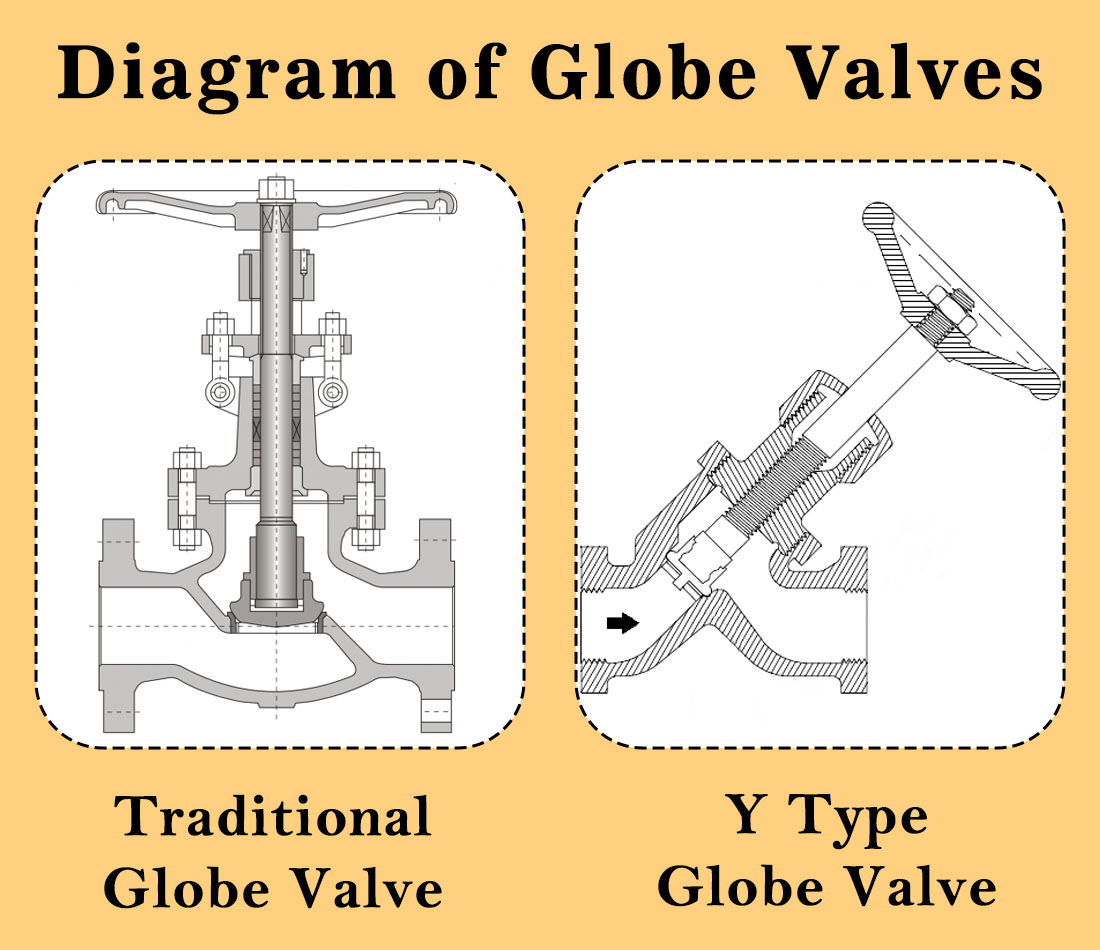
When the medium enters a conventional control globe valve, it first flows downward toward the seat and then upward toward the outlet. These two sharp directional changes reduce flow efficiency and increase turbulence. As a result, the globe valve pressure drop becomes relatively large compared with other valve types.
The Y type globe valve, also called an oblique globe valve, was developed to address this limitation. Instead of an S-shaped path, the Y-type body design allows the medium to pass through the valve with only one smooth directional change of approximately 90 degrees. This significantly reduces turbulence and improves flow efficiency.
Because of this design improvement, many pneumatic globe valve and automatic globe valve systems adopt Y-type structures in applications where flow performance and quick response are important.
The internal channel of a Y type globe valve aligns more closely with the direction of the pipeline. This design reduces friction losses and allows higher flow capacity compared with a conventional flanged globe valve or threaded globe valve with a straight body.
In fluid mechanics terms, fewer directional changes lead to lower energy loss. This means that the valve can deliver higher effective flow rates even with the same nominal diameter.
The difference in flow characteristics can be illustrated in the following comparison.
| Valve Type | Internal Flow Path | Direction Changes | Relative Pressure Drop | Typical Flow Capacity |
|---|---|---|---|---|
| Conventional Globe Valve | S-shaped | Two turns | High | Medium |
| Angle Globe Valve | 90° turn | One turn | Medium | Medium |
| Y Type Globe Valve | Smooth oblique path | One smooth turn | Low | High |
Because of the reduced pressure loss, Y-type designs are frequently selected for globe valve for steam, globe valve for water system, and other industrial fluid systems where maintaining stable flow is important.
For example, in a steam globe valve application within an HVAC or heating system, reduced pressure loss improves overall energy efficiency and helps maintain consistent downstream pressure.
Another important advantage of the Y-type structure is its excellent compatibility with automation systems. In modern industrial plants, many valves are equipped with pneumatic actuated globe valve mechanisms or integrated into a globe valve automation system.

Because the flow channel inside the valve body is smoother and less restrictive, the valve disc experiences lower hydraulic resistance during opening and closing. This allows faster movement when driven by a pneumatic globe valve actuator or an air operated globe valve system.
The reduced internal turbulence also means less vibration and mechanical stress on valve components. In automated environments where valves may operate thousands of cycles, this structural advantage helps improve durability.
Many stainless steel globe valve designs used in automated production lines adopt Y-type bodies for this reason. Combined with a pneumatic control globe valve, the system can achieve rapid response and reliable operation.
In industrial fluid systems containing steam, water, or gas, continuous turbulence inside the valve body can accelerate internal wear. Traditional S-shaped flow paths create strong local velocity changes that can erode sealing surfaces over time.
The smoother channel inside a Y type globe valve significantly reduces this effect. The medium flows more evenly through the valve body, which reduces erosion on the seat and disc.
This structural advantage provides several operational benefits:
◆ Reduced internal component wear
◆ Lower maintenance frequency
◆ Longer operational service life
In many industrial globe valve applications, including globe valve for chemical process or globe valve for HVAC systems, maintenance costs can represent a significant portion of lifecycle expenses. A design that naturally reduces internal wear therefore becomes attractive for long-term operation.

In certain industrial systems, the fluid may contain small particles, scale, or condensate. In conventional globe valves, the S-shaped flow path can create local dead zones where impurities accumulate.
The streamlined channel of a Y type globe valve helps minimize these stagnant regions. Because the medium passes through the valve body with fewer obstructions, suspended particles are less likely to settle inside the valve.
For this reason, Y-type designs are often selected for durable industrial globe valve applications where cleanliness and reliability are critical.
This characteristic is particularly beneficial in automated pipelines where manual inspection is limited.
Although the Y-type design offers clear advantages in flow efficiency and automation compatibility, it also has certain limitations.
Traditional control globe valve designs are widely used because they provide excellent flow regulation capability. The S-shaped path creates predictable flow characteristics that are useful for precise throttling control.
The Y-type body sacrifices some of this flow regulation performance. Because the flow path is smoother, the valve may not achieve the same fine control characteristics as a standard throttling globe valve.
In addition, Y-type valves are generally more suitable for moderate sizes and operating conditions. In extremely high pressure or high temperature applications, such as large high pressure globe valve systems, conventional forged body designs may still be preferred.
In most industrial systems, the advantages of Y-type valves are most noticeable when the pipe diameter is below approximately DN100.
(FK9025)
You May Interest In






Dec 12, 2025 Blog
What Is a Globe Control Valve?
Dec 11, 2025 Blog
Two ways for a globe valve to be bidirectional
Dec 10, 2025 Blog
How Does a Manual Globe Control Valve Work?
Dec 09, 2025 Blog
Working Principle of Check Valves

Get a free sample

Fokca is a brand of Ningbo Fokca Automation Co., Ltd.
Looking for custom pneumatic cylinder solutions? Visit our sister brand, Fescolo.→
© 2026 Ningbo Fokca Automation Co., Ltd. All rights reserved. Sitemap