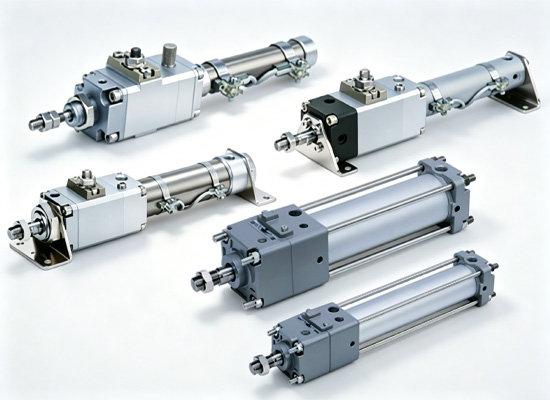
Locking cylinders use a mechanical spring-loaded pawl to physically lock the piston rod when air supply is cut off. When pilot air is applied, it overrides the spring and releases the lock, allowing normal cylinder motion. This design makes locking cylinders essential for vertical lifts, emergency stops, and fail-safe positioning where gravity or external forces could cause dangerous movement after air loss — unlike standard cylinders which cannot hold position without constant air pressure.
A locking cylinder is a special pneumatic actuator that mechanically locks the piston rod after it reaches the end of its stroke or any intermediate position. Its core value is that when the air supply is accidentally cut off or pressure drops, the locking mechanism automatically holds the current position, preventing table drop, workpiece fall, or equipment damage caused by gravity.
The locking cylinder uses a spring lock mechanism – locking is achieved by spring force driving a pawl to clamp the piston rod, while unlocking is done by compressed air pushing the pawl away.
The locking mechanism can lock the piston rod in both the extension and retraction directions, holding position in both directions. This means whether the load is pushing or pulling, the locking cylinder reliably holds position, complying with the fail-safe principle.
Lock on air loss, bidirectional holding, fail-safe – Fokca locking cylinders use a spring-lock, air-release mechanical design. When the air supply is accidentally cut off, the piston rod locks automatically, preventing vertical fall or position drift. Ideal for vertical lifts, emergency stops, and mid-stroke positioning.
● Spring lock, locks on air loss – No electrical control needed. Purely mechanical pawl lock activates automatically when air supply is lost, making emergency stop more reliable.
● Bidirectional locking – Locks in both extension and retraction directions. Whether the load pushes or pulls, position holding remains firm.
● Bore size options – Available from 125mm to 250mm bore diameters, suitable for heavy-duty vertical lifts and large conveyors.
● Manual release standard – Can be manually unlocked using a hex wrench when no air supply is available – no extra tools needed for maintenance.
● Magnetic switch ready – Optional magnetic switch detects piston position, enabling closed-loop control with lock status feedback.
| Feature | Locking Cylinder | Standard Cylinder + 5/3 Closed Center Valve |
| Locking Principle | Mechanical pawl clamps piston rod – physical lock | Valve spool cuts off ports – position held by trapped residual air |
Position Holding After Air Loss | Still locked | Residual air slowly leaks – position gradually lost |
| Long-Term Holding | No change for days or months | Minutes to hours |
| Vertical Load Fall Prevention | Reliable | Unreliable |
| Impact / Vibration Resistance | Mechanical lock unaffected | Pressure fluctuations may cause position drift |
| Application | Safety-critical, vertical loads, long-term holding | Horizontal loads, short stops, non-safety applications |
1. When mounted vertically, the locking cylinder is primarily used to prevent load falls – ensure the locking mechanism is loaded in compression. When mounted horizontally, the locking cylinder can be used for mid-stroke positioning.
2. The air pressure required for unlocking must be higher than the set minimum working pressure. Below this pressure, the locking mechanism cannot be released.
3. When using multiple locking cylinders in parallel, ensure the unlocking pressure is consistent across all cylinders to avoid asynchronous operation.
4. The CLS series comes standard with a manual release function – use a hex wrench to manually unlock when no air supply is available.
5. Manual release does not auto-reset. Before reapplying air, verify the locking mechanism has returned to the normal locked position.
6. It is recommended to install a lock status sensor to confirm the locking mechanism is properly engaged before proceeding to the next operation.
Need help selecting the right pneumatic component?
Contact our engineering team.

Get a free sample

Fokca is a brand of Ningbo Fokca Automation Co., Ltd.
Looking for custom pneumatic cylinder solutions? Visit our sister brand, Fescolo.→
© 2026 Ningbo Fokca Automation Co., Ltd. All rights reserved. Sitemap