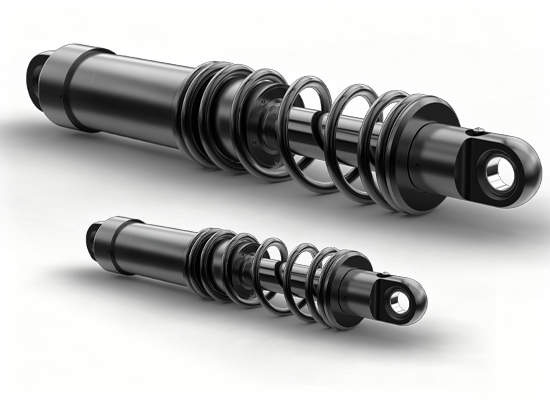
Hydraulic shock absorbers use oil throttling to generate damping, converting impact kinetic energy into heat for a smooth, soft stop. Unlike rubber or spring buffers, they offer no rebound, smoother absorption, and longer life — ideal for protecting automation equipment and reducing noise.
Fokca offers adjustable and fixed types. Adjustable models use a needle valve to vary damping force for different loads and speeds; fixed types are ready to use for stable conditions. Suitable for cylinders, rotary actuators, slides, and conveyors.
A hydraulic shock absorber is an impact absorption device that uses hydraulic oil as its working medium, designed specifically to absorb impact energy generated by moving components at the end of their stroke. In automation equipment, moving parts such as cylinders, slides, and conveyors can produce violent impact and rebound without proper control, leading to equipment vibration, increased noise, and shortened component life. Hydraulic shock absorbers solve this problem by converting impact energy into heat, achieving smooth deceleration, soft stops, and no rebound.
The working process of a hydraulic shock absorber consists of four steps:
● Impact transmission – When a moving object hits the piston rod, the piston begins to compress the hydraulic oil in the pressure chamber.
● Damping through throttling – The gap between the inner cylinder and piston is very small, so the compressed hydraulic oil is forced through throttle orifices. The flow resistance generated is the source of impact absorption.
● Energy conversion – The impact energy is converted into heat through dynamic pressure resistance. The heat is dissipated into the surrounding air through the shock absorber housing.
● Volume compensation – As the piston rod retracts, the space occupied by the rod volume causes the hydraulic oil to "expand," and the accumulator contracts to compensate for this volume change.
Compared to rubber absorbers or spring buffers, hydraulic shock absorbers offer significant advantages:
● No rebound – Rubber or spring buffers release energy after compression, causing rebound, while hydraulic shock absorbers absorb impact smoothly through hydraulic damping with no rebound.
● Compact size – For the same energy absorption capacity, hydraulic shock absorbers are much smaller than other buffer types.
● Smooth absorption – They repeatedly absorb impact energy in a gentle manner, avoiding sudden violent shocks.
● Adjustable – Adjustable types allow the throttle orifice size to be changed via a needle valve, adapting to different loads and speeds.
1. Ensure the moving object's direction aligns with the shock absorber axis to avoid eccentric impact.
2. Do not remove the front cap; the piston rod may over-extend and bottom out, causing internal damage.
3. Keep the piston rod free of rust chips and foreign matter to prevent seal damage and oil leakage.
4. Do not apply paint to threads or the piston rod, as it may affect heat dissipation and cause leakage.
5. Incorrect impact speed selection may prevent proper energy absorption and even generate abnormal reaction forces.
Need help selecting the right pneumatic component?
Contact our engineering team.
Get a free sample

Fokca is a brand of Ningbo Fokca Automation Co., Ltd.
Looking for custom pneumatic cylinder solutions? Visit our sister brand, Fescolo.→
© 2026 Ningbo Fokca Automation Co., Ltd. All rights reserved. Sitemap