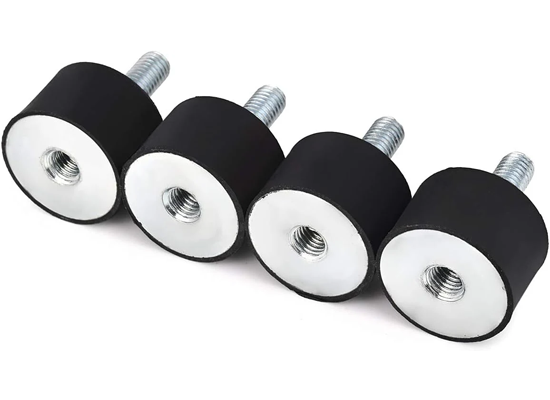
A rubber bumper is an industrial buffer that absorbs impact energy through the inherent elasticity of rubber material. When a moving part strikes, the rubber deforms elastically, converting kinetic energy into deformation energy. After impact, the rubber returns to its original shape.
Although a rubber stop does produce some rebound, its simple construction, low cost, no adjustment needed, and dust resistance make it one of the most widely used shock absorber types in industrial automation for light-duty, low-speed cushioning applications.
A rubber bumper is a cushioning component that uses the inherent elasticity of rubber material to absorb impact energy, reduce vibration, and lower noise. When a moving part strikes the bumper, the rubber undergoes elastic deformation, converting impact kinetic energy into deformation energy. After the impact, the rubber returns to its original shape, releasing the stored deformation energy.
Unlike hydraulic shock absorbers, rubber bumpers do produce some rebound. However, thanks to their simple structure, low cost, and easy installation, they remain one of the most widely used cushioning methods in industrial automation.
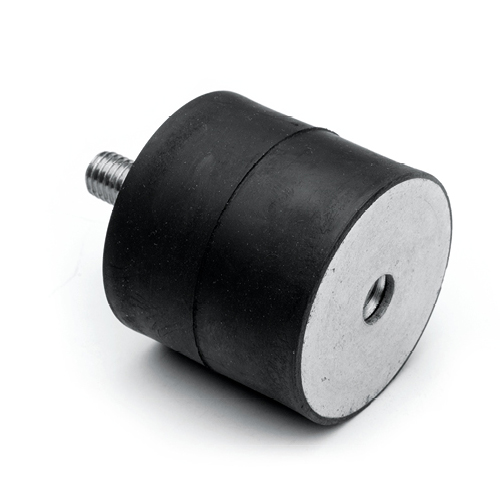
In automation equipment, rubber bumpers are typically installed at cylinder stroke ends, conveyor line ends, stacker crane limit positions, equipment door frames, and similar locations, serving as limit stops, impact buffers, and vibration/noise dampeners. They are rugged, durable industrial consumables — resistant to dust, requiring no adjustment, and ready to use out of the box.
| Aspect | Rubber Bumper | Hydraulic Shock Absorber |
| Working Principle | Rubber elastic deformation | Hydraulic oil throttling damping |
| Rebound | Yes | No |
| Absorption Efficiency | Fair | Excellent |
| Energy Absorption | Limited | High (up to thousands of joules) |
| Speed Adaptability | Fair | Excellent |
| Noise | Low | Very low |
| Adjustability | Non-adjustable | Adjustable types available |
| Cost | Low | High |
| Applications | Low speed, light load, general cushioning | High speed, heavy load, precision cushioning |
| Service Life | Affected by aging | Long |
| Material | Hardness Range | Features | Typical Applications |
Natural Rubber (NR) | Shore A 30–70 | Good elasticity, tear-resistant, eco-friendly | General industrial cushioning, vibration pads |
Silicone Rubber (VMQ) | Shore A 30–80 | High/low temperature resistance, food-grade certified | Food machinery, high-temperature baking equipment |
Polyurethane (PU) | Shore A 60–95 | Wear-resistant, oil-resistant, high load capacity | Heavy-duty equipment, oily environments |
Nitrile Rubber (NBR) | Shore A 40–80 | Excellent oil resistance | Automotive manufacturing, hydraulic equipment |
1. Ensure threaded bumpers are tightened properly to prevent loosening during use
2. Select the appropriate size to prevent impact energy from exceeding the bumper's capacity
3. Rubber ages over time, becoming hard or cracked. Inspect annually and replace when severely aged
4. Use silicone rubber for high temperatures; NBR or polyurethane for oily environments; food-grade silicone for food applications
5. Ensure the impact direction aligns with the bumper axis to prevent uneven wear on one side of the rubber head
Need help selecting the right pneumatic component?
Contact our engineering team.
Get a free sample

Fokca is a brand of Ningbo Fokca Automation Co., Ltd.
Looking for custom pneumatic cylinder solutions? Visit our sister brand, Fescolo.→
© 2026 Ningbo Fokca Automation Co., Ltd. All rights reserved. Sitemap