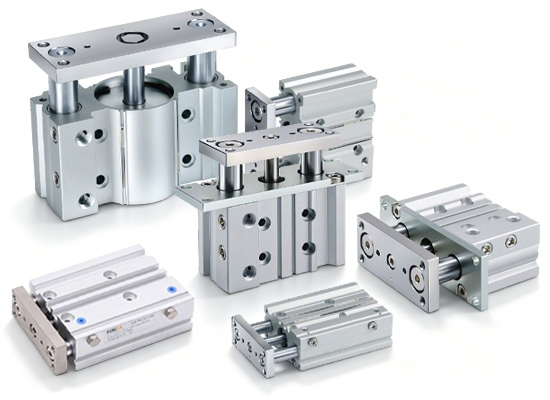
High rigidity, high precision, long service life —The guided cylinder integrates a guiding mechanism, with guide rods bearing side loads while the piston rod focuses solely on transmitting thrust, solving the problem of standard cylinders being unable to handle eccentric loads.
The Fokca MGP series offers two guide options — slide bearings and ball bearings — with bore sizes from 20mm to 100mm and strokes from 10mm to 400mm. The guide rods handle side forces, allowing the cylinder to withstand significant radial loads and torsional moments. Repeat positioning accuracy is within ±0.1mm. Ideal for slide table handling, cantilever structures, eccentric load applications, and similar use cases.
In pneumatic systems, the piston rod of a standard cylinder offers almost no resistance to side loads. When loads are eccentric or external forces act off-axis, the piston rod may bend, seals wear rapidly, and equipment damage can occur. Guided cylinders use an additional guiding structure to bear side loads, allowing the piston rod to focus solely on transmitting thrust, thereby significantly improving system rigidity and service life.
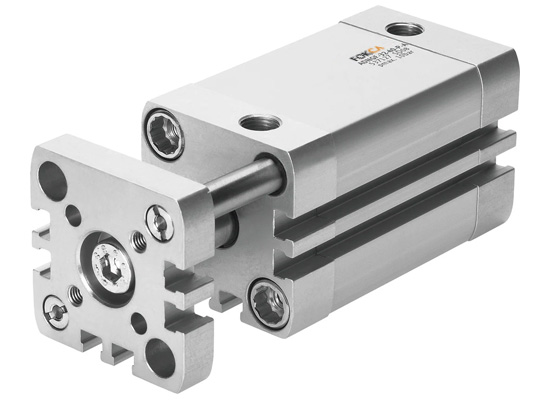
A guided cylinder incorporates guide rods or linear guides to maintain stable linear motion even when the piston rod is subjected to side loads. It is essentially a pneumatic actuator that integrates a guiding mechanism into the cylinder body, offering key advantages over standard cylinders:
● High Rigidity – Guide rods bear side loads while the piston rod only transmits thrust, allowing the cylinder to handle large radial loads and torsional moments.
● High Precision – The guiding structure ensures straightness of motion, with repeatability up to ±0.1mm.
● Long Service Life – Reduced wear on piston rods and seals results in significantly longer service life compared to standard cylinders.
| Aspect | Guided Cylinder | Dual Rod Cylinder |
| Core Function | Side load resistance, guided support | Anti-rotation, high thrust |
| Structural Feature | Cylinder body with independent guide rods or rails | Two air chambers with two parallel piston rods |
| Side Load Resistance | Guide rods bear side loads; piston rod transmits thrust only | Dual rods share side loads via geometric lever arm |
| Radial Load Capacity | Very high | Moderate |
| Anti-Rotation Principle | Guide rods constrain rotational freedom | Dual rods resist rotation via geometric lever arm |
| Output Thrust | Piston rod delivers thrust; guide rods do not contribute | Both rods transmit thrust simultaneously |
| Application Focus | Applications requiring large side loads or cantilevered loads | Applications requiring piston rod anti-rotation |
| Typical Use | Slide table handling, cantilever structures, lifting mechanisms, eccentric loads | Precision gripping, pick-and-place, anti-rotation positioning |
1. The mounting surface must be flat; otherwise, guide rods may bind and motion will be uneven.
2. Ensure radial loads and moments are within rated limits to avoid overloading that could bend guide rods or damage bearings.
3. Slide bearing types require periodic lubrication with recommended grease; ball bearing types are maintenance-free.
4. Compressed air must be filtered to remove moisture and contaminants.
5. In dusty environments, choose models with dust seals to prevent dust ingress into guide rods and bearings.
6. Regularly check guide rod surfaces for scratches, verify lubrication condition, and ensure mounting screws are tight.
Q1: What is the difference between a guided cylinder and a dual rod cylinder?
A1: A guided cylinder uses independent guide rods to bear side loads, offering excellent side load resistance for cantilever applications such as material handling and slide tables. A dual rod cylinder uses a geometric lever arm formed by two rods to resist rotation, offering higher anti-rotation precision for gripping and centering applications.
Q2: What guide options are available for the MGP series guided cylinders?
A2: The MGP series offers two guide options: slide bearings and ball bearings. Slide bearings provide high load capacity and impact resistance, making them suitable for heavy loads. Ball bearings have lower friction and smoother motion, making them ideal for high-speed, light-load applications.
Q3: How much side load can a guided cylinder handle?
A3: Side load capacity depends on bore size, stroke, and guide type. For the MGP series, larger bore sizes and shorter strokes allow greater radial loads. Refer to the product specification sheet for specific values.
Q4: Can guided cylinders be used in dusty environments?
A4: Yes. The MGP-XC4 series is specifically designed for dusty environments, featuring dust seals and lubricant retainers, making it suitable for applications involving ceramic powder, paper dust, metal powder, and similar conditions.
Need help selecting the right pneumatic component?
Contact our engineering team.

Get a free sample

Fokca is a brand of Ningbo Fokca Automation Co., Ltd.
Looking for custom pneumatic cylinder solutions? Visit our sister brand, Fescolo.→
© 2026 Ningbo Fokca Automation Co., Ltd. All rights reserved. Sitemap