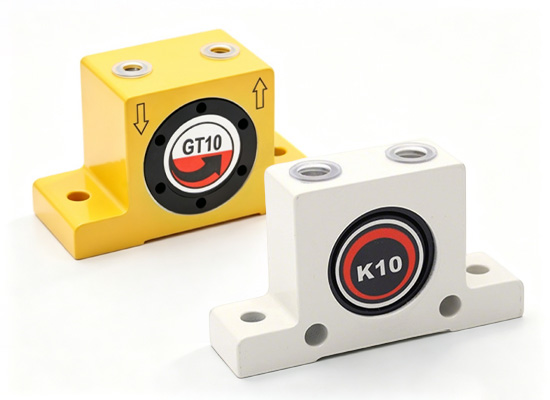
Pneumatic vibrators use compressed air to prevent material bridging and sticking in hoppers and silos. GT gear vibrator provides low-noise, high-frequency vibration for indoor, food, and pharma use. K ball vibrator delivers powerful centrifugal force with simple, robust construction. Explosion-proof, no electrics, adjustable force via air pressure. Ideal for cement, chemical, mining, bulk handling.
A pneumatic vibrator is a vibration device powered by compressed air. It generates vibration through high-speed movement of internal components (such as steel balls, gears, rollers, etc.), specifically designed to solve problems such as adhesion, blockage, bridging, and rat-holing of powder and granular materials in silos, hoppers, pipes, and bins.
In powder processing and bulk material handling, materials tend to adhere or bridge on vessel walls due to moisture, compaction, static electricity, etc., leading to poor discharge or complete blockage. Pneumatic vibrators transmit vibration to the vessel wall through high-frequency or high-impact vibration, loosening the adhered material and restoring normal flow.
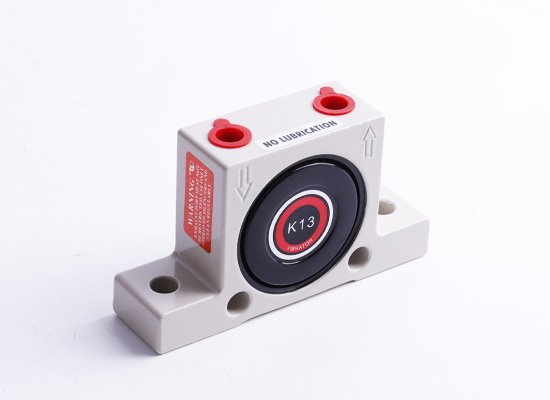
Compared to electric vibrators, pneumatic vibrators offer outstanding advantages such as explosion-proof safety, no electromagnetic interference, compact size, light weight, and stepless adjustable vibration force. They require no electricity, and vibration force and frequency can be continuously adjusted by regulating air supply pressure, making them particularly suitable for wet, dusty, and explosive environments.
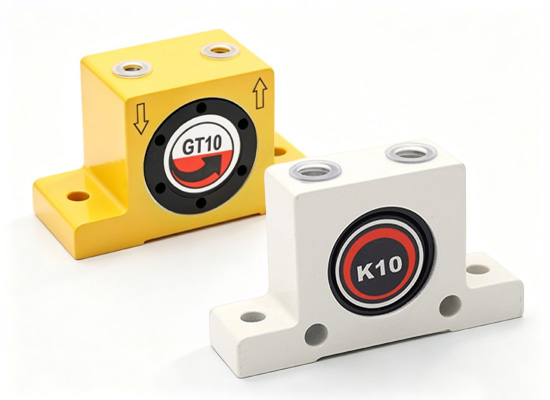
● K Series Ball Vibrator uses a classic ball-type structure. Compressed air drives a hardened steel ball to roll at high speed within a precision-ground raceway, generating strong centrifugal force. The steel ball is the only moving part, making the structure extremely simple with a very low failure rate. Compact, lightweight, and suitable for harsh environments.
● GT Series Gear Vibrator uses a unique gear meshing technology. Compressed air drives a precision gear train to rotate at high speed, generating stable and smooth centrifugal force. The gear-type structure provides high-frequency, low-amplitude vibration with extremely smooth operation and minimal impact on equipment.
| Feature | GT Series (Gear Type) | K Series (Ball Type) |
| Working Principle | Compressed air drives meshing gears to generate centrifugal force | Compressed air drives steel ball rolling on hardened raceway to generate centrifugal force |
| Vibration Characteristics | High frequency, low amplitude, continuous vibration | Medium-high frequency, vibration from ball rolling |
| Noise Level | Low noise, suitable for indoor use | Slightly higher noise, suitable for outdoor or industrial environments |
| Operating Temperature | Up to 120°C | -10~70°C standard, high-temp version available |
| Core Advantage | Smooth operation, low noise, long service life | Simple structure, low failure rate, high vibration force |
| Applications | Noise-sensitive environments, food/pharmaceutical, high-frequency vibration applications | Hopper bridging, screening, compaction, general industrial flow aid |
1. Install at the location most prone to blockage on the hopper or silo, typically the middle-lower part of the cone section.
2. The mounting surface must be flat. An uneven surface may cause the vibrator to malfunction due to torsional vibration.
3. Use grade 8.8 or higher hex socket or hex head screws, with spring washers and flat washers for fastening.
4. Re-tighten the screws after the vibrator has run for a few minutes to prevent loosening caused by initial vibration.
5. Do not run the vibrator under no load for extended periods to avoid structural damage when mounted on an empty hopper.
6. If vibration force is excessive, use a pressure regulator or flow control valve to adjust the air pressure before operation.
Need help selecting the right pneumatic component?
Contact our engineering team.
Get a free sample

Fokca is a brand of Ningbo Fokca Automation Co., Ltd.
Looking for custom pneumatic cylinder solutions? Visit our sister brand, Fescolo.→
© 2026 Ningbo Fokca Automation Co., Ltd. All rights reserved. Sitemap