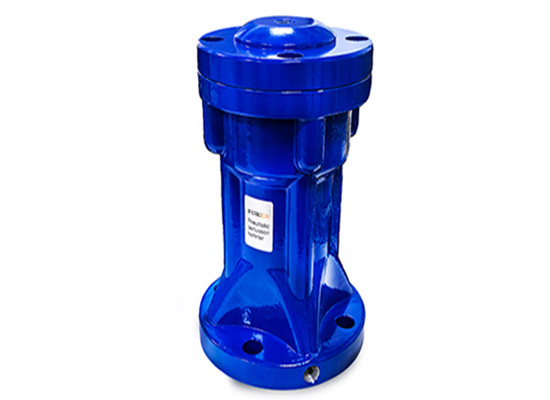
Pneumatic Hammer uses compressed air to drive a magnetic piston, generating instant impact force to solve powder material adhesion and blockage problems in silos and hoppers. The striking interval and operating duration can be adjusted through a timer relay. Compared with manual hammering, the periodic shock waves produced by the SK Series effectively loosen material buildup and restore smooth material flow.
The SK Series Pneumatic Hammer (also called Air Knocker) is a flow-aid device powered by compressed air. It is designed to eliminate material buildup, bridging, and blockage in hoppers, silos, chutes, pipelines, and storage bins handling powders or granules.
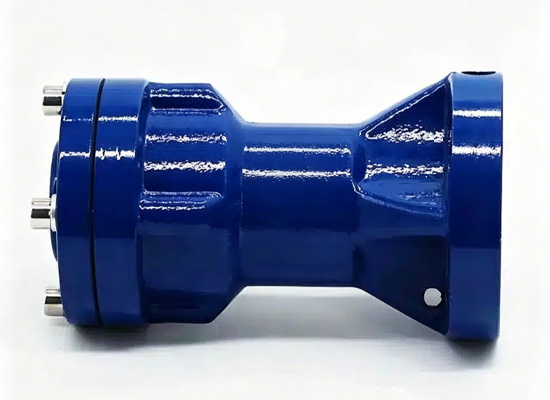
Unlike manual hammering, which is inefficient and may damage equipment, a pneumatic hammer creates controlled impact pulses that loosen stuck material and restore smooth discharge flow.
The SK series uses a magnetic piston impact mechanism:
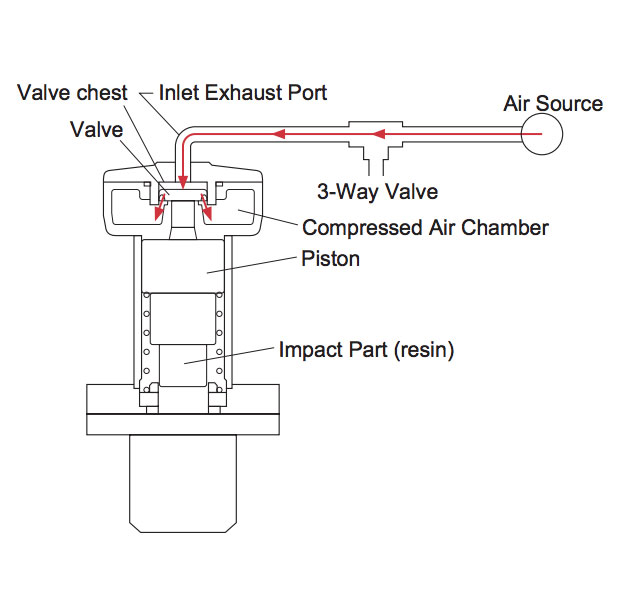
1. At rest: a strong magnet holds the piston tightly against the base plate.
2. Air supplied: compressed air enters the body and internal pressure rises.
3. Impact release: once air pressure exceeds magnetic force, the piston rapidly separates from the base, creating a powerful impact force.
4. Vibration transfer: the shock is transmitted through the mounting bracket into the hopper wall, dislodging adhered material.
5. Reset: after air is cut off, a spring returns the piston, and magnetic force pulls it back into position for the next cycle.
With a timer relay and solenoid valve, the striking interval and duration can be adjusted freely.
The magnetic piston design delivers an instant high-force strike, stronger than ordinary pneumatic vibrators, ideal for stubborn blockages.
Each impact uses only a small amount of compressed air, reducing operating cost.
Strike intervals can be controlled by timer relay and solenoid valve to match different materials and conditions.
Made with high-quality cast aluminum alloy housing, lightweight, corrosion-resistant, and easy to service.
Pure pneumatic construction with no electrical parts in the hammer body, suitable for dusty, wet, or hazardous areas.
Unlike manual hammering, vibration energy is transmitted through the structure without deforming silo walls.
Widely used in:
● Chemical industry (fertilizer, pigment, pesticide)
● Building materials (cement, lime, gypsum)
● Food processing (flour, starch, milk powder)
● Pharmaceutical powders
● Mining (ore powder, coal dust)
● Environmental systems (dust collector hoppers)
● Plastics, rubber, electronic materials
Model selection is usually based on:
● Hopper diameter
● Wall thickness
● Material flow characteristics
● Hopper shape
Examples:
● Hopper Ø1500 mm, wall 3 mm → SK-60, 2 units opposite mounted
● Hopper Ø800 mm, wall 2 mm → SK-40, 1–2 units
Square hoppers often require two units installed opposite each other for better vibration transmission.
● Install at the area most prone to blockage, usually lower cone section.
● Use rigid brackets or channel steel supports.
● Recommended air pressure: 0.3–0.7 MPa (3–7 kg/cm²).
● Use a 3/2 way solenoid valve + timer relay for automatic cycling.
● In hazardous areas, use explosion-proof valves or pneumatic pilot control.
● Check bolts, pressure stability, and valve operation regularly.
Need help selecting the right pneumatic component?
Contact our engineering team.
Get a free sample

Fokca is a brand of Ningbo Fokca Automation Co., Ltd.
Looking for custom pneumatic cylinder solutions? Visit our sister brand, Fescolo.→
© 2026 Ningbo Fokca Automation Co., Ltd. All rights reserved. Sitemap