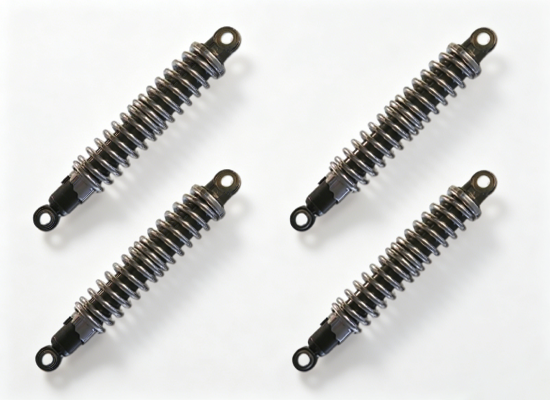
Compact design, smooth deceleration, no rebound — the mini hydraulic shock absorber is a miniaturized version of standard hydraulic shock absorbers, designed specifically for precision automation equipment with limited space.
It operates on the hydraulic throttling damping principle, converting impact kinetic energy smoothly into heat, achieving linear deceleration, soft stops, and no rebound, while significantly reducing equipment vibration and noise.
A miniature hydraulic shock absorber is a compact version of a standard industrial shock absorber. It is a precision component that uses hydraulic damping to absorb impact energy. When a moving object strikes the absorber, the piston rod is pushed into the cylinder, forcing hydraulic oil to flow through a metered orifice. This generates resistance, converting kinetic energy into heat and achieving smooth deceleration with zero rebound.
In precision automation equipment, such as mini pneumatic cylinders, compact robotic arms, linear modules, and electronic assembly lines, high-speed motion often leads to rigid impacts, noise, and positioning errors—especially in confined spaces. Mini shock absorbers are specifically designed to solve these problems. With their compact size and precise energy absorption, they can be easily integrated into tight installations to provide reliable end-of-stroke cushioning.
● Impact Phase – The moving object contacts the piston rod, initiating compression of the hydraulic oil inside the cylinder.
● Damping Generation – The oil is forced through precisely engineered orifices, creating flow resistance that absorbs the impact energy. These orifices are distributed along the stroke to ensure consistent and linear damping.
● Energy Conversion – The kinetic energy is converted into heat through internal fluid friction, which is then dissipated through the absorber housing.
● Smooth Stop – The piston gradually decelerates and comes to a smooth stop at the end of the stroke, without rebound or secondary impact. Afterward, an internal spring returns the piston rod to its original position for the next cycle.
This design ensures linear and controlled energy absorption, significantly reducing impact loads on machinery and enabling higher operating speeds and cycle rates.
| Comparison Factor | Mini Hydraulic Shock Absorber | Rubber Damper |
| Working Principle | Hydraulic throttling converts kinetic energy into heat | Elastic deformation absorbs impact |
| Rebound | No rebound | Noticeable rebound |
| Cushioning Performance | Smooth, linear deceleration | Abrupt stop, higher impact |
| Service Life | Long lifespan | Affected by aging |
| Energy Absorption | High (0.1–15 J) | Low |
| Space Requirement | Compact | Compact |
| Cost | Medium to high | Low |
| Applications | High-speed, precision automation | Low-speed, light-duty, cost-sensitive |
1. Ensure the piston rod is aligned with the direction of impact. Side loads or rotational forces are strictly prohibited, as they may cause oil leakage, rod bending, or seal failure.
2. Mount the shock absorber on a rigid and stable base to prevent deformation that could affect performance and lifespan.
3. For adjustable types, use proper tools to slowly and evenly adjust the setting ring. Avoid excessive force and lock the setting after adjustment.
4. Before full operation, test at low speed and fine-tune the damping performance step by step.
5. In dusty or debris-heavy environments, install a protective cover to prevent contamination and damage.
6. Regularly inspect for oil leakage, scratches or corrosion on the piston rod, and reduced damping performance. Replace if necessary.
7. This is a precision sealed component. Do not disassemble or refill oil, as it may lead to performance failure.
Need help selecting the right pneumatic component?
Contact our engineering team.
Get a free sample

Fokca is a brand of Ningbo Fokca Automation Co., Ltd.
Looking for custom pneumatic cylinder solutions? Visit our sister brand, Fescolo.→
© 2026 Ningbo Fokca Automation Co., Ltd. All rights reserved. Sitemap