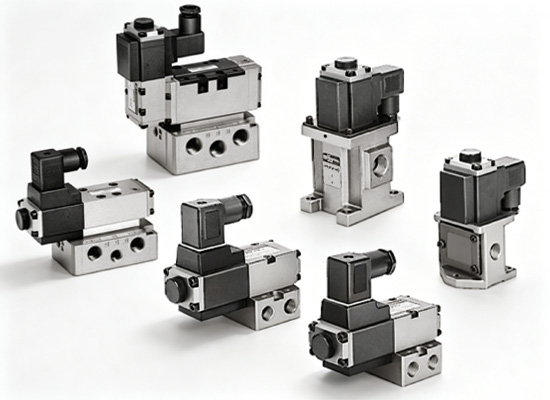
Pneumatic proportional valves (proportional control valves) provide continuous, precise regulation of pressure or flow proportional to an analog input signal (4-20mA or 0-10V).
Pneumatic proportional valves (also known as proportional control valves or electronic proportional valves) provide continuous, stepless control of pressure or flow. Unlike standard on/off solenoid valves, a proportional valve positions its spool or poppet at any point between fully closed and fully open, proportional to an analog input signal (4-20mA or 0-10V).
Note for automotive visitors: This page is for industrial pneumatic proportional valves used in factory automation and process control. If you are looking for automotive brake proportioning valves, please contact an auto parts supplier.
A proportional valve uses a solenoid coil that varies current proportionally to the input signal. Higher current = greater magnetic force = larger valve opening. An onboard electronic controller (often integrated) compares the actual output (pressure or position) to the command signal and adjusts the current to achieve the desired setpoint.
Available configurations:
● Proportional pressure control valves - Regulate outlet pressure infinitely
● Proportional flow control valves - Regulate flow rate infinitely
● Proportional directional control valves - Stepless spool positioning
| Application | Valve Type | Signal |
| Tension control (web, wire) | Proportional pressure regulator | 4–20 mA |
| Precision welding force control | Proportional pressure valve | 0–10 V |
| Leak testing | Proportional flow control valve | 4–20 mA |
| Paint spray pressure control | Proportional pressure regulator | 0–10 V |
| Closed-loop cylinder positioning | Proportional directional valve | ±10 V |
Key features:
● Hysteresis: <5%
● Linearity: <3%
● Response time: <30ms
● Pressure ranges: 0-0.5MPa, 0-1.0MPa, 0-2.0MPa
| Feature | Proportional Valve | Solenoid Valve |
| Control | Continuous (stepless) | On/Off (binary) |
| Signal | 4–20 mA, 0–10 V | 24V DC, 110/220V AC |
| Precision | High (hysteresis <5%) | Not applicable |
| Price | Medium to high | Low |
| Application | Closed-loop control | Open-loop, sequence control |
Choose a proportional valve when you need:
● Precise pressure control (not just on/off)
● Smooth acceleration/deceleration
● Closed-loop feedback control
● Position control without mechanical stops
Q1: Are these the same as brake proportioning valves for cars?
A1: No. Our proportional valves are industrial pneumatic control valves for factory automation, not automotive brake proportioning valves.
Q2: What is the difference between a proportional valve and a solenoid valve?
A2: A solenoid valve is either fully open or fully closed (on/off). A proportional valve can be positioned anywhere between open and closed, allowing continuous control of pressure or flow.
Q3: What control signals do proportional valves accept?
A3: Most industrial proportional valves accept 4-20mA or 0-10V analog signals, with some accepting RS485 (Modbus) or IO-Link.
Q4: Can a proportional valve replace a pressure regulator?
A4: Yes. A proportional pressure regulator can replace a manual pressure regulator when you need remote, programmable, or closed-loop pressure control
Need help selecting the right pneumatic component?
Contact our engineering team.
Get a free sample

Fokca is a brand of Ningbo Fokca Automation Co., Ltd.
Looking for custom pneumatic cylinder solutions? Visit our sister brand, Fescolo.→
© 2026 Ningbo Fokca Automation Co., Ltd. All rights reserved. Sitemap