Mar 16, 2026
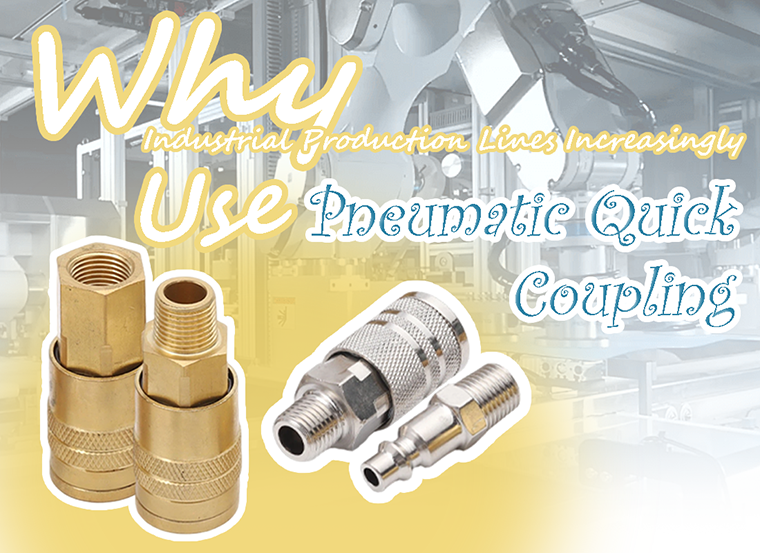
Modern manufacturing lines are designed around flexibility, speed, and minimal downtime. In this environment, components that simplify installation and maintenance become extremely valuable. The pneumatic quick coupling has gradually replaced traditional threaded air connections in many factories because it enables fast air hose connection, easy disconnection, and reliable sealing.
For equipment engineers and production managers, choosing the right pneumatic quick coupling connector is not only about convenience. It directly affects maintenance efficiency, equipment modularity, and system uptime. Industries such as packaging machinery, automated assembly lines, and robotic tools are among the biggest adopters of this technology.
Industrial automation systems increasingly follow a modular equipment architecture. Machines are divided into functional units such as feeding modules, clamping modules, and inspection stations. Each module often contains independent pneumatic circuits.
In this context, a pneumatic quick coupling connector allows engineers to connect or remove air supply lines instantly without tools. When a module needs replacement or upgrade, technicians simply release the air hose quick connector, swap the module, and reconnect it within seconds.
The result is a production line that can be reconfigured quickly, which is especially valuable for factories producing multiple product variants.
Maintenance speed is a critical factor in modern manufacturing. According to industrial maintenance studies, unexpected downtime can cost factories thousands of dollars per hour in lost productivity.
Traditional threaded fittings require wrenches and sealing tape, and removing them can take several minutes. By comparison, a quick connect air fitting allows technicians to disconnect air hoses instantly.
The time difference becomes significant when multiple pneumatic tools or cylinders are involved.
| Connection Type | Average Disconnect Time | Tools Required | Maintenance Efficiency |
|---|---|---|---|
| Threaded Air Fitting | 2–5 minutes | Wrench + seal tape | Low |
| Pneumatic Quick Coupling | 1–3 seconds | None | High |
Reducing maintenance time directly lowers production downtime, which explains why many factories are replacing conventional fittings.
Automation systems rely heavily on pneumatic actuators and air-powered tools. Robots used in assembly lines frequently require air supply for grippers, suction cups, and pneumatic drivers.
A pneumatic coupler allows these tools to be replaced quickly when switching product models or performing maintenance.
For example:
1.Packaging machines switching between bottle sizes
2.Robotic arms changing pneumatic grippers
3.Automated screwdriving stations replacing air tools
In these situations, air hose quick connectors allow operators to swap tools within seconds, improving production flexibility.
Modern pneumatic quick coupling designs include internal sealing valves and precision-machined locking mechanisms. These features help maintain stable airflow and reduce leakage.
Many industrial couplers are also designed with automatic shut-off valves, which stop airflow when the hose is disconnected. This prevents sudden air release that could cause safety risks.
Common performance advantages include:
1.Stable air sealing performance
2.Reduced air leakage
3.Improved workplace safety
Reliable airflow is especially important in automated equipment where pneumatic pressure directly affects actuator accuracy.
Today, quick connect air fitting technology is widely used across different manufacturing sectors. The following table highlights several typical application scenarios.
| Industry | Equipment Example | Benefit of Pneumatic Coupler |
|---|---|---|
| Packaging Machinery | Carton sealing machines | Faster maintenance |
| Automotive Assembly | Pneumatic tools & fixtures | Quick tool replacement |
| Electronics Manufacturing | Pick-and-place systems | Compact air connections |
| Food Processing | Pneumatic actuators | Easy cleaning and replacement |
These applications demonstrate how pneumatic quick coupling connectors improve both flexibility and operational efficiency.
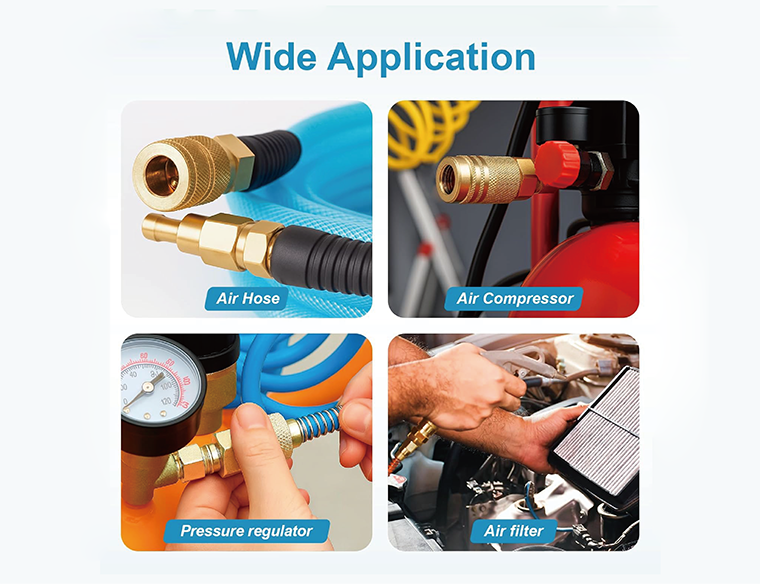
Although quick couplings are simple components, choosing the right type ensures long-term reliability. Engineers typically evaluate several factors before selecting an air hose quick connector.
Key considerations include:
◆Material – Brass, steel, or stainless steel depending on environment
◆Pressure rating – Matching system operating pressure
◆Flow capacity – Ensuring sufficient air delivery
◆Compatibility – Matching plugs and sockets
For systems operating in corrosive or hygienic environments, stainless steel couplers often provide better durability and service life.
Factories that integrate multiple pneumatic components often source connectors together with pneumatic cylinders and valves to ensure compatibility within the system.
Industrial production lines are evolving toward greater flexibility, faster maintenance, and higher automation levels. In this environment, the pneumatic quick coupling has become an essential component for efficient air system connections. By simplifying installation, reducing maintenance time, and improving operational safety, these connectors help manufacturers keep their production lines running smoothly.
For equipment builders and distributors working with pneumatic systems, selecting high-quality pneumatic couplers and quick connect air fittings is a practical way to enhance both machine performance and long-term reliability.
(FK9026)
 Pilot Pressure vs Working Pressure in Industrial Valves: Key Differences and Selection Guide
 Water Hammer Explained: Why Angle Seat Valves Are the Optimal Solution
 Valve Flow Rate Comparison: An Analysis of Four Common Valve Types
 The Temperature Limit of Valves: How Seal Material Affects Valve Body Performance
 Valve Flow Coefficients CV & KV: Differences Analysis and Selection Guide
You May Interest In

Dec 02, 2025 Blog
What are the parts of a pneumatic cylinder?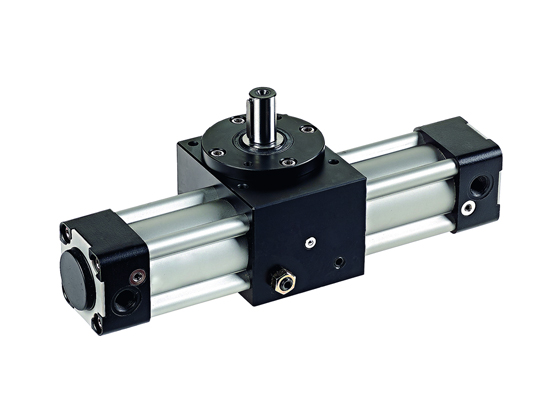
Apr 18, 2025 Blog
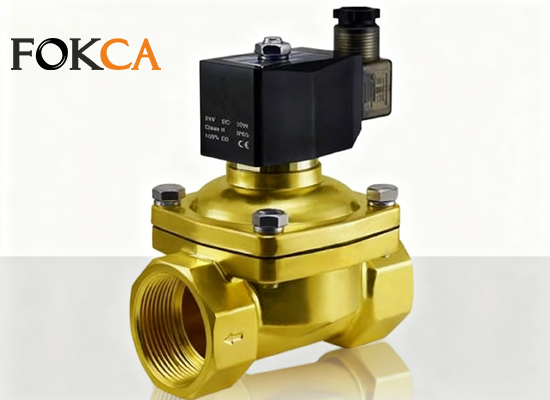
What is an Angle Seat Valve?
Get a free sample

Fokca is a brand of Ningbo Fokca Automation Co., Ltd.
Looking for custom pneumatic cylinder solutions? Visit our sister brand, Fescolo.→
© 2026 Ningbo Fokca Automation Co., Ltd. All rights reserved. Sitemap