Sep 24, 2026
When a valve is closed too quickly, the fluid inside a pipeline cannot stop instantaneously. Its momentum is converted into a pressure wave that travels through the piping system. The resulting water hammer, also called hydraulic shock, may cause pipe vibration, pressure fluctuations, seal damage, noisy operation, and, in severe cases, damage to valves, fittings, pumps, or piping.
The risk becomes more significant in systems with high flow velocity, long pipelines, large fluid volumes, or frequent valve operation. Choosing the right valve structure and controlling its closing characteristics are therefore important parts of water hammer prevention. Angle seat valves can be an effective option, particularly when their flow direction and actuator settings are properly selected.
Water hammer occurs when the velocity of a liquid changes rapidly inside a closed piping system. The classic example is a valve that suddenly stops flowing water. Because the liquid has inertia, the abrupt velocity change generates a pressure wave that travels through the pipe.
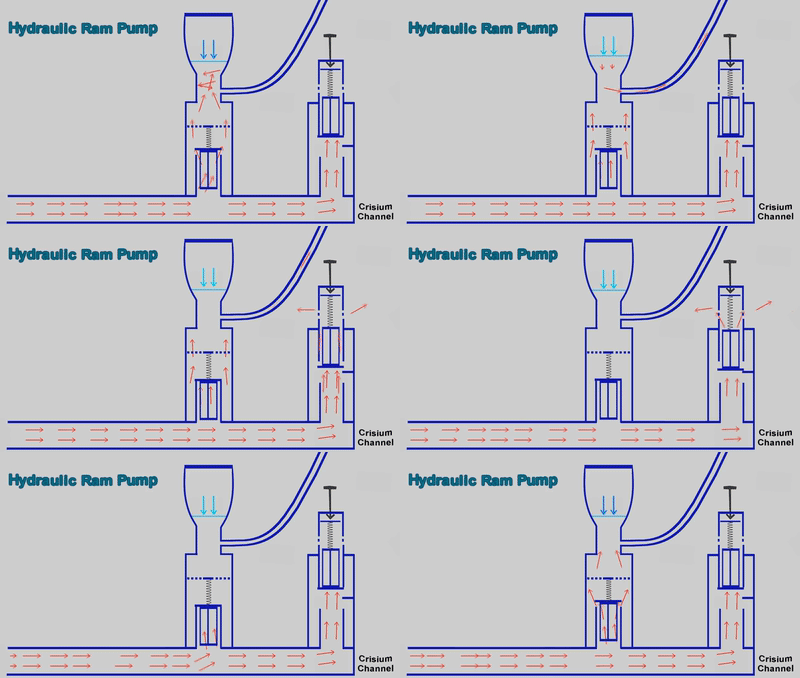
For a simplified case of rapid valve closure, the pressure rise can be estimated using the Joukowsky relationship:
ΔP = ρaΔV
where:
● ΔP is the pressure rise;
● ρ is the liquid density;
● a is the pressure-wave velocity in the fluid-pipe system;
● ΔV is the change in flow velocity.
For water, the wave velocity can be on the order of 1,000–1,500 m/s, depending on pipe material, diameter, wall thickness, and other system characteristics. This explains why even a relatively modest change in flow velocity can produce a substantial transient pressure rise.
The actual pressure peak depends on more than valve type alone. Valve closing time, pipe length, fluid velocity, pipe elasticity, pump characteristics, and system layout all influence the severity of water hammer.
Repeated pressure surges can place additional loads on valves, pipe joints, flanges, supports, and seals. Over time, this may contribute to leakage, loosening, vibration, or component fatigue.
Pressure fluctuations can affect pumps, flow meters, pressure sensors, and other components. In automated production systems, unstable flow may also interfere with process control.
A severe pressure surge can damage piping or cause leakage. If the pipeline carries hot water, steam condensate, chemicals, or other hazardous media, the consequences can extend beyond equipment damage and lead to production interruptions or safety concerns.
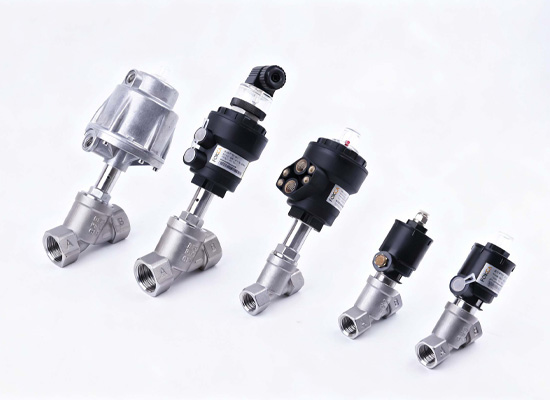
The ability of an angle seat valve to reduce water hammer does not come simply from its name or 90-degree body shape. Its performance depends mainly on flow direction, valve construction, actuator behavior, and closing speed.
Many angle seat valves are installed with the medium entering under the valve seat. In this configuration, fluid pressure acts against the closing movement of the valve element.
As the actuator closes the valve, the pressure force can oppose the movement of the plug or piston. This can help moderate the final closing action compared with a configuration where pressure assists the closing movement.
This is one reason manufacturers often specify a preferred flow direction for angle seat valves. However, the effect should not be treated as universal: actual water hammer performance depends on the specific valve design, pressure, flow rate, actuator, and control system.
For pneumatic angle seat valves, the actuator's air supply and exhaust characteristics are also important. A valve that closes very rapidly can still generate a significant transient even if its flow direction is favorable.
An angle seat valve uses an inlet and outlet arranged approximately at a right angle. This configuration can provide a relatively direct flow path while making the valve convenient to install in compact piping systems.
A well-designed flow passage can help limit unnecessary pressure loss and turbulence. However, the 90-degree geometry itself should not be considered a guarantee against water hammer. Flow velocity, valve opening, pipe arrangement, and operating conditions remain critical factors.
For applications where pressure loss and flow capacity are important, engineers should also compare the valve's Cv or Kv value rather than selecting a valve based only on nominal size.
Angle seat valves are widely used with pneumatic actuators because they can provide rapid and repeatable switching. However, fast operation is not automatically better when water hammer is a concern.
In liquid applications, the objective is often to achieve a sufficiently quick response without creating an excessively abrupt velocity change. Depending on the system, this may require adjusting the actuator speed with flow-control devices or using suitable control logic.
Soft seat materials such as PTFE can provide reliable sealing and are widely used for compatible media and temperature conditions. The sealing material, however, does not by itself determine water hammer performance. Valve movement and fluid dynamics remain the primary factors.
Angle seat valves are frequently used in applications requiring reliable on/off control and repeated cycling, including:
● Water and liquid processing systems with frequent valve switching
● Food and beverage equipment where hygienic and cleanable designs are required
● Compressed air and pneumatic systems where rapid actuation is needed
● Steam and hot-water systems, when the valve, seal, and temperature rating are correctly specified
● Industrial automation equipment requiring compact installation and repeatable switching
For high-pressure or high-temperature liquid systems, however, valve selection should not be based on water-hammer resistance alone. Engineers should evaluate working pressure, flow velocity, temperature, medium compatibility, Cv/Kv, pipe length, actuator speed, and the required closing time.
Selecting an appropriate valve is only one part of the solution. Depending on the application, additional measures may include:
● Reduce excessive flow velocity where practical.
● Control valve closing speed instead of allowing an unnecessarily abrupt shutoff.
● Use suitable actuator speed controls on pneumatic valves.
● Check pipe supports and connections to reduce vibration and mechanical movement.
● Consider surge-control equipment such as accumulators, air chambers, or other transient-pressure protection when required.
● Evaluate the complete piping system, rather than focusing on the valve alone.

Water hammer is ultimately a system-level hydraulic problem. An angle seat valve with a suitable bottom-inlet configuration can help manage the flow transition, but its effectiveness depends on how the valve is integrated into the entire piping system.
For applications involving frequent switching, compact installation, and controlled liquid flow, angle seat valves can provide a practical combination of reliable sealing, repeatable actuation, and favorable flow characteristics. Proper valve sizing, flow direction, and actuator-speed adjustment are essential to achieving stable operation and minimizing hydraulic shock.
(FK9025)
 Pilot Pressure vs Working Pressure in Industrial Valves: Key Differences and Selection Guide
 Water Hammer Explained: Why Angle Seat Valves Are the Optimal Solution
 Valve Flow Rate Comparison: An Analysis of Four Common Valve Types
 The Temperature Limit of Valves: How Seal Material Affects Valve Body Performance
 Valve Flow Coefficients CV & KV: Differences Analysis and Selection Guide
You May Interest In


Dec 02, 2025 Blog
What are the parts of a pneumatic cylinder?




Apr 18, 2025 Blog
What is an Angle Seat Valve?
Get a free sample

Fokca is a brand of Ningbo Fokca Automation Co., Ltd.
Looking for custom pneumatic cylinder solutions? Visit our sister brand, Fescolo.→
© 2026 Ningbo Fokca Automation Co., Ltd. All rights reserved. Sitemap