Nov 09, 2026
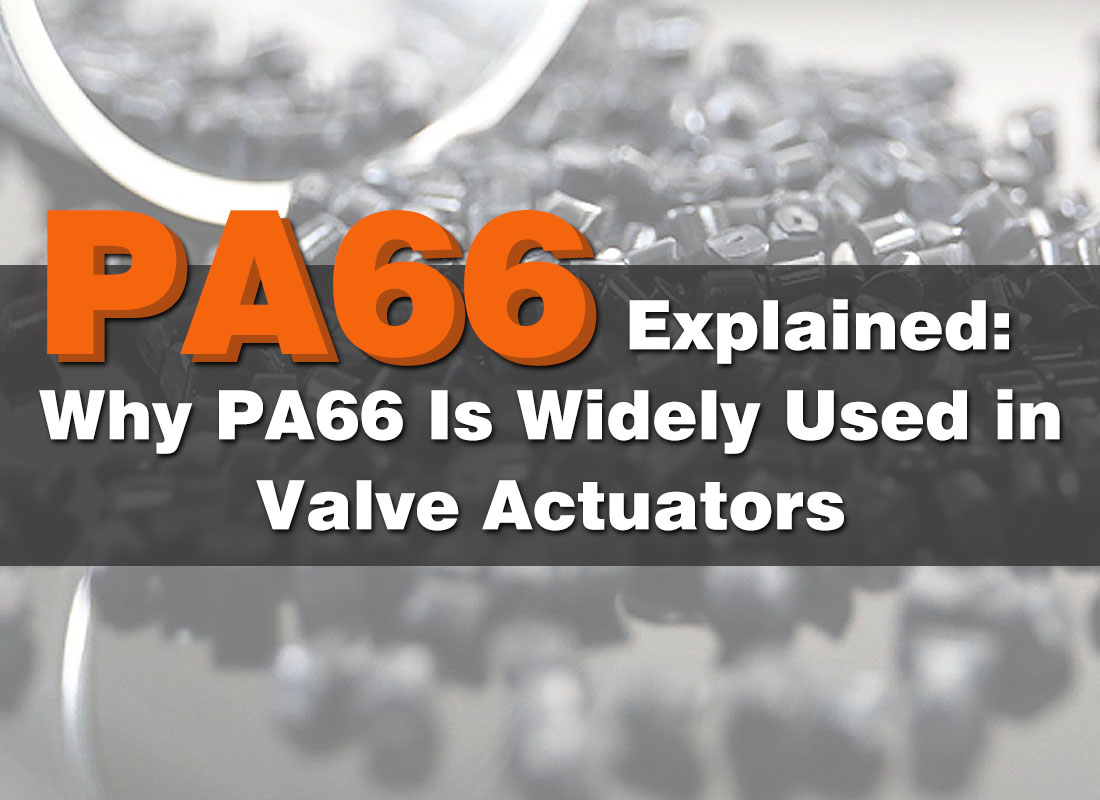
When inspecting an angle seat valve, pneumatic ball valve, or other industrial actuator, you may notice that its external housing is often made from black engineering plastic. One commonly used material is PA66, also known as Nylon 66.
PA66 is widely adopted in pneumatic and mechanical actuator components because it combines mechanical strength, dimensional stability, wear resistance, and relatively low manufacturing costs. Compared with metal, it also offers lower weight and greater flexibility in injection molding.
However, PA66 is not suitable for every operating condition. Its performance depends on material formulation, reinforcement, temperature, moisture exposure, and mechanical loading. Understanding these characteristics helps engineers select the right actuator material for different applications.
PA66 (Polyamide 66) is an engineering thermoplastic made through the polymerization of hexamethylenediamine and adipic acid. It is commonly used in automotive components, electrical equipment, gears, bearings, and industrial machinery.
In valve actuators, PA66 is frequently used for external housings, end covers, and selected structural components. Depending on the design, manufacturers may use unfilled PA66 or glass-fiber-reinforced PA66 to achieve different levels of strength and stiffness.
Glass-fiber reinforcement can improve tensile strength, rigidity, and dimensional stability, although it may also affect impact behavior and surface characteristics.
Valve actuator housings must maintain their shape while protecting internal components from external impact, vibration, and mechanical stress.
PA66 provides good tensile strength and stiffness for an engineering plastic. Reinforced grades can offer even greater rigidity, making them suitable for actuator housings and structural parts that require stable dimensions.
For many general-purpose pneumatic actuators, PA66 provides sufficient mechanical performance without the additional weight of a metal housing.
However, the material must be selected according to the actuator's design pressure, wall thickness, mounting structure, and actual mechanical loads. The pressure rating of an actuator cannot be determined from the material name alone.
Pneumatic actuators contain moving components that operate repeatedly during valve opening and closing. Friction occurs between internal parts such as pistons, guides, and sliding surfaces.
PA66 has useful wear and abrasion resistance, making it suitable for selected components subject to repeated movement. Its performance can be further improved through material modification, such as adding lubricating fillers or other wear-resistant additives.
However, wear resistance depends on contact pressure, surface finish, lubrication, operating speed, and material pairing. A PA66 housing itself does not guarantee that every internal actuator component will have a long service life.
PA66 has relatively favorable friction characteristics compared with many unmodified plastics. In certain designs, it can reduce friction between contacting components and help maintain smooth mechanical movement.
For applications requiring lower friction or improved wear resistance, manufacturers may use modified PA66 containing PTFE, graphite, or other suitable additives.
It is important to distinguish between standard PA66 and self-lubricating modified grades. Unmodified PA66 is not automatically a self-lubricating material, and lubrication requirements should follow the actuator manufacturer's recommendations.
Valve actuators in automated production lines may perform thousands of operating cycles over their service life. Their structural components must withstand repeated mechanical loading without developing cracks or excessive deformation.
PA66 offers good fatigue resistance when properly designed and operated within its material limits. Reinforced grades can provide additional stiffness for components exposed to higher mechanical loads.
Nevertheless, fatigue performance is influenced by stress concentration, temperature, moisture absorption, and material formulation. The service life of an actuator should be verified through product testing rather than inferred from the material alone.
Valve actuators are often installed near pipelines carrying water, oil, cleaning agents, compressed air, and industrial chemicals.
PA66 generally offers good resistance to many oils, greases, and selected organic solvents. However, its compatibility with chemicals varies significantly.
Strong acids, strong oxidizing agents, and certain chemical environments may damage or degrade PA66. Moisture absorption is another important consideration because PA66 is hygroscopic. Absorbed water can change its dimensions and reduce stiffness.
For this reason, engineers should check the chemical compatibility and moisture conditions before selecting PA66 for an actuator housing.
One of the main reasons manufacturers choose PA66 is its balance of performance and production cost.
Compared with stainless steel, PA66 has a much lower density. Its thermoplastic properties also make injection molding suitable for producing complex housing shapes, mounting features, and integrated structural details.
| Property | PA66 | Stainless Steel |
| Weight | Lightweight | Relatively heavy |
| Mechanical strength | Good for engineering plastic | Generally much higher |
| Corrosion resistance | Good in suitable environments | Depends on grade and medium |
| Temperature capability | More limited | Generally higher |
| Manufacturing | Suitable for injection molding | Requires metalworking processes |
| Electrical conductivity | Insulating | Conductive |
| Typical cost | Often lower for molded parts | Usually higher |
The actual cost difference depends on part geometry, material grade, production volume, and manufacturing process.
Although PA66 is suitable for many general-purpose actuators, some operating conditions require alternative materials.
| Operating Requirement | Possible Material Choice | Main Consideration |
| High mechanical loading | Aluminum alloy or stainless steel | Strength and structural rigidity |
| Elevated temperatures | Metal or high-temperature engineering plastics | Heat resistance and dimensional stability |
| Strong chemical exposure | Stainless steel or special alloys | Chemical compatibility |
| Outdoor or corrosive environments | Suitable stainless steel or protected metal | Corrosion resistance |
| Fire-resistant requirements | Certified metal or approved material system | Applicable fire and safety standards |
Metal housings are often preferred for demanding mechanical and thermal conditions. However, stainless steel is not automatically compatible with every chemical, and material selection must consider the specific medium and operating environment.
For hazardous-area applications, using a metal housing alone does not make an actuator explosion-proof. The complete equipment assembly must meet the applicable safety and certification requirements.
Before choosing between PA66, aluminum alloy, and stainless steel, engineers should evaluate several factors:
● Operating temperature: Check the material's continuous service temperature and short-term temperature limits.
● Mechanical loading: Consider internal pressure, mounting forces, vibration, and potential external impact.
● Environmental exposure: Evaluate humidity, water, UV exposure, dust, and chemical contact.
● Material formulation: Confirm whether the component uses standard PA66, glass-fiber-reinforced PA66, or a modified grade.
● Service requirements: Consider maintenance frequency, expected operating cycles, and the consequences of component failure.
The actuator manufacturer's technical data and test results should always take priority over general material descriptions.
PA66 remains widely used in industrial valve actuators because it offers a practical combination of mechanical performance, wear resistance, lightweight construction, and manufacturing efficiency.
For general-purpose pneumatic actuators, it provides a cost-effective housing material when operating conditions remain within its specified limits. For applications involving high temperatures, heavy mechanical loads, or aggressive chemicals, aluminum alloy, stainless steel, or specialized engineering plastics may be more appropriate.
FOKCA provides pneumatic valves and actuator solutions for different industrial applications. Contact our team with your operating temperature, pressure, environmental conditions, and installation requirements to identify a suitable actuator configuration.
(FK9025)
You May Interest In


Dec 02, 2025 Blog
What are the parts of a pneumatic cylinder?
Apr 18, 2025 Blog
What is an Angle Seat Valve?
Get a free sample

Fokca is a brand of Ningbo Fokca Automation Co., Ltd.
Looking for custom pneumatic cylinder solutions? Visit our sister brand, Fescolo.→
© 2026 Ningbo Fokca Automation Co., Ltd. All rights reserved. Sitemap