Nov 04, 2026
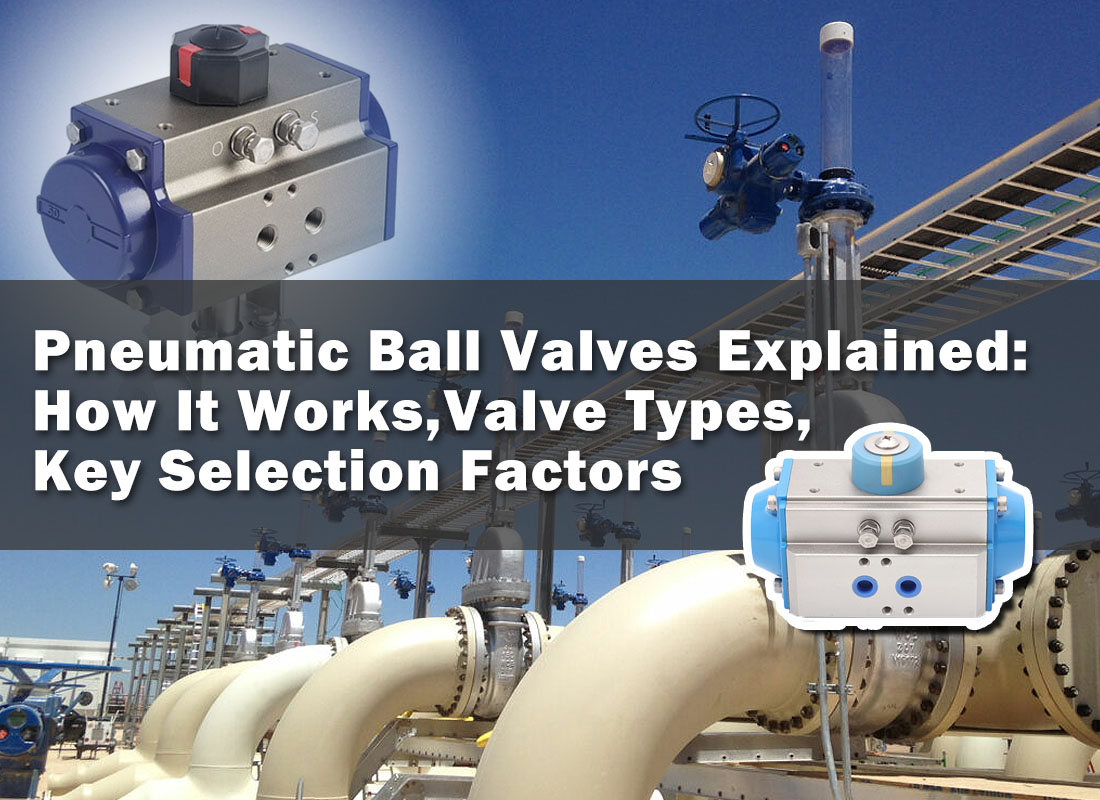
Pneumatic ball valves are widely used in industrial automation systems for controlling the flow of liquids and gases. By combining a ball valve with a pneumatic actuator, they use compressed air to operate the valve automatically, eliminating the need for manual operation.
Compared with manual valves, pneumatic ball valves support remote control and automated switching. They are particularly useful in production lines and process systems requiring frequent operation, fast response, or integration with PLC control systems.
However, selecting the right pneumatic ball valve involves more than choosing a valve size. Engineers must consider its flow path, actuator configuration, operating pressure, sealing materials, and process conditions.
A pneumatic ball valve consists of two main components:
● Ball valve body: Contains a spherical ball with a bore through its center. Rotating the ball controls whether the flow passage is open, closed, or redirected.
● Pneumatic actuator: Converts compressed air energy into mechanical torque to rotate the valve stem.
When compressed air enters the actuator, internal pistons or a vane move and generate rotary motion. In a common rack-and-pinion actuator, linear piston movement drives a central pinion connected to the valve stem. Other designs, such as scotch-yoke actuators, use a different mechanical arrangement to produce torque.
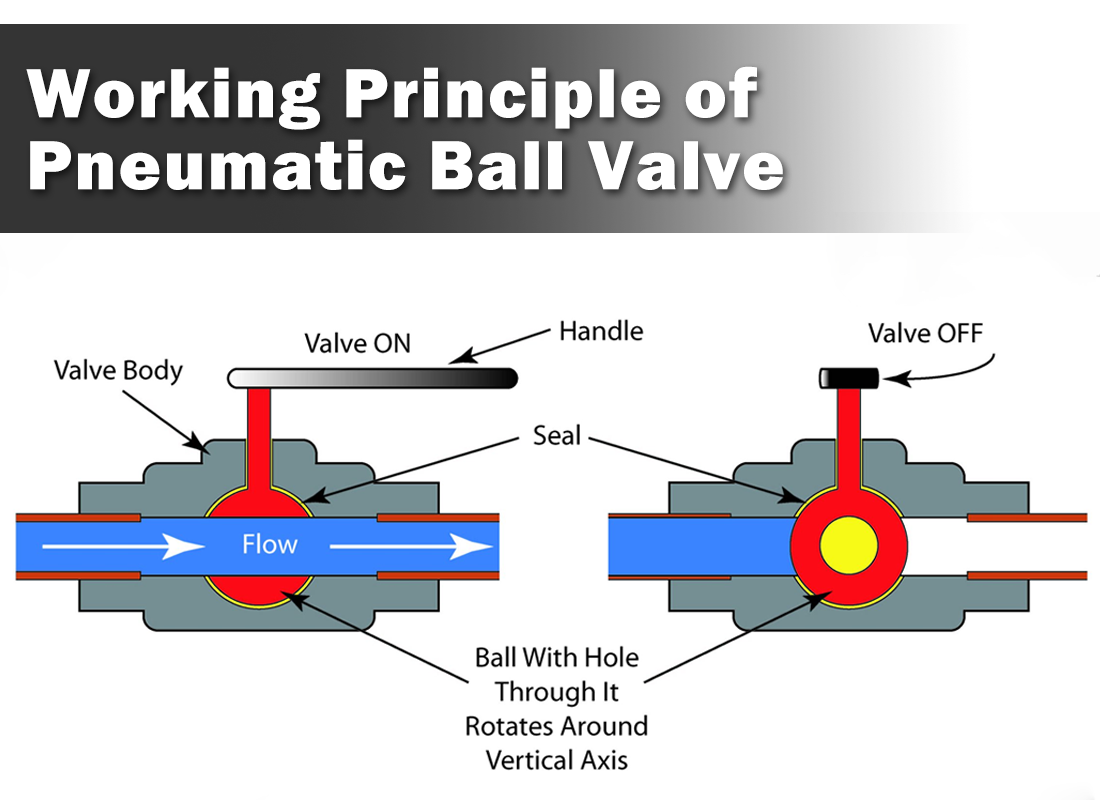
For a standard quarter-turn ball valve, the ball rotates approximately 90 degrees between fully open and fully closed positions. When the bore aligns with the pipeline, the valve allows flow. When the solid side of the ball faces the flow path, the valve shuts off the medium.
Pneumatic actuators are generally available in two configurations:
● Single acting (spring return): Compressed air drives the actuator in one direction, while an internal spring provides the return movement. Depending on the configuration, the valve can return to a fail-open or fail-closed position when air pressure is lost.
● Double acting: Compressed air drives both opening and closing movements. This design provides powered operation in both directions but does not inherently guarantee a defined valve position after air failure.
The choice depends on the required failure response, valve torque, available air pressure, and operating frequency.
Pneumatic ball valves are available in different flow-path configurations. The correct design depends on how the process medium needs to enter, exit, or change direction.
A two-way ball valve has one inlet and one outlet. Its primary function is to start or stop flow through a pipeline.
It is commonly used in water treatment, compressed air systems, general industrial piping, and automated production equipment. Its relatively simple flow path makes it suitable for straightforward on/off control.
A three-way ball valve has three ports and is commonly available in L-port and T-port configurations.
● L-port: Connects two ports at a time, making it suitable for diverting flow between two outlets or selecting between two sources.
● T-port: Can connect multiple ports in different combinations, depending on the ball design, allowing flow mixing, distribution, or directional switching.
Three-way valves are useful in batching, blending, and fluid distribution systems. They can simplify piping arrangements by combining switching functions into one valve, provided the selected flow configuration meets the process requirements.
Four-way ball valves have four ports and are designed for more complex flow-routing requirements. Depending on the internal ball passage, they can connect different port combinations to change the direction of flow.
They are used in specialized process equipment and fluid-routing systems where a conventional two-way or three-way valve cannot provide the required switching arrangement. Because port connections and flow patterns vary by design, the valve's flow diagram should always be checked before installation.
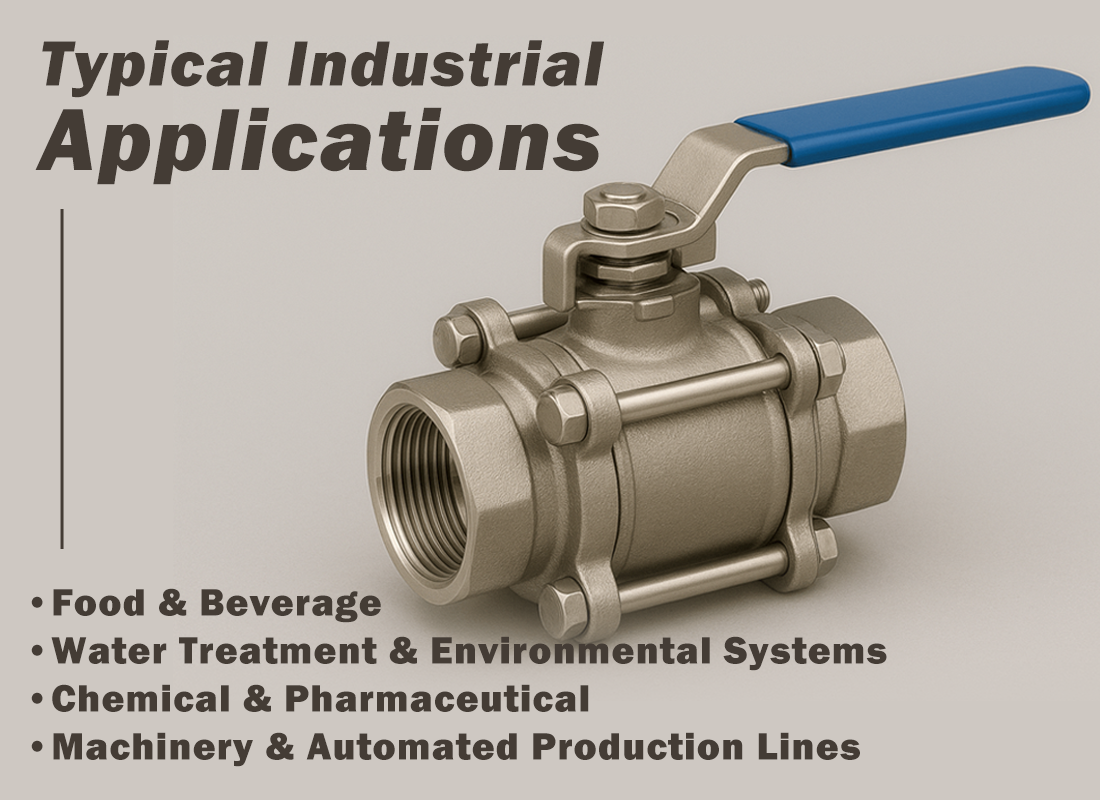
Pneumatic ball valves are used across industries where automated flow switching and shutoff are required.
| Industry | Typical Applications | Important Considerations |
| Food and beverage | Water, ingredient, and product transfer lines | Hygienic design, suitable seals, cleanability |
| Water treatment | Pump stations, filtration, and distribution | Corrosion resistance, pressure rating |
| Chemical processing | Chemical transfer and isolation | Medium compatibility, body and seal materials |
| Pharmaceutical | Process fluid distribution and isolation | Cleanability, material compliance |
| Industrial automation | Machine fluid circuits and automated pipelines | Cycle frequency, control compatibility |
For food and pharmaceutical applications, stainless steel bodies and suitable sealing materials may be required. However, a stainless steel valve alone does not establish hygienic compliance. Surface finish, internal geometry, cleaning requirements, and applicable standards must also be considered.
In hazardous areas, pneumatic actuation can avoid using an electric motor at the valve. However, the complete assembly—including solenoid valves, limit switches, sensors, and other accessories—must meet the applicable hazardous-area requirements.
Pneumatic ball valves offer several practical advantages in automated systems:
1. Fast switching: Quarter-turn operation allows relatively quick opening and closing. Actual cycle time depends on actuator size, air pressure, valve torque, tubing, and control accessories.
2. Automation compatibility: Pneumatic actuators can be controlled through solenoid valves and integrated with PLCs, limit switches, and position feedback devices.
3. Simple operating mechanism: The quarter-turn ball design provides straightforward on/off control with relatively few moving parts.
4. Flexible configurations: Two-way, three-way, and four-way designs, combined with different actuator types and materials, support a wide range of process requirements.
5. Suitability for demanding environments: Pneumatic systems can be useful where electrical drive equipment is undesirable. Nevertheless, operating temperature, moisture, corrosion, and hazardous-area requirements must be assessed for the complete valve assembly.
Correct selection helps prevent leakage, insufficient torque, premature wear, and unnecessary maintenance. Consider the following factors before purchasing:
| Selection Factor | Options or Parameters | What to Check |
| Valve body material | Stainless steel, carbon steel, PVC | Medium compatibility, temperature, pressure |
| Actuator type | Single acting, double acting | Required failure position and operating torque |
| Seat material | PTFE, reinforced PTFE, PPL, other options | Chemical compatibility, temperature, sealing requirements |
| Connection type | Threaded, flanged, welded, tri-clamp | Pipeline design and installation requirements |
| Flow configuration | Two-way, L-port, T-port, four-way | Required flow direction and switching logic |
| Operating conditions | Pressure, temperature, cycle frequency | Valve rating, actuator sizing, service life |
Actuator sizing deserves particular attention. The actuator must provide sufficient torque to overcome the valve's breakaway, running, and seating torque under actual operating conditions. Engineers should also account for the manufacturer's recommended safety factor and verify torque at the minimum available air pressure.
For single acting actuators, both the air-driven and spring-return torque must be checked. For double acting actuators, confirm that the available torque is sufficient in both directions.
Pneumatic ball valves provide a practical solution for automated on/off control and fluid routing. Their performance depends on matching the valve structure, actuator torque, sealing materials, and connection type to the actual application.
A two-way valve is suitable for basic flow control, while three-way and four-way configurations support more complex routing requirements. Single acting actuators provide spring-return operation, whereas double acting actuators use compressed air for both movements.
FOKCA offers pneumatic valve solutions for industrial automation and fluid control applications. Contact our team with your medium, operating pressure, temperature, valve size, and control requirements to identify a suitable pneumatic ball valve configuration.
(FK9025)
 Pneumatic Ball Valves Explained: How It Works, Valve Types, and Key Selection Factors
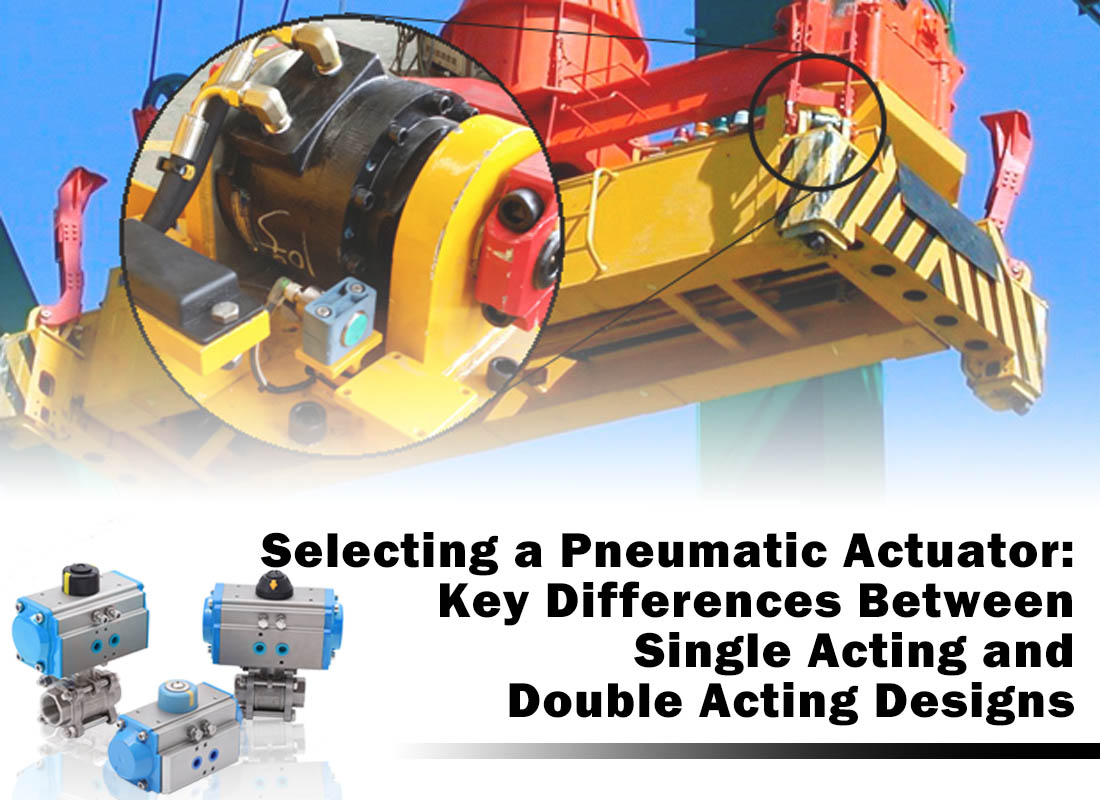 Selecting a Pneumatic Actuator: Key Differences Between Single Acting and Double Acting Designs
 Pneumatic Actuator: The Core Power Unit Behind Industrial Automation
 Why Food Grade Diaphragm Valve Has Become the Standard in Hygienic Piping Systems
 AV700 Series Fill Valve: A Comprehensive Application Guide
You May Interest In

Dec 02, 2025 Blog
What are the parts of a pneumatic cylinder?
Apr 18, 2025 Blog
What is an Angle Seat Valve?
Get a free sample

Fokca is a brand of Ningbo Fokca Automation Co., Ltd.
Looking for custom pneumatic cylinder solutions? Visit our sister brand, Fescolo.→
© 2026 Ningbo Fokca Automation Co., Ltd. All rights reserved. Sitemap




 None