Nov 23, 2026
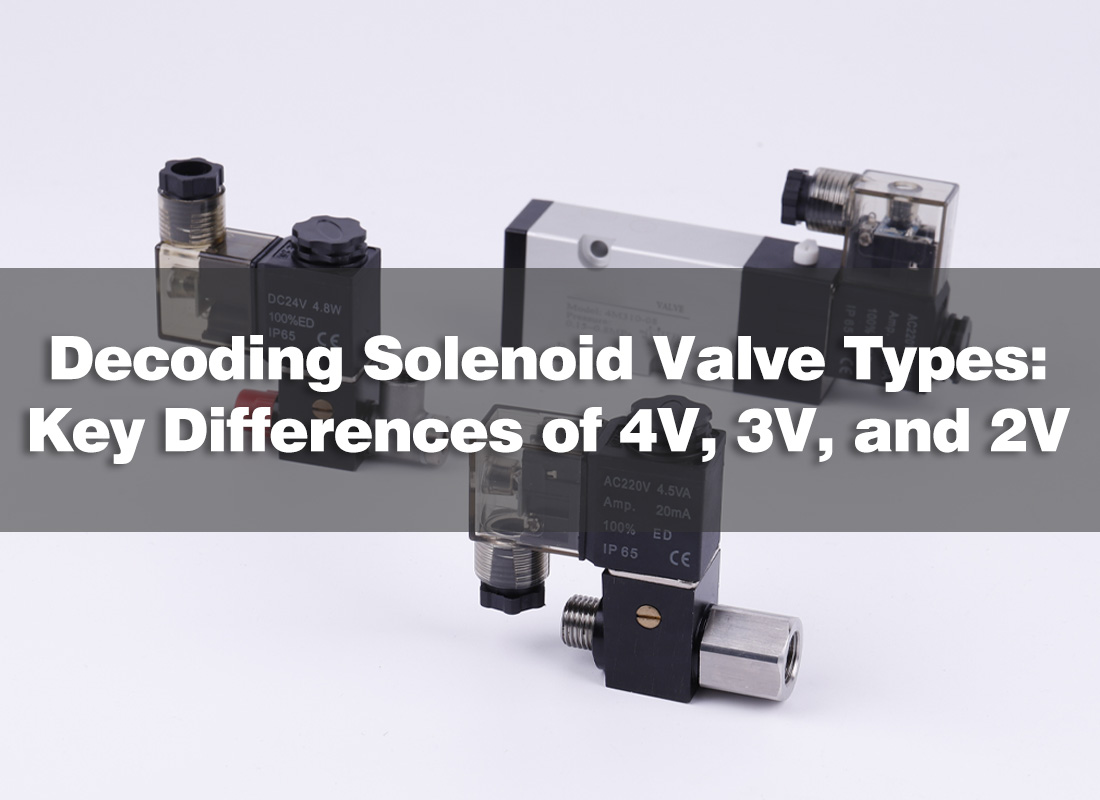
When choosing a pneumatic solenoid valve, buyers and engineers often encounter model labels such as 4V, 3V, and 2V. Although these codes look similar, the valves commonly associated with them have different port arrangements and control functions.
The main difference lies in how many fluid connections the valve has and how it directs or interrupts airflow. A five-port directional valve can reverse a cylinder's movement, a three-port valve can control a single-acting actuator, and a two-port valve provides basic flow switching. Understanding these configurations helps prevent mismatched components and simplifies pneumatic circuit design.
In many pneumatic product ranges, the letter V appears in solenoid valve model codes. The numbers are commonly associated with the valve's port and position configuration. However, manufacturers may use different naming conventions, so the product datasheet should always be checked before ordering.
The common configurations discussed in this guide are:
● 4V: Commonly associated with a 5/2 directional valve, featuring five ports and two switching positions.
● 3V: Commonly associated with a 3/2 directional valve, featuring three ports and two switching positions.
● 2V: Commonly associated with a 2/2 valve, featuring two ports and two switching positions.
The first number in a configuration such as 5/2 identifies the number of ports, while the second indicates the number of positions. These arrangements determine whether a valve can reverse airflow, exhaust a connected line, or simply open and close a passage.
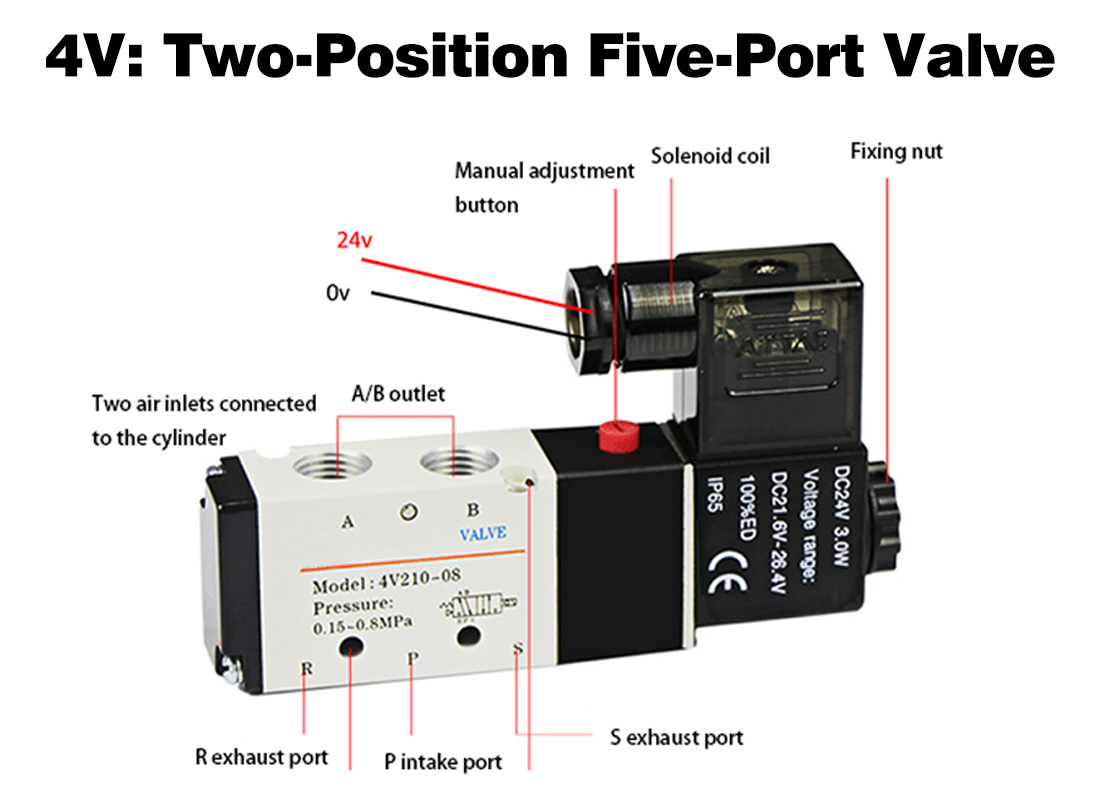
A 5/2 solenoid valve is widely used to operate double-acting pneumatic cylinders. It has five connections: one pressure supply, two working ports, and two exhaust ports.
In a common port designation:
| Port | Function |
| 1 (P) | Compressed-air supply |
| 2 (A) | Working port |
| 4 (B) | Working port |
| 3 (R) | Exhaust |
| 5 (S) | Exhaust |
When the valve switches position, compressed air is directed to one side of the cylinder while the opposite chamber releases air through an exhaust port. Switching the valve reverses these connections, allowing the piston rod to extend or retract.
This configuration is suitable for:
● Double-acting pneumatic cylinders
● Automated assembly and handling equipment
● Packaging and sorting machinery
● Applications requiring repeated forward-and-reverse movement
Separate exhaust paths also allow the two cylinder chambers to be managed independently. Flow controls and silencers can be installed where appropriate to adjust movement speed and reduce exhaust noise.
A 3/2 solenoid valve has three ports: pressure supply, working outlet, and exhaust. It is commonly used with single-acting cylinders and other actuators that require air pressure in one direction and a spring or external force for return movement.
In one switching position, the valve connects the supply to the working port. In the other, it blocks the supply and connects the working port to exhaust. This allows the actuator to move forward under air pressure and return after the pressure is released.
Typical applications include:
● Single-acting pneumatic cylinders
● Pneumatic pilot control
● Air blow-off and release functions
● Compatible angle seat and diaphragm valve actuators
A 3/2 valve does not provide the same reversing function as a 5/2 valve. Its simpler port arrangement makes it suitable for one-direction actuation and basic pneumatic switching.
A 2/2 solenoid valve has one inlet and one outlet. Its primary function is to open or close a flow passage rather than reverse airflow between actuator chambers.
Depending on its design, it may be normally closed or normally open. A normally closed model blocks flow when de-energized, while a normally open model allows flow until the coil is energized.
Common applications include:
● Compressed-air supply switching
● Water and compatible fluid control
● Filling and dispensing equipment
● General pipeline isolation and start/stop operations
Unlike 3/2 and 5/2 directional valves, a 2/2 valve has no dedicated exhaust port for controlling a pneumatic actuator. Its suitability for air, water, oil, or other media depends on the valve's construction, sealing materials, pressure range, and manufacturer specifications.
| Configuration | Ports / Positions | Main Function | Typical Application |
| 4V (5/2) | 46144 | Reverses airflow | Double-acting cylinders |
| 3V (3/2) | 46083 | Supplies and exhausts one working line | Single-acting actuators |
| 2V (2/2) | 46055 | Opens or closes a flow passage | Air and fluid ON/OFF control |
The correct choice depends on the actuator and circuit requirements, not simply the number of ports. Actual flow capacity and switching performance also depend on the valve's orifice size, pressure conditions, coil characteristics, and internal design.
Start by identifying what the connected device needs to do.
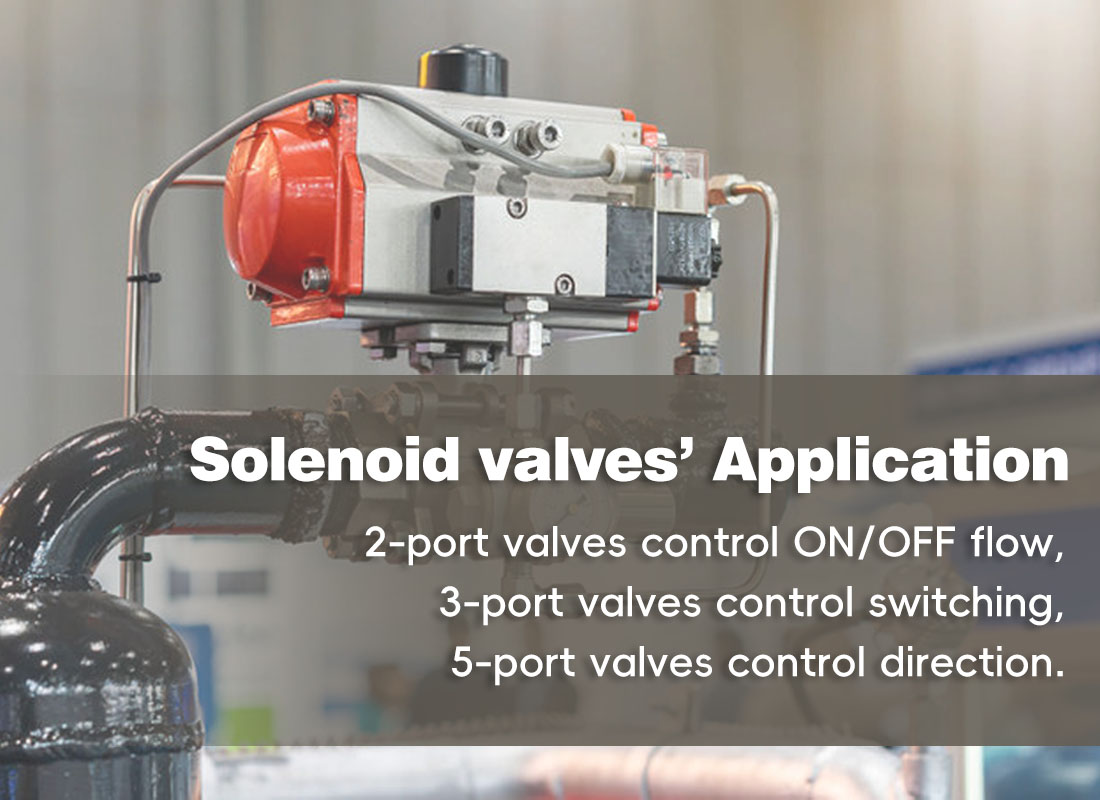
If a double-acting cylinder must extend and retract through pneumatic control, a 5/2 valve is a common solution. Confirm that its port size and flow capacity match the cylinder and required cycle time.
A 3/2 valve is generally appropriate for single-acting cylinders and similar spring-return devices. Check whether the required resting state is normally open or normally closed.
A 2/2 valve may be suitable when no directional switching or actuator exhaust function is needed. Verify that its body, seals, and operating principle are compatible with the medium.
Also consider operating pressure, voltage, connection size, switching frequency, installation space, and environmental protection rating. For pilot-operated valves, check the minimum operating pressure and differential-pressure requirements. These details can affect whether the valve switches reliably under actual working conditions.
Understanding the distinction between these configurations makes pneumatic valve selection more straightforward: five-port valves commonly handle directional control, three-port valves manage single-line supply and exhaust, and two-port valves provide basic flow switching. Matching the valve structure to the circuit helps support stable operation and easier maintenance.
(FK9025)
 How Viscous Fluid Influence Valve Flow Rate Calculation
 Can Pneumatic Valves Operate in Vacuum? Key Insights for Industrial Automation
 VND Series Valves for Steam Applications: High Temperature, Low Maintenance
 Common Pressure Unit Conversion Guide: bar, MPa, psi, and kgf
 Decoding Solenoid Valve Types: Key Differences of 4V, 3V, and 2V
You May Interest In

Dec 02, 2025 Blog
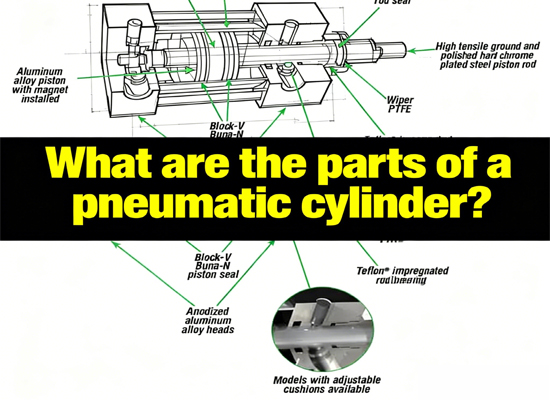
What are the parts of a pneumatic cylinder?

Apr 18, 2025 Blog
What is an Angle Seat Valve?
Get a free sample

Fokca is a brand of Ningbo Fokca Automation Co., Ltd.
Looking for custom pneumatic cylinder solutions? Visit our sister brand, Fescolo.→
© 2026 Ningbo Fokca Automation Co., Ltd. All rights reserved. Sitemap