Apr 07, 2025
Modern food and beverage production relies on automated machinery to maintain consistent product quality, improve production efficiency, and reduce manual intervention. From ingredient processing and liquid filling to bottle capping and final packaging, automated equipment must perform repetitive operations accurately while maintaining stable production speeds.
Pneumatic technology is widely used in these machines because it provides a practical way to control linear movement, clamping, positioning, switching, and material handling. Pneumatic cylinders, solenoid valves, air preparation units, tubing, and fittings work together to convert compressed air into controlled mechanical motion.
Compared with more complex drive systems, pneumatic components offer a relatively simple structure, fast response, and convenient integration into automated production lines. They are particularly suitable for repetitive movements such as opening and closing filling valves, pushing products into position, operating packaging mechanisms, and controlling conveyor diverters.
However, food and beverage machinery operates under conditions that place additional demands on component selection. Water exposure, frequent cleaning, humidity, temperature changes, and potential contact with food products all influence the materials and configurations required.
For equipment manufacturers, the goal is not simply to select pneumatic components with suitable pressure and stroke specifications. Components must also provide reliable operation, withstand the actual production environment, and meet applicable hygiene and material requirements.
Pneumatic systems are involved in many stages of food and beverage production. Their specific functions depend on the machine structure, production process, and degree of automation.
In liquid, paste, and granular packaging machines, filling stations must deliver a consistent quantity of material into bottles, containers, or packaging bags.
Pneumatic cylinders are commonly used to actuate filling valves, raise and lower filling nozzles, operate shut-off mechanisms, and position containers beneath dispensing outlets. When a container reaches the filling position, a solenoid valve directs compressed air to the corresponding cylinder, allowing the filling mechanism to move through its programmed sequence.
Angle seat valves can also be used to control the flow of compatible liquids, gases, and other process media. Their compact structure and relatively high flow capacity make them suitable for certain automated fluid-control applications.
For filling equipment manufacturers, the selection of cylinders and valves should consider required response time, operating frequency, media compatibility, and the accuracy of the overall dosing system.
Bottle handling systems require reliable movement to transfer containers between filling, labeling, inspection, and capping stations.
Pneumatic cylinders operate bottle stoppers, lifting platforms, positioning mechanisms, and clamping devices. Compact cylinders are particularly useful where installation space is limited, while guided cylinders can provide better resistance to side loads during positioning operations.
In automated capping machines, pneumatic actuators can control bottle clamping, cap feeding mechanisms, and vertical movement of the capping head. Solenoid valves coordinate these movements according to signals from the machine controller.
The clamping force and movement speed should be properly adjusted to prevent damage to lightweight plastic bottles or unstable containers.
Conveyor systems move products between different processing stations, but products often need to stop temporarily for inspection, filling, labeling, or packaging.
Pneumatic cylinders are frequently installed as stop gates, positioning actuators, and product-separation mechanisms. A cylinder extends to block incoming containers and retracts when the next station is ready to receive them.
For applications involving different bottle sizes or changing production formats, adjustable pneumatic positioning mechanisms can help equipment manufacturers accommodate multiple product specifications.
Solenoid valves provide the directional control required for cylinder extension and retraction, while sensors confirm the position of products and actuators.
Food packaging machinery includes bagging, wrapping, carton forming, tray sealing, and case packing equipment. These processes often require multiple coordinated pneumatic movements.
Pneumatic cylinders can drive film-cutting mechanisms, operate sealing jaws, open and close packaging clamps, and push finished products into cartons. Depending on the machine design, compact cylinders, standard profile cylinders, and guided actuators may be used.
In heat-sealing equipment, pneumatic actuators provide the mechanical force needed to bring sealing elements together. Consistent movement and appropriate pressure settings help maintain stable sealing operations.
For high-speed packaging lines, cylinder response time, operating frequency, cushioning, and service life should all be considered during system design.
Automated sorting systems separate products according to size, weight, appearance, packaging type, or inspection results.
After a camera, weighing device, or other inspection system identifies a product, the control system sends a signal to a solenoid valve. The valve then directs compressed air to a pneumatic cylinder or actuator, which pushes the selected product toward the appropriate conveyor or collection area.
This arrangement is widely used in food sorting, bottle inspection, carton classification, and automated reject systems.
The actuator must respond quickly enough to match conveyor speed. Its stroke, mounting position, and operating force should be selected according to product dimensions and transfer distance.
Pneumatic technology is also used in robotic and semi-automated handling systems.
Examples include opening and closing grippers, picking up containers, transferring food trays, and positioning packaged products. Vacuum components are particularly useful when handling flat, smooth, or lightweight products that are difficult to grip mechanically.
Vacuum suction cups, vacuum generators, and related control valves can be integrated into pick-and-place systems to create a flexible handling solution.
When selecting vacuum components, manufacturers should consider the product surface, weight, shape, air consumption, and the consequences of vacuum loss during operation.
Food and beverage production lines often include cleaning, flushing, and auxiliary fluid-control processes.
Angle seat valves can be used in suitable automated liquid and gas control circuits, while solenoid valves manage compressed-air distribution and auxiliary pneumatic movements.
Air preparation units help regulate pressure and remove contaminants from compressed air before it enters downstream pneumatic equipment.
It is important to distinguish between pneumatic control air and process cleaning media. Components used in cleaning-fluid circuits must be specifically selected for the chemical composition, temperature, pressure, and material compatibility of the medium.
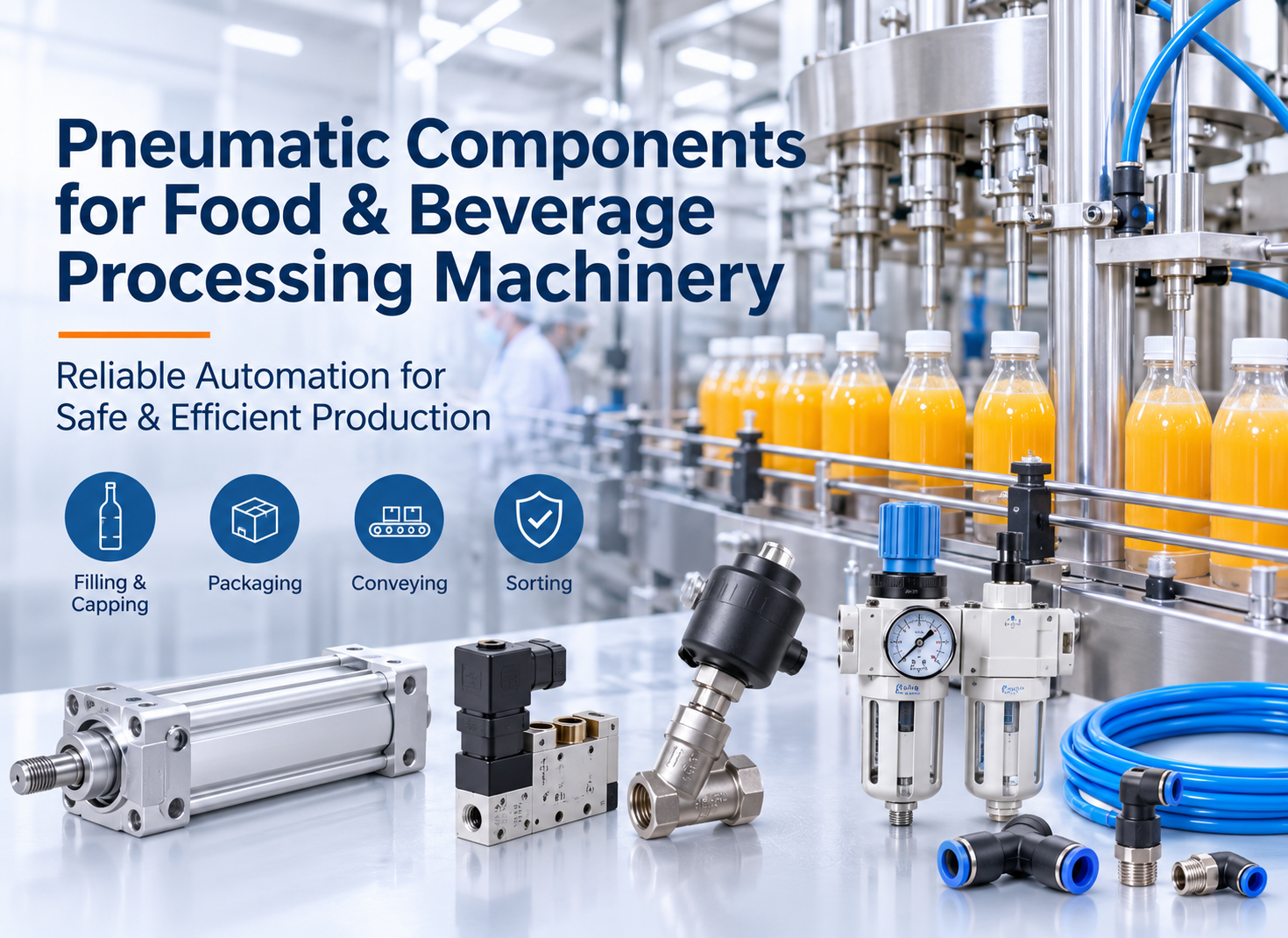
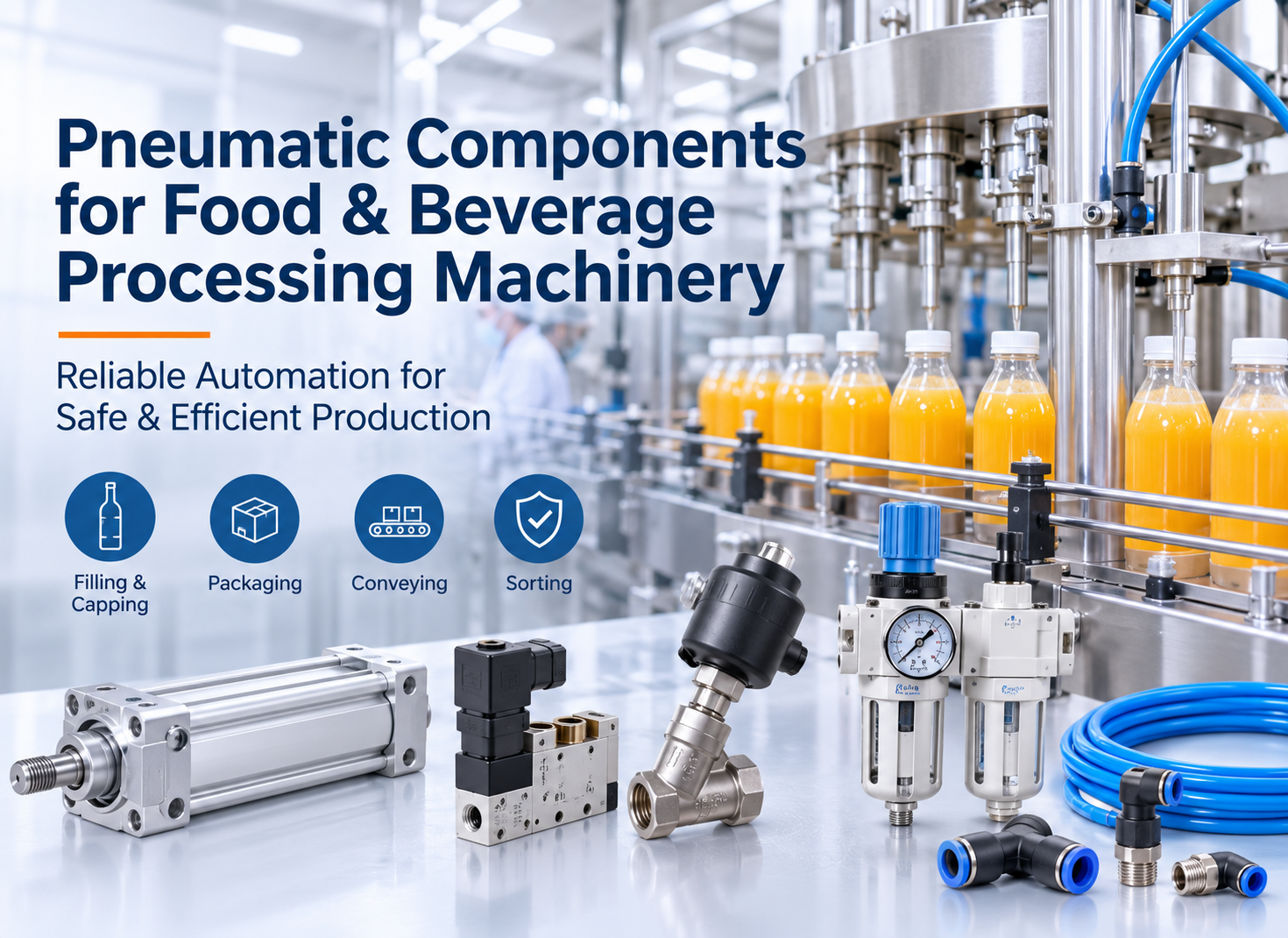
Different pneumatic components perform different functions within an automated production line. Selecting the correct combination helps improve equipment reliability, simplify installation, and reduce maintenance requirements.
Pneumatic cylinders are among the most widely used actuators in food and beverage machinery. They convert compressed air into linear motion and provide the mechanical force required for positioning, clamping, pushing, lifting, and opening or closing mechanisms.
Common applications include:
● Operating filling nozzles and shut-off mechanisms.
● Positioning bottles and containers.
● Driving packaging and sealing mechanisms.
● Pushing products into sorting channels.
● Operating clamps and transfer mechanisms.
Standard cylinders are suitable for many general-purpose applications where the installation environment is relatively clean and dry.
For equipment exposed to frequent washing, moisture, or corrosive cleaning agents, stainless steel cylinders or specially configured cylinders may be more appropriate. The cylinder barrel, end covers, piston rod, fasteners, and seals should be evaluated separately rather than assuming that one material choice provides complete corrosion resistance.
Solenoid valves control the direction and switching of compressed air in automated pneumatic systems.
They receive electrical signals from a PLC or other control device and direct compressed air to the corresponding cylinder or actuator. This allows multiple movements to be coordinated according to the production sequence.
Typical applications include:
● Controlling cylinder extension and retraction.
● Operating bottle stoppers and positioning devices.
● Switching pneumatic grippers.
● Controlling air supply to packaging mechanisms.
● Coordinating automated sorting and transfer operations.
For food and beverage machinery, valve selection should consider voltage, port size, flow capacity, response time, operating frequency, and installation conditions.
If valves are installed near washdown areas, enclosure protection and the suitability of electrical connections should also be checked.
Angle seat valves are designed for automated control of compatible fluids, gases, steam, and other process media, depending on their construction and material specifications.
Their angled flow path and actuator design can provide relatively high flow capacity and reliable switching in many industrial fluid-control applications.
In food and beverage machinery, potential applications include:
● Controlling water supply in suitable equipment circuits.
● Switching compatible liquid transfer lines.
● Controlling steam in appropriately rated systems.
● Operating automated process and auxiliary fluid circuits.
The valve body material, seal material, temperature rating, pressure range, and media compatibility must be verified before use.
Importantly, an angle seat valve is not automatically suitable for direct food contact. Applications involving ingredients or finished beverages require confirmation of the wetted materials and relevant food-contact compliance documentation.
Air preparation units, commonly known as FRL units, combine filtration, pressure regulation, and lubrication functions.
A typical configuration includes:
● Air Filter: Removes solid particles and separates condensed moisture from compressed air.
● Pressure Regulator: Maintains the required downstream pressure for stable actuator operation.
● Lubricator: Supplies oil mist when required by compatible pneumatic equipment.
In food and beverage production environments, air quality deserves particular attention. Contaminated compressed air can affect equipment performance and may create product contamination risks if air is released near exposed food or comes into contact with product-contact surfaces.
For this reason, filtration should be selected according to the air quality requirements of the application. Oil-free air or additional filtration may be necessary in certain processes.
Lubricators should not be installed indiscriminately. If downstream components are designed for non-lubricated operation, introducing oil mist may cause problems or increase maintenance requirements.
Tubing and fittings connect compressors, air preparation units, solenoid valves, cylinders, and other pneumatic components.
Their quality directly affects system sealing, pressure stability, installation flexibility, and maintenance efficiency.
Common options include:
● PU Tubing: Flexible and suitable for general pneumatic connections and compact machine layouts.
● PA Tubing: Offers good mechanical strength and is useful in applications requiring greater rigidity or pressure resistance.
● Stainless Steel Fittings: Provide improved corrosion resistance in suitable humid or washdown environments.
● Brass Fittings: Commonly used in general industrial pneumatic systems where environmental conditions permit.
For food and beverage machinery, the material of the tubing and fittings should be selected according to their installation location. Components used in ordinary compressed-air circuits do not automatically need to meet the same requirements as materials that directly contact food.
Where tubing or fittings may be exposed to cleaning chemicals, temperature changes, or frequent washing, chemical resistance and sealing performance should be verified.
Vacuum systems are commonly integrated into automated food packaging and product-handling machinery.
Vacuum generators use compressed air to create negative pressure, while suction cups transfer products without requiring mechanical clamping.
Typical applications include:
● Picking up packaging films and trays.
● Handling lightweight containers.
● Transferring flat food packages.
● Opening bags and cartons.
● Moving products between conveyor stations.
Suction cup material is an important consideration. Its compatibility with the product surface, cleaning agents, temperature, and applicable food-contact requirements should be confirmed when direct contact with food or primary packaging is involved.
Although sensors are not pneumatic actuators, they are essential for coordinating pneumatic movements in automated production equipment.
Magnetic cylinder sensors detect piston positions, while photoelectric and proximity sensors identify bottles, containers, packaging materials, and machine components.
They provide feedback to the PLC, allowing the control system to activate solenoid valves at the correct time.
For example, a photoelectric sensor detects a bottle entering the filling station. The PLC then triggers the relevant pneumatic sequence. After filling is completed, another signal allows the positioning cylinder to retract and the conveyor to move the bottle forward.
In humid or washdown environments, sensor protection ratings, connector sealing, cable routing, and mounting methods should be checked against the actual cleaning conditions.
Food and beverage equipment operates under environmental conditions that are often more demanding than those found in general industrial automation. Component selection must account for hygiene, corrosion, moisture, and material compatibility.
Water, acidic ingredients, alkaline cleaning agents, salt-containing products, and disinfectants can accelerate corrosion of exposed metal components.
Standard aluminum alloy or carbon steel components may be suitable for protected areas of a machine, but they may not provide sufficient resistance in continuously wet or chemically aggressive environments.
Stainless steel components, particularly suitable grades such as 304 or 316, can offer improved corrosion resistance depending on the application.
However, stainless steel grade alone does not guarantee suitability. Surface finish, weld quality, fastener materials, crevices, and chemical concentration also influence long-term performance.
Many food processing machines undergo regular cleaning to remove product residues and maintain sanitary conditions.
During washdown, pneumatic components may be exposed to water spray, high humidity, cleaning solutions, and temperature fluctuations.
These conditions can affect:
● Cylinder seals and external sealing structures.
● Valve electrical connections.
● Sensor housings and cable connectors.
● Tubing connections and fitting seals.
● Exposed fasteners and mounting brackets.
When selecting components for washdown areas, check their IP protection ratings and confirm whether the specified protection applies to the actual installation and cleaning conditions.
An IP rating should not be interpreted as automatic approval for high-pressure cleaning or chemical exposure.
Different components require different material considerations.
For example, aluminum alloy can provide a lightweight solution for general pneumatic cylinder construction, while stainless steel may be more appropriate for exposed components in corrosive environments.
Seals also require careful selection. NBR, EPDM, FKM, and PTFE have different chemical resistance and temperature characteristics.
● NBR: Commonly used for general pneumatic sealing applications.
● EPDM: Offers good resistance to water and many cleaning-related chemicals, but is not suitable for every oil-based medium.
● FKM: Provides good resistance to many oils and chemicals and can be suitable for certain higher-temperature applications.
● PTFE: Offers broad chemical resistance and low friction, with specific sealing design considerations.
The final choice depends on the actual media, temperature, pressure, and operating conditions.
Compressed air quality is particularly important in food and beverage production.
Air used for ordinary machine actuation has different requirements from air that may contact exposed food, food-contact surfaces, or primary packaging.
Depending on the application, compressed air treatment may need to address:
● Solid particles.
● Water and moisture.
● Oil aerosols and vapors.
● Microbiological contamination risks.
Filtration, drying, and oil-control measures should be designed according to the intended use of the compressed air.
For processes where air comes into direct or indirect contact with food, manufacturers should assess the applicable food safety requirements and relevant compressed-air quality standards rather than relying on a standard industrial filter alone.
Not every pneumatic component installed on a food processing machine needs to be food-contact certified.
For example, a cylinder installed inside a protected machine cabinet and used only to operate a mechanical positioning device has different requirements from a suction cup that directly touches unpackaged food.
The distinction is important when evaluating materials and certifications.
For components that may directly contact food, manufacturers should verify:
● Whether the material is suitable for the specific food type.
● Whether the seal and lubricant are appropriate for the intended contact conditions.
● Whether relevant food-contact declarations or certifications are available.
● Whether the material complies with applicable regional regulations.
FDA-related compliance should be confirmed for the specific material and intended application. It should not be assumed that an entire pneumatic assembly is FDA approved simply because one of its materials has supporting documentation.
Selecting pneumatic components requires more than matching cylinder dimensions or valve port sizes. Equipment manufacturers should evaluate the operating environment, production requirements, and maintenance conditions together.
The choice between stainless steel and standard materials depends primarily on installation location and exposure conditions.
| Selection Factor | Standard Materials | Stainless Steel Options |
| General machine interiors | Suitable for many applications | Suitable where additional resistance is needed |
| Humid environments | Depends on surface protection | Often preferable |
| Frequent washdown | Requires careful evaluation | Better suited when correctly specified |
| Corrosive cleaning agents | Limited by material and coating | Depends on stainless steel grade and chemical compatibility |
| Cost and weight | Often lower and lighter | Generally higher |
A practical approach is to use corrosion-resistant materials in exposed areas while retaining standard components in protected machine sections where environmental conditions allow.
Seal selection affects leakage, service life, and operating reliability.
Manufacturers should identify the substances that may come into contact with the seals, including compressed air, cleaning solutions, process liquids, and lubricants.
Temperature and pressure also influence sealing performance. A seal suitable for ordinary room-temperature operation may not perform reliably under repeated high-temperature cleaning cycles.
Material selection should therefore be based on the complete operating environment rather than a single chemical-resistance specification.
Temperature affects seal elasticity, tubing flexibility, and valve performance. Both normal operating temperature and temporary temperature peaks should be considered.
Working pressure should be selected according to the equipment's required actuator force and the pressure ratings of all connected components.
For cylinders, the theoretical output force is calculated using piston area and operating pressure:
F = P × A
Where:
● F = Theoretical output force.
● P = Operating pressure.
● A = Effective piston area.
Actual available force is lower because of friction and other mechanical losses. Equipment designers should also consider load variation, acceleration, and safety margins when selecting cylinder bore sizes.
Cleaning chemicals can affect metal surfaces, elastomers, plastics, and protective coatings.
Before choosing components, equipment manufacturers should identify the cleaning agents used in the facility, their concentrations, operating temperatures, and contact times.
This is particularly important for fittings, tubing, external cylinder surfaces, and seals located near cleaning stations.
A material that performs well in ordinary humid conditions may deteriorate quickly when exposed to concentrated alkaline or acidic cleaning solutions.
The location of pneumatic components affects both service life and maintenance efficiency.
Components installed in exposed areas may require better corrosion protection and higher enclosure protection. Components installed inside protected control cabinets may have less demanding environmental requirements.
Maintenance accessibility is equally important.
Filters should be easy to inspect and replace. Pressure regulators should be accessible for adjustment. Cylinders, sensors, and fittings should be positioned so technicians can inspect connections and replace worn parts without dismantling large sections of the machine.
Good pneumatic system layout reduces unnecessary tubing length, simplifies troubleshooting, and makes routine maintenance more efficient.
Food and beverage machinery manufacturers often need several types of pneumatic components within one production line. Managing different suppliers for cylinders, valves, air preparation units, tubing, and fittings can increase purchasing complexity and make product coordination more difficult.
Fokca provides a broad range of pneumatic components to support equipment manufacturers, automation integrators, and industrial distributors.
Fokca's product range covers key components used in automated pneumatic systems, including:
● Pneumatic cylinders and customized cylinder solutions.
● Solenoid valves and angle seat valves.
● Air filters, regulators, and lubricators.
● PU, PA, and other pneumatic tubing options.
● Push-in fittings and pneumatic quick couplings.
● Vacuum-related components and pneumatic accessories.
● Sensors and other automation components.
This multi-category supply capability helps OEMs coordinate component sourcing across different machine sections and reduces the complexity of managing multiple product suppliers.
Different production processes require different pneumatic configurations.
A bottle filling machine may need compact cylinders, solenoid valves, and flow-control components, while a packaging line may require guided actuators, vacuum generators, and multiple positioning mechanisms.
Fokca supports product selection based on application requirements, including:
● Cylinder bore, stroke, mounting, and operating pressure.
● Valve function, voltage, flow capacity, and connection size.
● Tubing dimensions, material, and working pressure.
● Fitting specifications and connection standards.
● Material and seal requirements based on the installation environment.
Providing operating conditions and installation details helps improve the accuracy of product selection and reduces the risk of component mismatches during equipment assembly.
For food and beverage machinery, material specifications are particularly important.
Fokca can support OEM purchasing teams in confirming product configurations, material options, dimensions, and technical specifications according to individual project requirements.
For applications involving washdown, moisture, or potential food contact, customers should communicate the actual working environment and intended use before ordering.
Specific material declarations, food-contact documentation, and applicable certifications must be checked against the selected product and its configuration. Not all standard pneumatic components are designed or certified for direct food contact.
Food and beverage equipment manufacturers may require standard pneumatic products for regular production as well as customized components for special machine designs.
Fokca supports OEM and project-based purchasing requirements through product coordination, specification confirmation, and customized pneumatic solutions where applicable.
Whether the requirement involves cylinders for bottle positioning, valves for automated fluid control, or tubing and fittings for machine connections, accurate technical communication helps establish a more consistent component supply process.
For equipment manufacturers developing new machinery or upgrading existing production lines, early coordination of pneumatic component specifications can simplify machine integration and future maintenance.
Pneumatic components support many essential operations in food and beverage machinery, including filling, capping, conveying, sorting, packaging, and automated product handling.
Their performance directly affects machine movement, production consistency, and maintenance requirements. However, food processing environments introduce additional considerations such as moisture, corrosion, cleaning chemicals, compressed-air quality, and food-contact material compliance.
The most suitable solution is not necessarily the one that uses the highest specification for every component. It is the one that matches each component's material, sealing structure, operating parameters, and protection level to its actual installation environment and function.
For OEMs and automation integrators, evaluating these requirements during the machine design stage helps improve system reliability, simplify maintenance, and avoid unnecessary component replacement.
Need Help with Your Pneumatic Component Requirements? →
Contact FOKCA to discuss your equipment requirements, confirm product specifications, and identify suitable pneumatic components for your application.
Email: sales@fokca.com
WhatsApp: +86 15057491870
You May Interest In
Get a free sample

Fokca is a brand of Ningbo Fokca Automation Co., Ltd.
Looking for custom pneumatic cylinder solutions? Visit our sister brand, Fescolo.→
© 2026 Ningbo Fokca Automation Co., Ltd. All rights reserved. Sitemap