Jan 15, 2026
Nylon tubing is widely used in pneumatic systems due to its high pressure resistance, dimensional stability, and good chemical compatibility. Pneumatic nylon tubes and nylon hoses are commonly found in automation equipment, mobile machinery, and industrial air lines.
However, when systems operate in cold environments, engineers often ask a critical question: does nylon tubing become brittle at low temperatures, and is it still suitable for these conditions?
The answer depends on how nylon responds to low temperatures and how its performance compares with other plastic tubing materials.
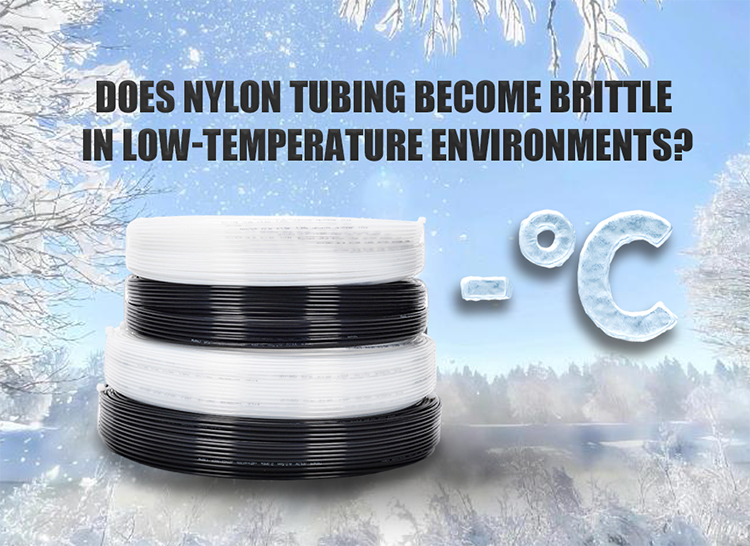
Nylon is a semi-crystalline thermoplastic. As temperature decreases, molecular movement within the material slows down, causing the tube to become stiffer and less flexible. This change is gradual rather than sudden, but it becomes noticeable as temperatures approach the lower end of nylon’s operating range.
In practical terms, a pneumatic nylon tube used in cold conditions may require a larger bending radius and more careful handling during installation. Reduced flexibility does not immediately mean failure, but it does affect how well the tube can tolerate movement, vibration, and impact.
Impact resistance is a key factor when evaluating brittleness. At low temperatures, nylon’s ability to absorb sudden mechanical energy decreases. External impacts, sharp bending, or accidental knocks during maintenance can introduce localized stress concentrations.
Over time, these stresses may lead to micro-cracks, especially near fittings or fixed bend points. This is why users sometimes describe nylon tube failure in cold environments as “brittle cracking,” even though the root cause is reduced impact toughness combined with mechanical stress, not an inherent defect in the material.
To judge nylon’s suitability, it is helpful to compare its low-temperature behavior with other commonly used pneumatic tube materials.
| Material | Low-Temperature Flexibility | Impact Resistance | Typical Cold-Environment Performance |
|---|---|---|---|
| Nylon tube | Moderate | Moderate | Stable in static use, caution in dynamic motion |
| Polyurethane (PU) tube | Good | High | Performs well in dynamic low-temperature systems |
| PVC tube | Poor | Low | Becomes brittle quickly in cold conditions |
| PE tube | Fair | Low to moderate | Limited pressure capability at low temperature |
Compared with PVC, nylon tubing performs significantly better in cold environments. However, when compared with polyurethane pneumatic hoses, nylon generally shows lower flexibility and impact resistance at low temperatures.
In static installations, such as fixed air supply lines in cold storage facilities, pneumatic nylon tubes often perform reliably when properly sized and installed. The risk of brittle failure is relatively low because mechanical movement is minimal.
In dynamic applications, such as moving machinery, robotic arms, or mobile equipment exposed to winter conditions, reduced flexibility becomes more critical. Repeated bending or vibration accelerates fatigue, making nylon tubing more vulnerable than more elastic materials.
Understanding this distinction is essential for engineers making material selections for low-temperature systems.
When nylon tubing is considered for low-temperature use, engineers should evaluate:
1.Minimum operating temperature of the system
2.Degree of movement, vibration, or bending
3.Required bending radius and installation method
4.Potential impact or mechanical shock risks
In many cases, nylon tubing remains a viable option when movement is limited and installation is well controlled. For more demanding conditions, alternative materials or reinforced hose structures may provide better long-term reliability.
Nylon tubing does not suddenly become unusable at low temperatures, but its flexibility and impact resistance do decrease, increasing the risk of fatigue-related damage in dynamic applications. By understanding these material behaviors and comparing nylon with other pneumatic tube options, engineers can make informed decisions.
In cold environments, proper material selection—sometimes combined with reinforced hose designs—plays a key role in maintaining stable, long-term pneumatic system performance.
(FK9026)
You May Interest In

Dec 02, 2025 Blog
What are the parts of a pneumatic cylinder?

Apr 18, 2025 Blog
What is an Angle Seat Valve?
Get a free sample

Fokca is a brand of Ningbo Fokca Automation Co., Ltd.
Looking for custom pneumatic cylinder solutions? Visit our sister brand, Fescolo.→
© 2026 Ningbo Fokca Automation Co., Ltd. All rights reserved. Sitemap