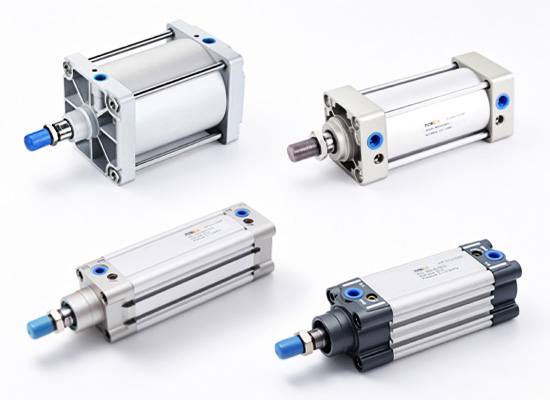
Strong versatility, complete specifications, stable and reliable – The standard cylinder is the most fundamental and widely used pneumatic actuator. It converts compressed air energy into mechanical energy to drive linear piston motion, powering various automation equipment.
Its bore, stroke, and mounting dimensions comply with ISO 15552 and other international standards, ensuring good interchangeability between brands and significantly reducing spare parts inventory and maintenance costs.
Fokca standard cylinders cover mainstream series such as DNC, CA1, SC, and SU. Single-acting/double-acting options available, bore sizes 32-250mm, stroke up to 2800mm. Magnetic ring design enables position sensing with magnetic switches. Rich accessories. A universal power solution for industrial automation, packaging machinery, automotive manufacturing, and more.
A standard cylinder is the most fundamental and widely used type of pneumatic actuator. It converts the pressure energy of compressed air into mechanical energy, driving the piston in linear reciprocating motion to provide pushing, pulling, clamping, lifting, and other forces for various automation equipment.
Since cylinders can be classified in multiple ways, the term "standard" has different meanings. In a broad sense, standard cylinders refer to those that comply with ISO 15552 (ISO 6431) mounting dimensions. However, in a narrower sense based on shape and function, some manufacturers' basic models—even if they do not meet ISO 15552—are often referred to as standard cylinders as well.
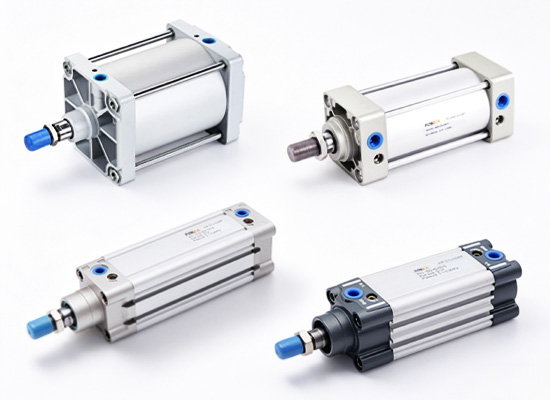
Fokca's standard cylinders feature square end caps and cover major series from Festo, SMC, Airtac, and Metalwork, including DNC, SC, SU, MBB, and others. They comply with ISO 15552 or Airtac standards, offering excellent interchangeability.
Single-acting and double-acting options are available, with bore sizes ranging from 32mm to 250mm and stroke lengths up to 2800mm. A wide range of accessories is also available. They are the general-purpose power solution for industrial automation, packaging machinery, automotive manufacturing, material handling, and other fields.
The core structure of a standard cylinder includes the cylinder barrel, piston, piston rod, front/rear end caps, and seals. These components together form an enclosed space inside the cylinder, which is divided into two chambers by the piston.
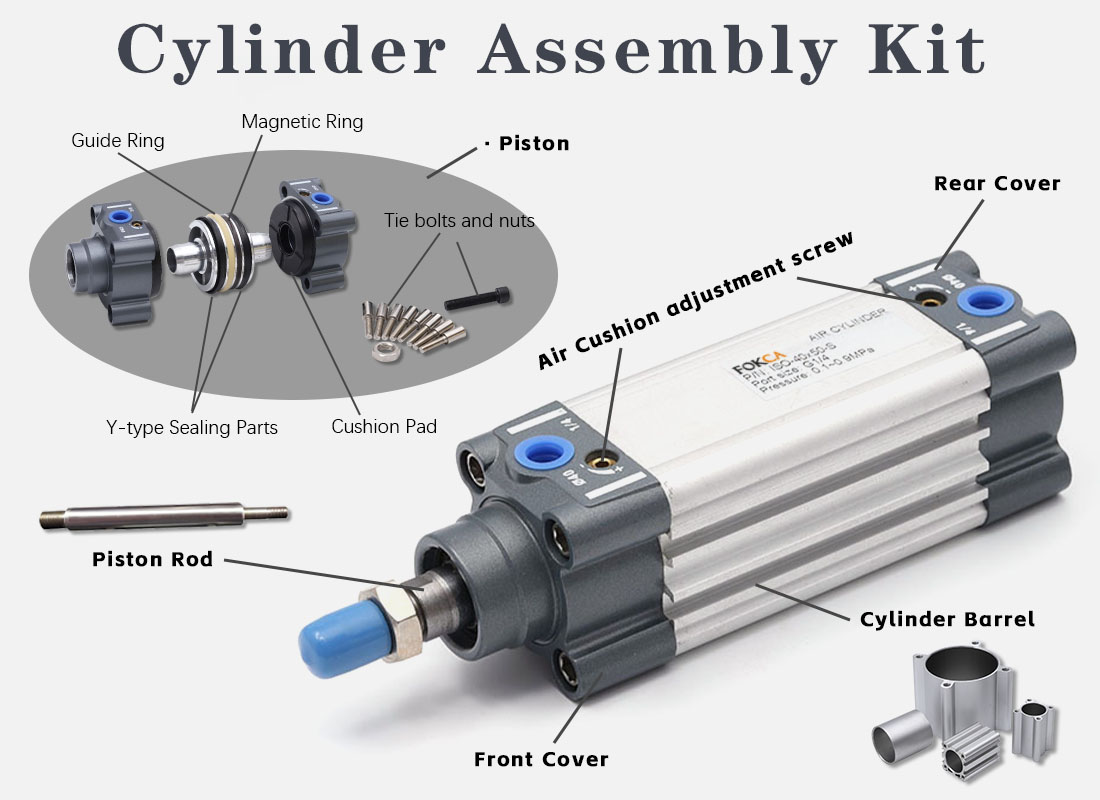
When compressed air is supplied to one chamber, the piston is pushed toward the other chamber, driving the piston rod to move and perform work. Based on how the piston retracts, cylinders are divided into single-acting and double-acting types.
Double-acting cylinder: Air is supplied alternately to both sides of the piston. When air enters side A, the piston is pushed toward side B, extending the piston rod. When air enters side B, the piston rod retracts. Both extension and retraction produce force, making this the most common type.
Single-acting cylinder: Only one side has an air inlet; the other side relies on a spring for return. When air is supplied, the piston rod extends. When the air is cut off, the spring automatically returns the rod. Simple in structure and low in energy consumption, it is suitable for simple control applications such as clamping and ejecting.
Additionally, cylinders may include extra features such as a magnetic ring for position detection and automatic control, as well as guide sleeves and cushioning mechanisms for smooth motion.
Step 1: Determine the actuation method
Choose double-acting if bidirectional force or high thrust is required. Choose single-acting if only unidirectional force is needed for simple control and moderate force.
Step 2: Calculate the required bore size
Calculate the required thrust based on load weight and working pressure, then determine the theoretical thrust and bore size. Load factor: ≤50% for horizontal motion, 30%-50% for vertical motion, ≤70% for static clamping.
Step 3: Determine the stroke
Based on actual travel distance. For longer strokes, a 10-20mm margin is recommended.
Step 4: Select the cylinder series
Consider mounting dimensions, cost, and operating environment. For applications requiring ISO 15552 mounting dimensions, the DNC series is an excellent choice. For cost-sensitive applications, the SC series is the most cost-effective general-purpose option.
Step 5: Select the mounting style
Choose flange, foot, trunnion, or other mounting accessories based on equipment structure.
Step 6: Confirm whether position detection is needed
If the PLC requires position feedback, select a cylinder with a magnetic ring and a compatible magnetic switch.
Step 7: Confirm special requirements
For needs such as high temperature resistance, corrosion resistance, special piston rods, or custom cylinders, contact technical support for customization.
Although standard cylinders already cover a wide range of industrial automation applications, some special situations still make it difficult to find a perfectly matched standard cylinder—such as limited installation space, the need for a special piston rod structure, high-temperature or corrosive environments, or non-standard stroke and bore size requirements. In these cases, cylinder customization is necessary.
Fokca specializes in cylinder customization, backed by extensive experience and numerous successful cases. Our customization services include, but are not limited to:
Component replacement: Replacing certain parts of the cylinder with alternative materials or specifications (e.g., seals, piston rod, cylinder barrel)
Structural modification: Adjusting the cylinder structure to meet special installation or usage conditions
Drawing-based production: Producing cylinders precisely according to customer-provided drawings
Custom design: Designing cylinders based on customer requirements and providing complete drawing solutions
We offer fast response capabilities, efficient sample production, and mature batch production capacity, ensuring a smooth process from sample validation to mass delivery. Whether you are an equipment manufacturer or an end user, Fokca can provide the most suitable cylinder customization solution for your needs.
1. During cylinder installation, ensure that the direction of piston rod movement aligns with the load direction to avoid side loads that could cause rod wear or seal damage.
2. The compressed air supplied to the cylinder must be filtered to remove moisture and contaminants. It is recommended to install an FRL unit (filter-regulator-lubricator) upstream for proper air preparation.
3. For high-speed or heavy-load applications, adjust the cushioning screws on the cylinder end caps to prevent the piston from impacting the end caps at high speed, which could cause damage and noise.
4. When installing a magnetic switch on a cylinder with a magnetic ring, adjust the switch position until the indicator lights up when the piston reaches the end of stroke, then tighten the switch to prevent loosening.
5. Regularly inspect the piston rod surface for scratches, check for air leaks around seals, and verify cushioning performance. Replace worn components promptly.
6. When the cylinder is not in use for extended periods, store it in a dry environment and apply rust-preventive oil to the piston rod surface.

Get a free sample

Links: www.fescolo.com(Pneumatic)
FOKCA ©1998-2025 All Rights Reserved Sitemap