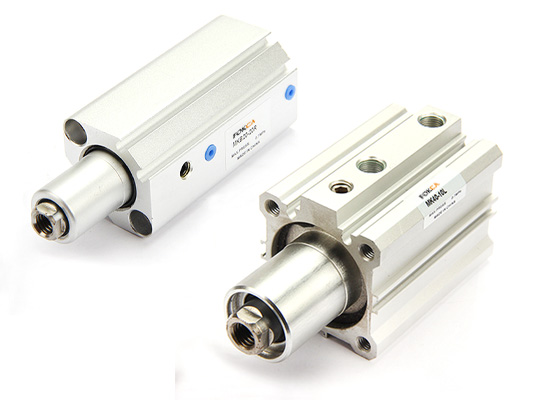
A rotary clamping cylinder integrates rotary motion and linear clamping into a single unit. One cylinder completes two actions—“rotate into position → press down”—effectively solving workspace constraints in fixture loading and unloading.
Fokca focuses on the QCK series with QPQ treatment piston rod and stainless steel scraper, providing excellent resistance to welding spatter. Available bore sizes: 12–63 mm; clamping stroke: 10–50 mm; rotation angle: 90° ±2°. Double-acting, with selectable left- or right-hand rotation. Ideal for welding fixtures, CNC machining centers, and automated assembly lines requiring fast workpiece loading and unloading.
A rotary clamping cylinder is a specialized pneumatic actuator that integrates rotary motion with linear clamping in a single unit. Within one complete operating cycle, it performs two sequential actions: first rotating 90°, then moving downward linearly to clamp the workpiece. During release, it reverses the sequence—lifting vertically first, then rotating 90° back to its original position to clear the workspace.
In the design of automated fixtures and welding jigs, engineers often face a common challenge: the clamping arm must apply force from above the workpiece, yet it can obstruct loading and unloading operations. Traditional solutions typically involve complex cylinder combinations or manual clearance mechanisms.
A rotary clamping cylinder eliminates this issue by rotating into position for clamping and rotating away during release. This enables fast, unobstructed operation—essentially “in and out without interference.”
The Fokca AirTac QCK Series rotary clamping cylinders feature anti-welding-spatter design, a compact structure, and selectable rotation direction (left or right). They are widely used in welding fixtures, CNC machining centers, automated assembly lines, and tooling applications where quick workpiece loading and unloading is essential.
The key feature of a rotary clamping cylinder lies in the helical groove machined on its piston rod. When compressed air enters the cylinder, a guide pin fixed to the cylinder body engages with the helical groove on the piston rod.
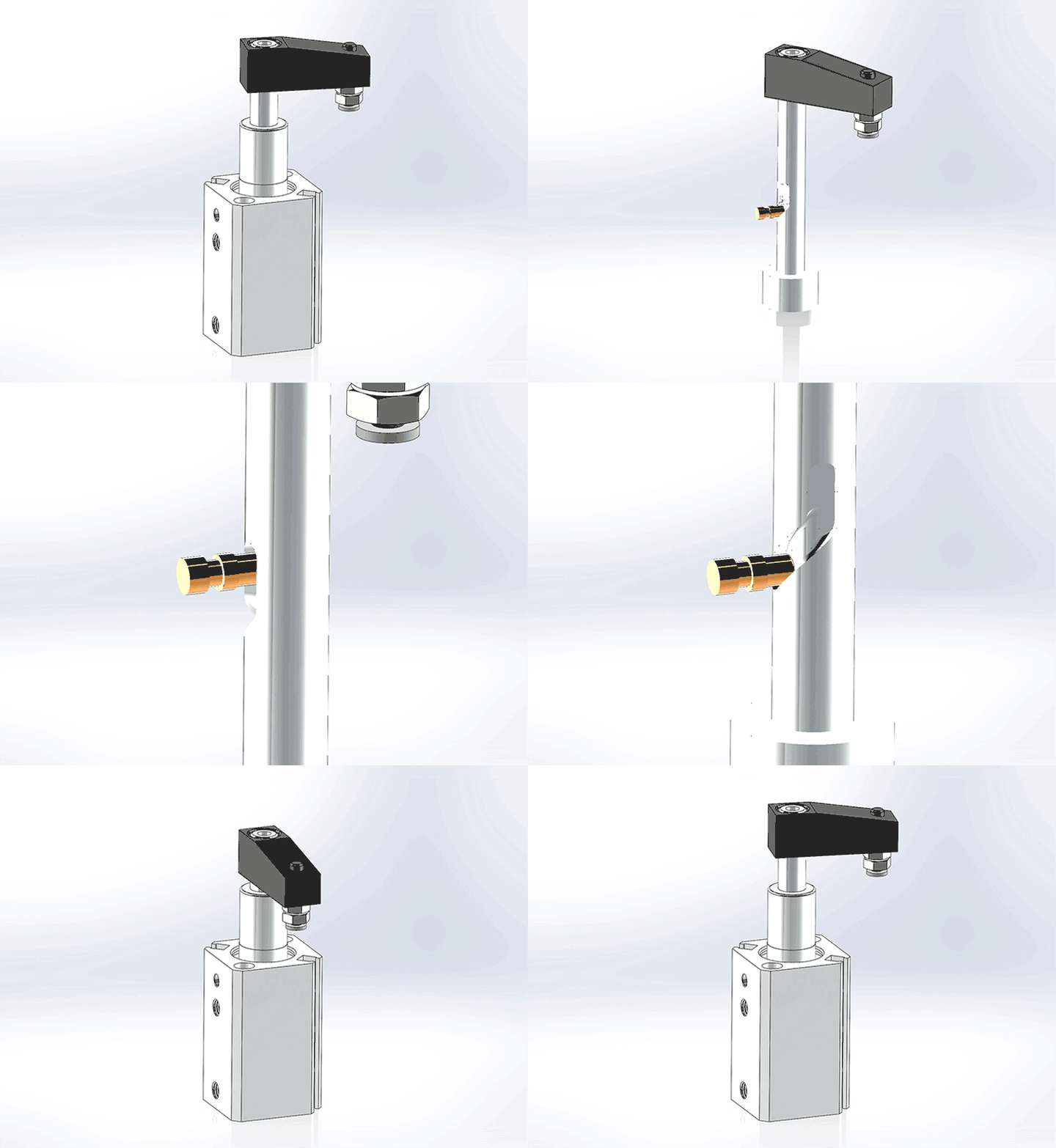
As a result, the piston rod follows the groove path—first completing a rotational movement, then transitioning into a linear clamping stroke. These two motions are mechanically linked and require no external control logic.
The piston rod is treated with QPQ (Quench–Polish–Quench), offering significantly better resistance to welding spatter compared to conventional hard chrome plating. Spatter is less likely to adhere, and even when it does, it is easier to remove.
The front cover is equipped with a stainless steel scraper that actively removes debris such as welding spatter and dust during piston movement. This design is more robust and durable than traditional dust boots.
The QCK series is available in both left-hand (QCKL) and right-hand (QCKR) rotation, allowing flexible configuration based on workstation layout.
The mounting dimensions of the QCK series are identical to the ACQ series, enabling shared mounting accessories and making upgrades or replacements simple and convenient.
Q1: What is the difference between QCKL and QCKR?
A1: Viewed from above, a clockwise rotation during clamping indicates QCKR (right-hand rotation), while a counterclockwise rotation indicates QCKL (left-hand rotation).
Q2: What happens if the clamping arm hits the workpiece during rotation?
A2: This can generate shear stress on the internal helical groove, potentially damaging the guide pin or groove structure. Proper installation and adjustment are critical to ensure sufficient clearance during the rotation stroke.
Q3: Do rotary clamping cylinders require flow control valves?
A3: Yes, it is strongly recommended to install flow control valves at both the inlet and outlet ports, using exhaust throttling to regulate speed. The rotational motion generates significant inertia, and without proper speed control, impact forces at the end of rotation may damage the internal helical mechanism over time.

Get a free sample

Links: www.fescolo.com(Pneumatic)
FOKCA ©1998-2025 All Rights Reserved Sitemap