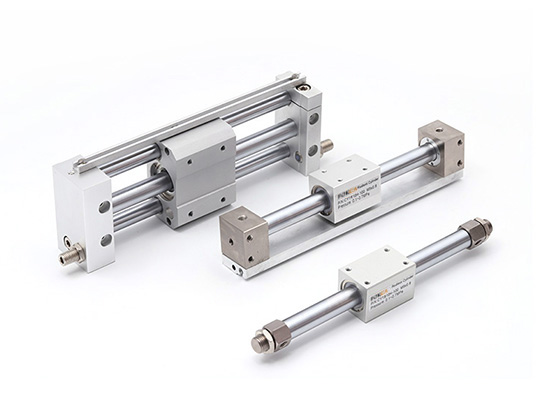
A rodless cylinder is the preferred solution for long-stroke, compact-layout applications. It uses magnetic coupling to drive the external carriage through the cylinder wall, with no mechanical connection between piston and carriage. The fully sealed design means zero dynamic seal wear, zero particle generation, and zero external leakage.
Compared to traditional cylinders, a rodless cylinder reduces installation space by over 50% for the same stroke, with greater savings on longer strokes. Though not suitable for heavy loads due to magnetic coupling limits, it delivers irreplaceable value in medium-to-light load, long-stroke, and clean-operation applications.
A rodless cylinder is a pneumatic actuator that eliminates the traditional piston rod found in standard cylinders. In a conventional cylinder, the piston rod extends outside the cylinder body to drive the load, which results in an overall installation length that is typically more than twice the stroke length.
In contrast, a rodless cylinder uses a magnetic coupling system to connect the internal piston with an external carriage. The two components are physically separated, and the carriage moves synchronously along the outside of the cylinder as the piston moves inside. This design eliminates the need for space to accommodate a protruding rod.
The key advantage of a rodless cylinder is space efficiency. For example, with a 1000 mm stroke, a standard cylinder may require approximately 2500 mm of installation space, while a rodless cylinder typically requires only about 1200 mm, saving more than 50% of space.
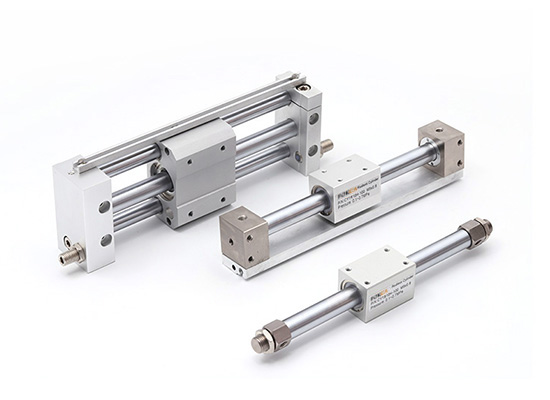
In addition, because the cylinder body is fully sealed and has no external moving parts, it effectively prevents dust ingress and lubricant leakage at the source.
Fokca rodless cylinders utilize magnetic coupling technology, where internal and external permanent magnets transmit force through a non-magnetic cylinder wall. The internal piston and external carriage are not mechanically connected in any way. The cylinder body is made of high-strength aluminum alloy or 304 stainless steel, combined with a precision sealing system to ensure long-term sealing performance and stability.
The core principle of a magnetic coupling rodless cylinder is the creation of a closed magnetic circuit. Force is transmitted through the non-magnetic cylinder wall via magnetic attraction, allowing the internal piston to drive the external carriage without any mechanical connection.
To achieve this, the cylinder tube must be made of a non-magnetic material, forming a completely sealed pressure chamber. Permanent neodymium magnets are embedded in both the internal piston and the external carriage, with their magnetic poles precisely aligned so that the two components are strongly coupled together.
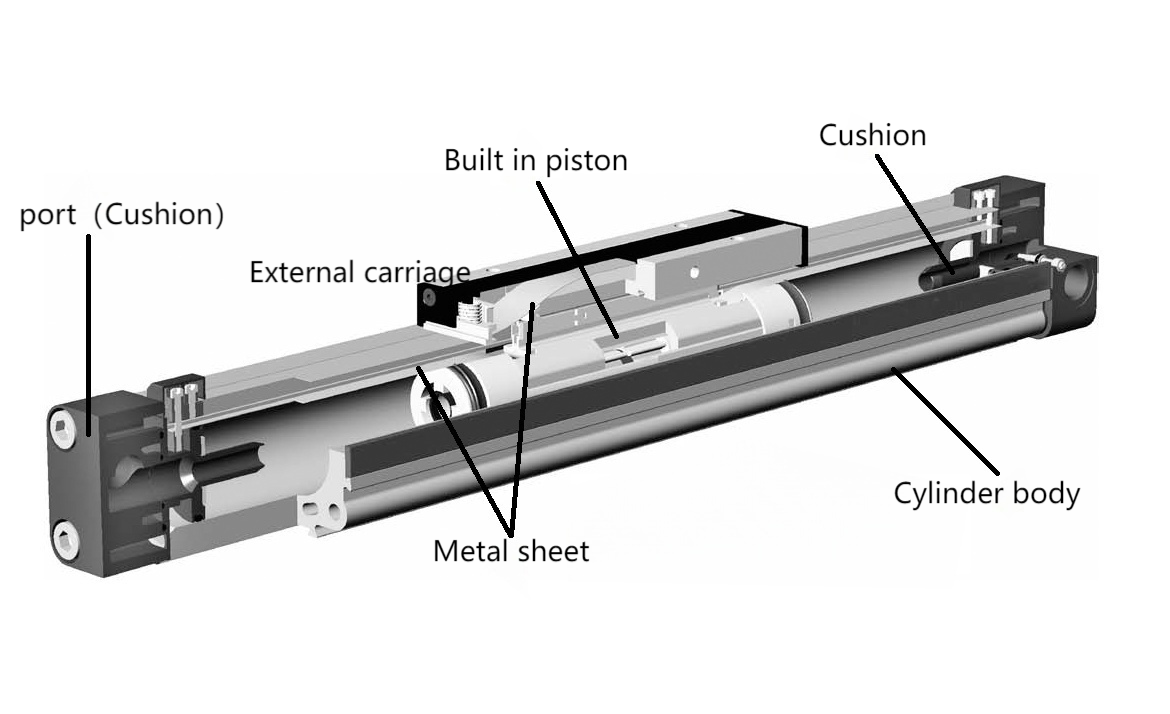
When compressed air is introduced into one side of the cylinder, pressure drives the internal piston to move. Due to the magnetic coupling, the external carriage follows in perfect synchronization, moving at the same speed and in the same direction. When the airflow is reversed, the piston moves in the opposite direction, and the carriage follows accordingly.
This design offers a significant advantage: a fully sealed air circuit with excellent leak resistance. Traditional cylinders require a dynamic seal on the piston rod, which inevitably introduces wear and potential contamination. In contrast, a magnetic rodless cylinder only uses static seals at the end caps, fundamentally eliminating air leakage and dust ingress issues.
Since magnetic coupling has a limited transmission force, proper sizing is essential. If the load exceeds the rated magnetic coupling force, decoupling may occur—meaning the piston continues moving internally while the external carriage stops. This is not a failure or damage. To recover, simply shut off the air supply and manually slide the carriage back to the same side as the piston, after which the magnetic coupling will re-engage.
Step 1: Determine whether a rodless cylinder is needed
· Limited installation space and long stroke → rodless cylinder is ideal
· Clean environments requiring dust-free operation → fully sealed structure is advantageous
· Long stroke with medium/low load → better cost-effectiveness
Step 2: Select bore size
Calculate the required thrust based on load weight, operating pressure, and mounting conditions. Note that the actual output force of a magnetic rodless cylinder is limited by magnetic coupling force rather than theoretical pneumatic force.
For horizontal applications, the load should generally not exceed 70% of the magnetic coupling force. For vertical applications, it should not exceed 30–50%, with an adequate safety margin reserved.
Step 3: Determine stroke length
Select based on actual travel distance. It is recommended to leave a 10–20 mm margin at both ends of the stroke. For ultra-long strokes (>1500 mm), intermediate supports are recommended to prevent cylinder deflection due to its own weight.
Step 4: Determine whether external guidance is required
The carriage of a rodless cylinder is sensitive to side loads and torque. If the load is off-center or generates lateral force, an external linear guide must be used. A floating connection between the carriage and the load is recommended to avoid rigid mounting that may cause sticking or decoupling.
Step 5: Confirm cushioning method
For high-speed or heavy-load applications, external hydraulic shock absorbers are recommended to absorb end-of-stroke impact, prevent magnetic decoupling, and reduce noise.
Step 6: Check special requirements
For high-temperature sealing, special mounting interfaces, explosion-proof requirements, or other customized needs, please consult technical support.
1. The mounting surface must be flat, with a flatness tolerance of ≤ 0.1 mm/m. Otherwise, cylinder deformation and piston sticking may occur.
2. When mounted directly on a steel base, magnetic flux may be partially diverted into the steel, reducing coupling strength. It is recommended to use a 10–20 mm aluminum or stainless steel spacer plate for isolation.
3. The load must be connected to the carriage via a floating joint to compensate for installation tolerances and avoid rigid connection that could cause decoupling.
4. Compressed air must be properly filtered (recommended 5 μm filtration) to remove moisture and impurities. Magnetic rodless cylinders have compact sealing structures and require clean air supply.
5. Installation should be kept away from strong magnetic fields (e.g., electromagnets, large motors) to avoid interference with magnetic coupling performance.
6. Before pressurizing, manually move the carriage to ensure smooth motion and no sticking. The initial operation should be at low speed and low pressure, gradually increasing after confirming normal performance.
7. In case of magnetic decoupling, immediately shut off the air supply and manually return the carriage to the piston-side end position; the magnetic coupling will re-engage automatically.

Get a free sample

Links: www.fescolo.com(Pneumatic)
FOKCA ©1998-2025 All Rights Reserved Sitemap