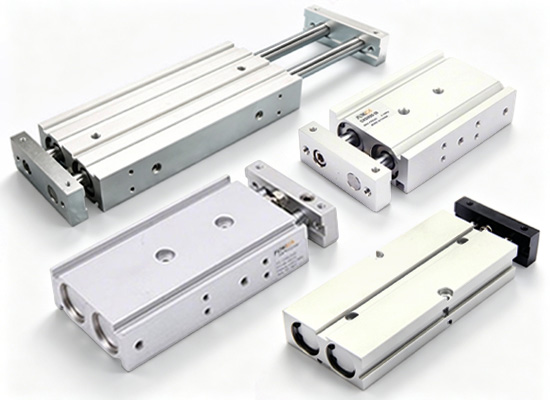
Double thrust, anti-rotation, smooth motion — dual rod cylinders use two parallel piston rods to form a natural lever arm against rotation. They deliver double the thrust of single rod cylinders for the same bore size, with anti-rotation accuracy of ±0.06°–0.1°, eliminating twisting caused by eccentric loads.
Fokca dual rod cylinders are ideal for precision gripping, pick-and-place, and anti-rotation positioning. Unlike guided cylinders, they focus on preventing rod rotation rather than side loads, making them the top choice for high-precision angle alignment and greater thrust applications.
In pneumatic systems, single rod cylinders are simple and widely used, but their round piston rods offer almost no inherent resistance to rotation. When loads are eccentric or external forces act off-axis, single rod cylinders are prone to twisting and wobbling, leading to reduced positioning accuracy, accelerated seal wear, and even equipment damage. Dual rod cylinders are specifically designed to solve these problems.
A dual rod cylinder uses two parallel piston rods that drive simultaneously, transmitting force through both rods to create a natural lever arm structure that resists rotation and side loads. This makes it an ideal choice for precision positioning, anti-rotation applications, and radial load-bearing tasks.
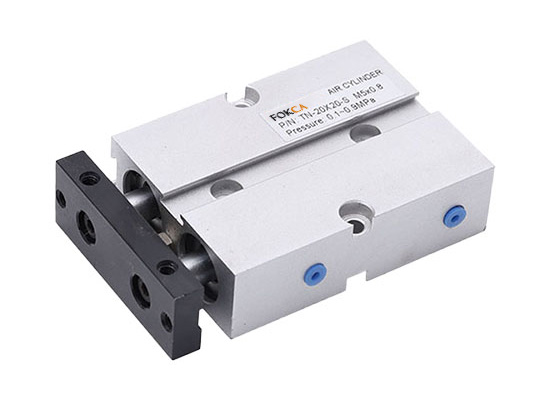
Unlike guided cylinders, dual rod cylinders have two air chambers. This allows them to deliver twice the thrust of a standard cylinder of the same bore size, with the thrust evenly distributed.
| Aspect | Dual Rod Cylinder | Guided Cylinder |
|---|---|---|
| Core Function | Anti-rotation, torque resistance | Side load resistance, guided support |
| Structural Feature | Two parallel piston rods extending together, forming a lever arm | Guide rods added to the cylinder body |
| Torque Resistance Principle | Lever arm formed by dual rods resists rotation | Guide rods bear side loads |
| Radial Load Capacity | Moderate | High |
| Output Thrust | Double (for same bore size) | Single |
| Application Focus | Applications requiring piston rod anti-rotation or high thrust | Applications requiring large side loads or cantilevered loads |
| Typical Use | Precision gripping, pick-and-place, anti-rotation positioning | Slide table handling, cantilever structures, eccentric loads |
1. Ensure the movement direction of both piston rods aligns with the load direction to avoid concentrating side forces on a single rod.
2. When using a dual-cylinder parallel design, ensure both cylinders receive air synchronously to prevent binding caused by out-of-sync operation.
3. Compressed air must be filtered to remove moisture and contaminants.
4. If large side loads are expected, use linear guide rails in conjunction with the cylinder.
5. Regularly check piston rod surfaces for scratches, seals for air leaks, and mounting screws for looseness.
Q1: What is the anti-rotation accuracy of a dual rod cylinder?
A1: The anti-rotation accuracy of mainstream dual rod cylinders can reach ±0.06° to ±0.1°, far superior to single rod cylinders, making them suitable for precision positioning and angle-critical applications.
Q2: How do I choose between a dual rod cylinder and a guided cylinder?
A2: The choice depends on your primary need – if you need to prevent piston rod rotation and ensure angular alignment, choose a dual rod cylinder. If you need to handle large side loads or cantilevered loads, choose a guided cylinder. If both are required, a guided dual rod cylinder is available.
Q3: Are dual rod cylinders suitable for high-speed applications?
A3: Yes. For example, the CX2 series can achieve maximum piston speeds of up to 800mm/s. However, for high-speed applications, pay attention to cushioning adjustment and load matching to avoid impact damage.

Get a free sample

Links: www.fescolo.com(Pneumatic)
FOKCA ©1998-2025 All Rights Reserved Sitemap