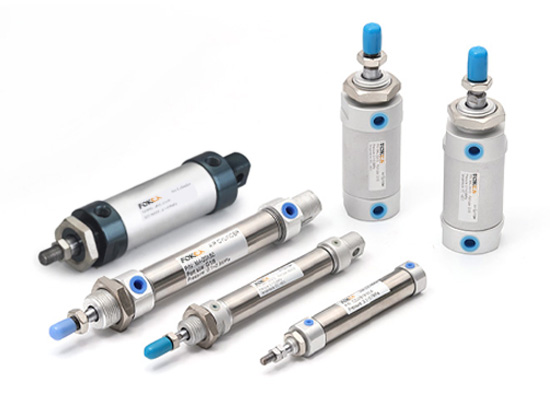
The core features of a mini cylinder can be summarized by three "smalls": small bore, small size, and small output force. Unlike standard cylinders, it is specifically designed for space-constrained, light-load applications such as electronics assembly, micro automation, and medical devices.
Fokca mini cylinders are available in three series: MA (stainless steel barrel), MAL (aluminum alloy body), and DSN (ISO 6432 standard). Double-acting and single-acting options are available, with bore sizes ranging from 8mm to 40mm and strokes from 5mm to 500mm. They support magnetic piston position detection and various mounting styles.
A mini pneumatic cylinder is a compact actuator with a small bore, designed specifically for applications with limited space and light loads. Its defining characteristics can be summarized by three “smalls”: small bore, small size, and small output force. It is an ideal power source for miniature automation equipment and precision instruments.
The name “mini cylinder” comes from its compact form. It is also known as a micro cylinder or small-bore cylinder. Unlike compact cylinders that reduce vertical space by flattening their structure, mini cylinders are proportionally reduced in all dimensions. With a slim, cylindrical design, they can be easily installed in narrow spaces or among densely packed components.
Despite their small size, mini cylinders are not simplified in structure or function. Fokca mini cylinders are available in three main series:
· MA (stainless steel tube)
· MAL (aluminum alloy tube)
· DSN (ISO 6432 standard)
They offer full functionality, including double-acting or single-acting options, magnetic piston position sensing, and multiple mounting configurations, meeting the control requirements of precision automation systems.
| Comparison Aspect | Mini Cylinder | Compact Cylinder | Standard Cylinder |
|---|---|---|---|
| Shape | Slim cylindrical | Flat, square | Round or square |
| Installation Space | Small in all dimensions | Small vertical space, larger horizontal footprint | Larger overall space required |
| Bore Range | Typically 8–40 mm | Typically 12–100 mm | Typically 32–250 mm |
| Stroke Range | Typically 5–200 mm | Typically 5–100 mm | Typically 25–2000 mm |
| Weight | Very light | Light | Heavy |
| Mounting Methods | Standard accessories (clevis, foot, flange, etc.) | Multi-directional mounting via through-holes or threaded holes | Dedicated accessories (flange, foot, trunnion, etc.) |
| Output Force | Low | Medium | High |
| Cost | Low | Medium | Medium |
| Typical Applications | Miniature devices, precision applications, electronics assembly | Compact equipment, low-profile structures, limited vertical space | General industrial use, long stroke, heavy loads |
Step 1: Determine the operating mode
Choose double-acting if bidirectional force is required; choose single-acting (spring return) for one-directional force and simpler control.
Step 2: Calculate the required bore size
Determine the required thrust based on load and working pressure. Mini cylinders are suitable for light loads (typically within a few kilograms). For higher force requirements, consider compact or standard cylinders.
Step 3: Define the stroke length
Select based on the actual travel distance. Standard strokes for mini cylinders are typically up to 80 mm.
Step 4: Select the cylinder series
Choose based on material, cost, and standard compatibility:
· Humid or corrosive environments → MA series (stainless steel tube)
· Lightweight and cost-sensitive applications → MAL series (aluminum alloy)
· Need for international standard interchangeability → DSN series (ISO 6432)
Step 5: Choose the mounting method
Select appropriate mounting accessories such as trunnion, foot, or flange, depending on the equipment structure.
Step 6: Confirm position sensing requirements
If PLC feedback is needed, select a cylinder with a magnetic piston and use it with magnetic switches.
Step 7: Check for special requirements
For conditions such as dust resistance or high temperature, consult technical support for customized solutions.
1. Ensure the piston rod movement direction aligns with the load direction to avoid side loads that may cause wear or seal damage.
2. When using mounting accessories, apply appropriate tightening torque to prevent cylinder deformation.
3. Use filtered compressed air to remove moisture and contaminants; installing an air preparation unit (FRL) upstream is recommended.
4. Mini cylinders typically use rubber cushioning or have no cushioning, so their shock absorption is limited. For high-speed or heavy-load applications, external shock absorbers are recommended.
5. For position sensing, fix the magnetic switch with a dedicated mounting band, adjust it until the indicator lights up at the desired position, and then tighten it securely.
6. Perform regular inspections: check for scratches on the piston rod, air leakage in seals, and loosened mounting screws; replace worn parts promptly.
7. MA series (stainless steel) is suitable for humid and corrosive environments; MAL series (aluminum alloy) should be protected from strong acids and alkalis.

Get a free sample

Links: www.fescolo.com(Pneumatic)
FOKCA ©1998-2025 All Rights Reserved Sitemap