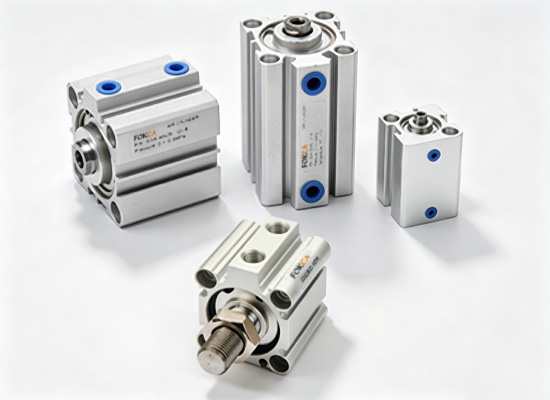
A compact cylinder retains the basic functions of a standard cylinder while significantly reducing its axial length, allowing it to be installed in space-constrained equipment — this is its fundamental difference from a standard cylinder. The cylinder body typically features multiple through-holes around its perimeter, enabling direct bolt fixing without the need for additional mounting accessories.
A compact cylinder is a pneumatic actuator whose overall height is significantly lower than that of a standard cylinder. Through a flattened design, it reduces installation height to one-third or one-half that of a standard cylinder while maintaining sufficient bore size and thrust, making it an ideal choice for space-constrained applications.
The name "compact cylinder" comes from its flat profile. It is also referred to as a thin cylinder, flat cylinder, or low-profile cylinder. It is not a single model from one manufacturer, but rather a general term for a range of compact cylinders that comply with ISO 21287 standards or individual manufacturer standards.
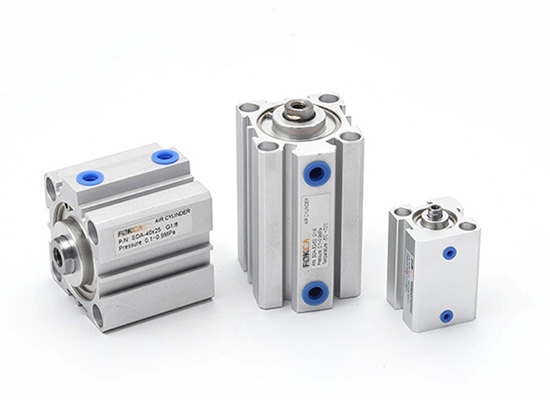
Fokca's compact cylinders cover major models including the AirTac SDA series, SMC CQ2 series, and Festo ADN series. Bore sizes range from 12mm to 100mm, and strokes from 5mm to 100mm. Magnetic rings and various mounting accessories are available. They are suitable for applications with strict height requirements, such as electronics assembly, precision equipment, packaging machinery, and medical devices.
| Aspect | Compact Cylinder | Mini Cylinder | Standard Cylinder |
|---|---|---|---|
| Shape | Flat, square | Slender cylindrical | Round or square |
| Installation Space | Requires small vertical space, larger horizontal space | Small in all dimensions | Requires large space in all dimensions |
| Bore Range | 12–100 mm | 8–40 mm | 32–250 mm |
| Stroke Range | Typically 5–100 mm | Typically 5–500 mm | Typically 25–2000 mm |
| Weight | Light | Extremely light | Heavy |
| Mounting Style | Through-hole / threaded hole, multi-directional | Trunnion, foot, flange, etc. | Flange, foot, trunnion, etc. |
| Output Force | Medium | Small | Large |
| Cost | Medium | Low | Medium |
| Applications | Compact equipment, thin structures, vertical space constraints | Micro equipment, precision applications, electronics assembly | General industry, long stroke, heavy-duty applications |
Step 1: Determine installation space
Measure the vertical installation height of your equipment to confirm that a compact cylinder will fit. Also consider the extended piston rod length within the stroke range to avoid interference with other components.
Step 2: Calculate required bore size
Calculate the required thrust based on load weight and working pressure, then determine the bore size using the cylinder's theoretical thrust chart. Compact cylinders are suitable for light to medium load applications. For high thrust requirements, choose a standard cylinder.
Step 3: Determine stroke
Choose based on actual travel distance. Standard strokes for compact cylinders typically do not exceed 100mm. For longer strokes, a standard cylinder is recommended.
Step 4: Select cylinder series
Consider cost, brand compatibility, and accessory availability. SDA offers high cost-performance, CQ2 has rich accessory options, and ADN complies with international standards.
Step 5: Select mounting style
Choose through-hole mounting or threaded end mounting based on equipment structure. The ability to mount in multiple directions is a key advantage of compact cylinders and should be fully utilized.
Step 6: Determine if position detection is needed
If the PLC requires position feedback, select a cylinder with a magnetic ring and a compatible magnetic switch. The magnetic switch mounting groove on compact cylinders is typically located on the side of the body for easy installation.
Step 7: Confirm special requirements
For dustproof, high-temperature resistance, or other special needs, contact technical support for confirmation.
1. Compact cylinders can be mounted in multiple directions, but ensure the direction of piston rod movement aligns with the load direction to avoid side loads.
2. When securing the cylinder using through-holes or threaded end holes, apply moderate tightening torque. Overtightening may deform the cylinder body.
3. Compact cylinders have compact seals and require clean compressed air. The air supplied to the cylinder must be filtered to remove moisture and contaminants. It is recommended to install an FRL unit (filter-regulator-lubricator) upstream for proper air preparation.
4. Compact cylinders typically use rubber cushioning, which has limited impact absorption capacity. For high-speed or heavy-load applications, consider adding an external shock absorber.
5. Insert the magnetic switch into the T-slot or C-slot on the side of the cylinder body. Adjust its position until the indicator lights up when the piston reaches the end of stroke, then tighten the securing screw.
6. Regularly inspect the piston rod surface for scratches, check for air leaks around seals, and verify that mounting screws are tight. Replace worn components promptly.

Get a free sample

Links: www.fescolo.com(Pneumatic)
FOKCA ©1998-2025 All Rights Reserved Sitemap