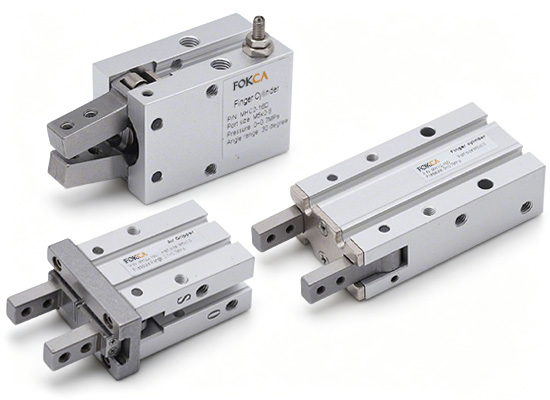
Pneumatic grippers are end effectors that directly pick workpieces on automated production lines. Driven by compressed air to open and close, they perform picking, assembly, and loading/unloading. Rather than long-stroke pushing and pulling, they focus on smooth gripping, precise positioning, and steady motion — the indispensable "hand" of automation equipment.
Fokca offers MHZ, MHY, MHC, and HFY series, with parallel and angular gripper types available. Repeatability ±0.01mm, bore sizes 6-32mm, gripping force from a few newtons to hundreds of newtons. Built-in magnetic ring enables position feedback with magnetic switches. Ideal for precision assembly, pick-and-place, and injection molding part removal.
A pneumatic gripper, also known as an air gripper or pneumatic finger, is a pneumatic actuator that uses compressed air to open and close its fingers for gripping, holding, and handling workpieces. It is one of the most common types of end effectors in automation equipment, acting as the “hand” of a robot that directly contacts the workpiece.
Unlike the linear motion of a cylinder, a pneumatic gripper converts the pressure energy of compressed air into radial opening and closing motion of the jaws to grip and release objects. It is typically mounted on robotic arms, linear modules, or pneumatic slides to perform picking, placing, assembling, loading, and unloading operations.
Fokca pneumatic grippers cover multiple series from two leading brands, SMC and AirTac. Both parallel and angular gripper types are available, with two-finger configurations. Bore sizes range from 6mm to 32mm, with gripping force from a few newtons to several hundred newtons. They are widely used in electronics manufacturing, automotive parts assembly, injection molding robots, packaging automation, and other fields.
Based on the jaw opening and closing method, pneumatic grippers are mainly divided into two categories: parallel grippers and angular grippers.
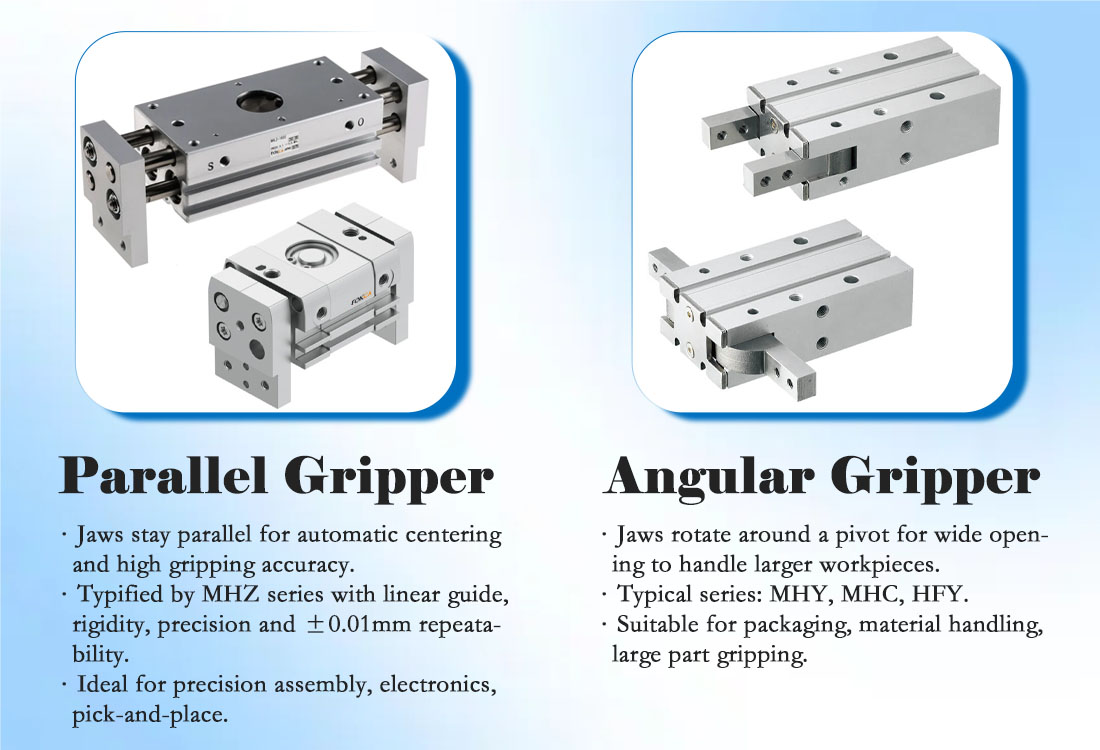
Parallel Gripper – The jaws remain parallel during opening and closing, providing automatic centering and high gripping accuracy. The MHZ series is a typical example, featuring a linear guide structure with high rigidity and precision, achieving repeatability of ±0.01mm. Suitable for precision assembly, electronics manufacturing, pick-and-place, and other applications requiring high positioning accuracy.
Angular Gripper – The jaws rotate around a pivot point, offering a wide opening suitable for gripping larger workpieces. Typical series include the MHY series, MHC series, and AirTac HFY series. Suitable for packaging, material handling, and large workpiece gripping applications.
Step 1: Determine the gripper type
High precision, automatic centering, small workpiece gripping → Choose Parallel Gripper
Large opening, large workpiece gripping → Choose Angular Gripper
Step 2: Calculate the required gripping force
Calculate the required gripping force based on workpiece weight, gripping method, and friction coefficient. A safety factor of 2 to 4 is recommended during selection.
Step 3: Determine the bore size
Select the appropriate bore size based on the required gripping force using the product specification table. Larger bore sizes provide greater gripping force but also increase size and weight.
Step 4: Select the actuation method
Double-acting: Air pressure drives both opening and closing. Suitable for applications requiring active opening and closing.
Single-acting: Air pressure drives one direction, with a spring for return. Suitable for simple control and energy-saving applications.
Step 5: Determine if a magnetic switch is needed
If the PLC requires position feedback on jaw opening/closing, select a model with a magnetic ring and use a compatible magnetic switch.
1. Ensure the gripper center aligns with the workpiece center during installation to avoid eccentricity that could cause unstable gripping or finger damage.
2. Compressed air must be filtered to remove moisture and contaminants. It is recommended to install an FRL unit upstream.
3. The cylinder portion does not require lubrication, but the sliding parts of the jaws need periodic application of grease to ensure smooth operation and extend service life.
4. Some models come with built-in variable flow control valves to adjust jaw opening/closing speed and avoid impact.
5. Design appropriate finger attachments based on workpiece shape and size to ensure stable gripping without damaging the workpiece.
6. Regularly inspect the jaw sliding parts for wear, check for loose screws, and verify normal gripping force. Perform maintenance in a timely manner.

Get a free sample

Links: www.fescolo.com(Pneumatic)
FOKCA ©1998-2025 All Rights Reserved Sitemap