Jan 22, 2026
In flat sealing systems, the choice between an ED seal and a traditional O-ring often looks simple on paper. Both are widely used, both are elastomer-based, and both appear in pneumatic and hydraulic connections every day. Yet in real applications—especially in threaded ports and flat-face connections—the sealing behavior, reliability, and long-term stability can differ significantly. Understanding these differences helps distributors, engineers, and buyers make decisions that balance performance, cost, and risk.
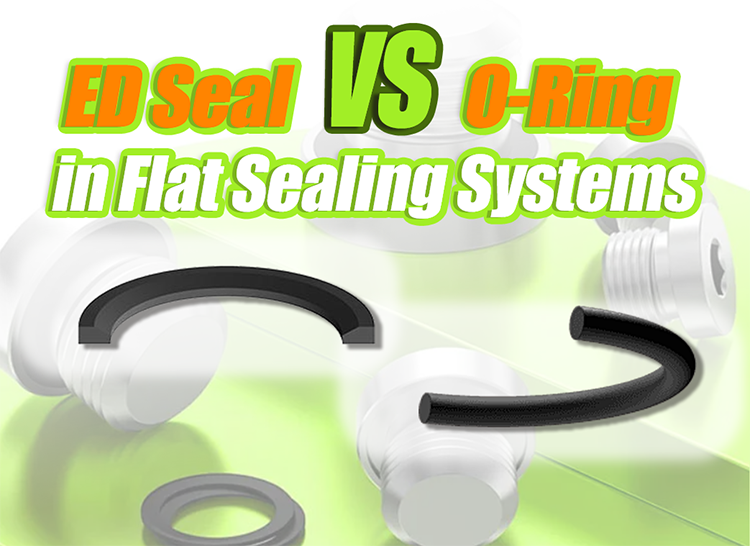
Unlike radial sealing, flat sealing relies entirely on axial compression between two surfaces. Any variation in surface finish, tightening torque, or component alignment directly affects sealing quality. In these conditions, the geometry of the seal becomes just as important as the material itself. This is where the structural difference between an O-ring seal and an ED seal starts to matter.
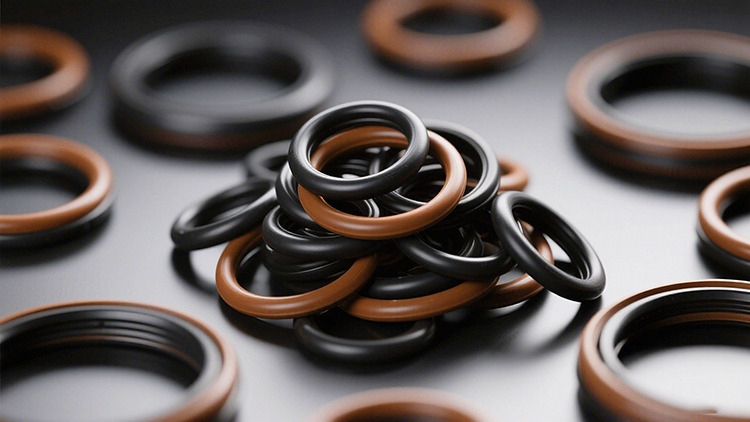
The Rubber O-ring remains one of the most widely used sealing elements in the industry. Its circular cross-section allows it to function in both radial and axial sealing designs, making it extremely versatile. Materials such as NBR (Nitrile Rubber) offer good resistance to oil, compressed air, and moderate temperatures, which explains why O-rings dominate general-purpose pneumatic fittings.
From a procurement and inventory standpoint, O-rings are attractive because they are:
◆Easy to source globally
◆Available in countless sizes and materials
◆Economical for high-volume applications
However, in flat sealing systems, an O-ring relies heavily on correct groove design and controlled compression. Without precise machining, the O-ring may roll, extrude, or compress unevenly, especially under repeated assembly.
An ED seal combines an elastomer sealing element with a rigid metal support ring, typically steel. This hybrid structure fundamentally changes how the seal behaves under load. Instead of relying solely on rubber deformation, the metal ring limits axial compression and stabilizes the sealing geometry.
In flat sealing systems, this results in:
◆More predictable compression
◆Reduced risk of over-tightening damage
◆Improved resistance to vibration and pressure fluctuation
Compared to an O-ring steel-supported design, ED seals are inherently more forgiving in real-world assembly conditions, where torque control is not always perfect.
In practical applications, ED seals tend to outperform O-rings in several critical areas. The metal support ring ensures that sealing force is evenly distributed across the contact surface, reducing localized stress. This leads to more consistent sealing pressure, even after multiple tightening cycles.
ED seals also perform better when:
◆Surface flatness is less than ideal
◆The connection is frequently assembled and disassembled
◆The system experiences vibration or pressure spikes
For equipment engineers, this means fewer leak-related adjustments during commissioning and more stable performance over the equipment’s service life.
Despite the advantages of ED seals, O-ring seals are far from obsolete. In many flat sealing applications with controlled machining quality and moderate operating conditions, a properly selected O-ring delivers reliable performance at a lower cost.
O-rings are particularly suitable when:
◆The sealing surface is well-machined
◆Assembly torque is consistent
◆Cost sensitivity is high
◆Replacement frequency is low
For distributors and maintenance teams, the simplicity and availability of O-rings often outweigh the performance benefits of more complex sealing solutions.
| Feature | ED Seal | O-Ring Seal |
|---|---|---|
| Sealing structure | Elastomer + metal support | Elastomer only |
| Compression control | Highly stable | Operator-dependent |
| Resistance to over-tightening | Excellent | Limited |
| Vibration resistance | High | Medium |
| Cost level | Medium | Low |
| Application flexibility | Flat sealing only | Very broad |
This comparison highlights a common pattern: ED seals offer higher reliability, while O-rings offer greater versatility and economy.
In real factories, not every connection needs the highest possible sealing performance. A more practical approach is to match the seal type to the risk level of the connection. Critical joints, pressure ports, and hard-to-access locations benefit from ED seals. Non-critical or frequently replaced connections remain ideal candidates for O-rings made from NBR or similar materials.
This balanced strategy helps control costs without compromising system reliability.
For procurement managers and distributors, the question is rarely “which seal is better” but rather which seal is more appropriate. ED seals reduce warranty risk and service calls in demanding applications, while O-rings simplify inventory management and keep unit costs low.
Suppliers that can offer both ED seals and O-ring seals, along with material guidance and dimensional support, give customers more than products—they provide decision confidence.
In flat sealing systems, ED seals deliver superior connection stability, while O-rings remain the most economical and universal solution. Choosing correctly is less about preference and more about understanding how geometry, compression, and real-world assembly interact over time.
(FK9026)
You May Interest In
Dec 09, 2025 Blog
Working Principle of Check Valves
Get a free sample

Fokca is a brand of Ningbo Fokca Automation Co., Ltd.
Looking for custom pneumatic cylinder solutions? Visit our sister brand, Fescolo.→
© 2026 Ningbo Fokca Automation Co., Ltd. All rights reserved. Sitemap