Sep 24, 2025
In industrial piping systems, dimensions become “standards” not because someone declares them so, but because they repeatedly solve real problems. 3/4 hose and connectors earned their reputation through decades of practical use in compressed air, water circulation, and medium-pressure transfer systems. Engineers choose them because they sit at a critical balance point—large enough to deliver stable flow, yet compact enough to install efficiently.
When pipe diameter is undersized, pressure drop increases rapidly with distance. In a production line where compressors are positioned far from end-use equipment, a 1/2-inch line may cause noticeable pressure instability during peak demand. Moving to 1 inch reduces restriction, but installation becomes heavier, more rigid, and more expensive.
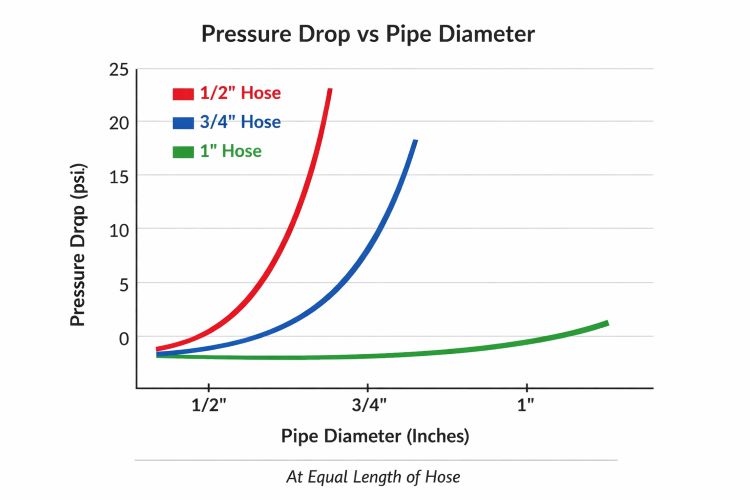
The 3/4-inch internal diameter often represents the optimal middle ground. It supports medium-to-high airflow rates while maintaining manageable weight and bend radius. In mid-scale pneumatic networks, this size frequently prevents pressure fluctuation without forcing a complete infrastructure upgrade.
International equipment manufacturers rarely design exclusively for one thread system. North America primarily uses NPT, while Europe and parts of Asia rely on BSP standards. Despite differences in thread angle and sealing method, the nominal 3/4 dimension remains consistent.
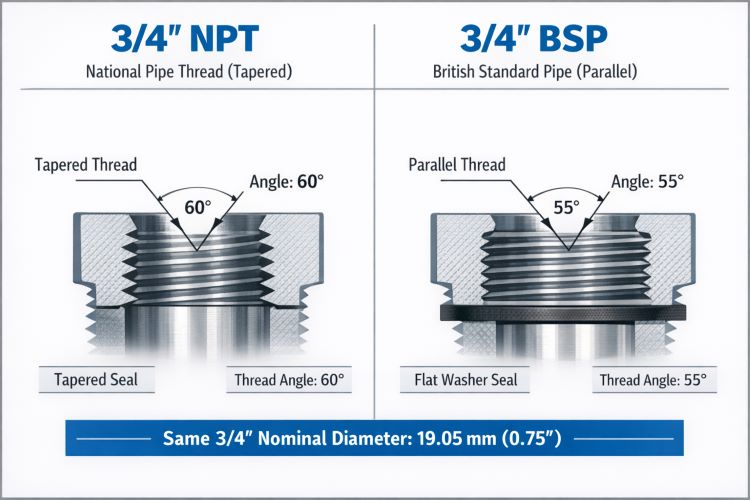
This shared nominal sizing allows OEMs to keep the same piping architecture while adjusting thread forms per destination market. The result is reduced redesign cost and faster export adaptation. A dimension that works across thread systems naturally gains international recognition.
Standardization is reinforced by availability. Distributors worldwide consistently stock 3/4 fittings because demand remains stable across industries. Products such as Pneumatic Quick Couplings and Pipe Fittings And Connectors almost always include 3/4 models as core catalog items.
This widespread production scale stabilizes pricing and shortens procurement lead time. For maintenance departments managing hundreds of connection points, reducing size variation simplifies spare parts planning and lowers downtime risk.
Beyond flow, mechanical reliability matters. A 3/4 threaded connection provides sufficient engagement length for stable sealing under typical 6–12 bar compressed air pressure. Smaller diameters may be more sensitive to vibration loosening, especially in mobile or high-frequency equipment environments.
Larger fittings offer higher structural margin, but they increase torque requirements and material cost. In practice, 3/4 connectors deliver reliable sealing performance without unnecessary structural overdesign. That balance contributes to their long-term preference in factories and construction sites.
In compressed air networks, main distribution lines frequently adopt 3/4 diameter before branching into smaller lines. When connected to an Air Source Treatment Unit, this dimension maintains stable upstream pressure and prevents starvation during simultaneous equipment operation.
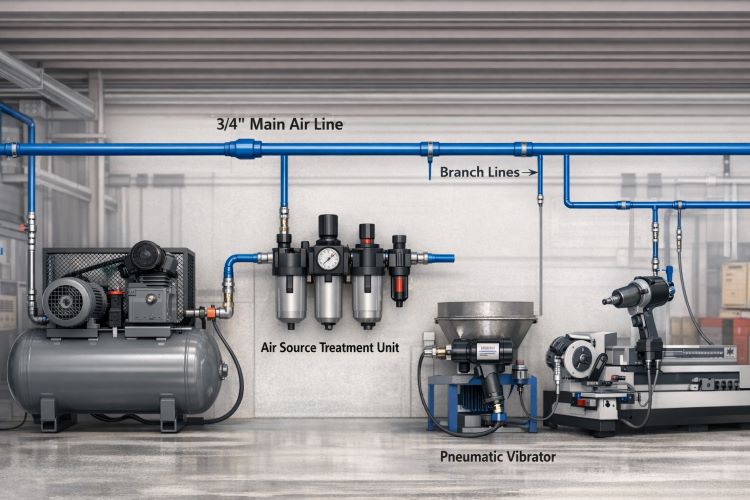
Systems using air-driven devices such as Pneumatic Vibrator or high-consumption tools benefit from consistent volume supply. An undersized main line can cause oscillating output and unpredictable equipment behavior. The 3/4 configuration often mitigates that risk in medium-capacity installations.
Initial fitting cost rarely determines long-term efficiency. If a pipe diameter is too small, compressors work harder to compensate for pressure loss, increasing energy consumption over time. If it is too large, capital and installation costs rise without proportional benefit.
The 3/4 range frequently falls near the optimal point in lifecycle cost calculations. It offers sufficient volumetric capacity while maintaining moderate material consumption. For many industrial systems, it becomes the economically rational compromise rather than a purely conventional choice.
True industrial standards often emerge from repetition. When a dimension consistently delivers predictable performance, integrates easily with global supply chains, and balances mechanical and economic factors, it becomes a reference point.
That is why 3/4 hose and connectors are widely regarded as an international fitting standard. Their position is built on engineering logic, field reliability, and cross-border compatibility—not on marketing terminology, but on sustained industrial validation.
(FK9027)
 Pilot Pressure vs Working Pressure in Industrial Valves: Key Differences and Selection Guide
 Water Hammer Explained: Why Angle Seat Valves Are the Optimal Solution
 Valve Flow Rate Comparison: An Analysis of Four Common Valve Types
 The Temperature Limit of Valves: How Seal Material Affects Valve Body Performance
 Valve Flow Coefficients CV & KV: Differences Analysis and Selection Guide
You May Interest In

Get a free sample

Fokca is a brand of Ningbo Fokca Automation Co., Ltd.
Looking for custom pneumatic cylinder solutions? Visit our sister brand, Fescolo.→
© 2026 Ningbo Fokca Automation Co., Ltd. All rights reserved. Sitemap