Aug 27, 2025
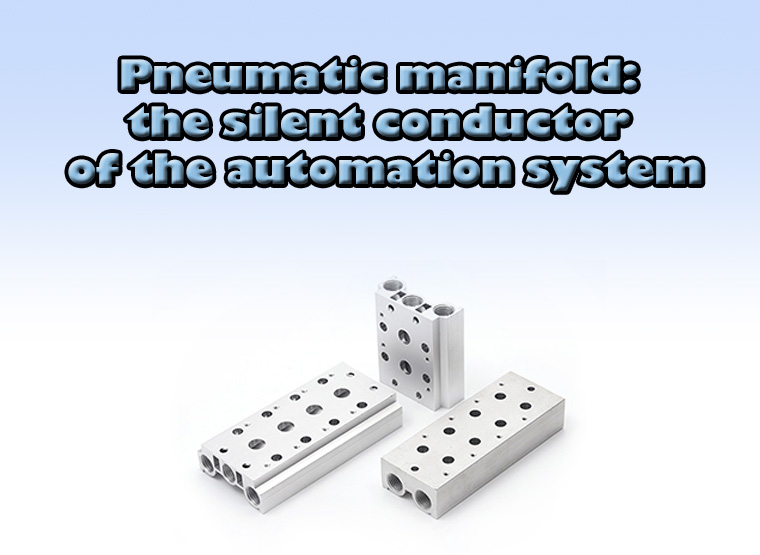
In a well-designed automation system, motion looks simple. Cylinders extend and retract, valves switch quietly, and compressed air seems to flow exactly where it is needed. What often goes unnoticed is the component coordinating this order behind the scenes. A pneumatic manifold does not create motion, nor does it consume energy directly, yet it determines how efficiently air and control signals are distributed across the system. When layout, response time, or maintenance becomes a problem, the root cause is frequently hidden in the manifold design rather than in the valves themselves.
As pneumatic systems scale up, point-to-point valve installation quickly becomes inefficient. Individual valves require separate air supplies, exhaust ports, electrical wiring, and mounting space. This approach works in small machines but becomes fragile in automated lines where dozens of actuators must operate in coordination. A pneumatic manifold centralizes these interfaces. By sharing supply and exhaust channels while keeping valve outputs independent, it reduces physical complexity without sacrificing control precision.
More importantly, manifolds change how engineers think about system architecture. Instead of designing air paths valve by valve, the manifold becomes a fixed distribution platform. Valves turn into modular control elements rather than structural components, which simplifies both initial design and later expansion.
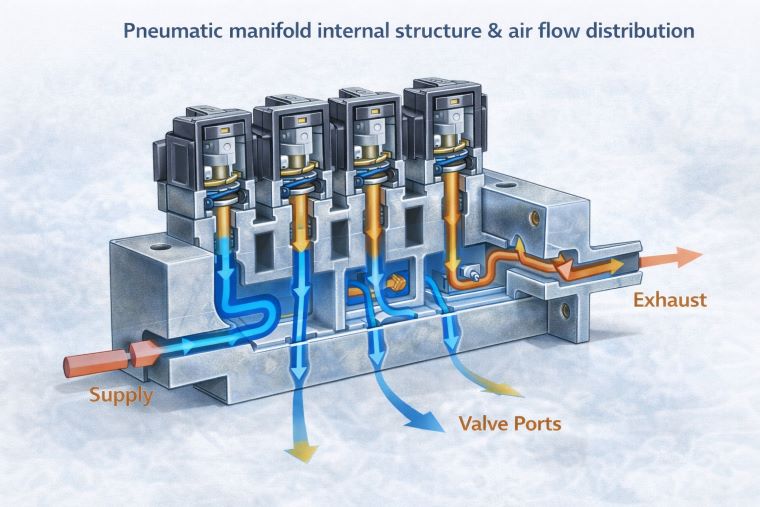
Inside a pneumatic manifold, air does not simply pass through drilled holes. The internal flow paths are designed to balance pressure stability, response speed, and space constraints. If passages are undersized or poorly arranged, pressure drop increases under load, leading to inconsistent actuator behavior. This is especially noticeable in applications where multiple cylinders operate simultaneously, such as pick-and-place systems or packaging machines.
A well-designed manifold provides a common supply channel with sufficient cross-section to maintain pressure even during peak demand. At the same time, individual valve ports remain isolated to prevent pressure fluctuations from propagating between actuators. This internal separation is one reason why manifolds improve repeatability compared to loosely connected standalone valves.
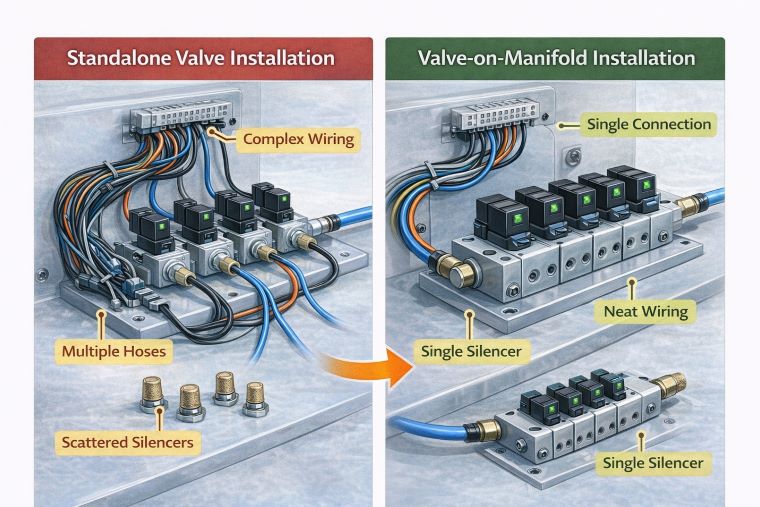
Exhaust management is often underestimated during system design. Without a manifold, each valve vents air independently, creating multiple noise sources and uneven back pressure conditions. A pneumatic manifold collects exhaust flows into shared channels, allowing exhaust to be managed deliberately rather than incidentally.
Centralized exhaust ports make it possible to install properly sized pneumatic silencers or route exhaust air away from sensitive areas. In clean manufacturing environments or enclosed machines, this reduces airborne contamination and acoustic fatigue. From a reliability perspective, fewer exhaust points also mean fewer components exposed to dust, oil mist, or mechanical impact.
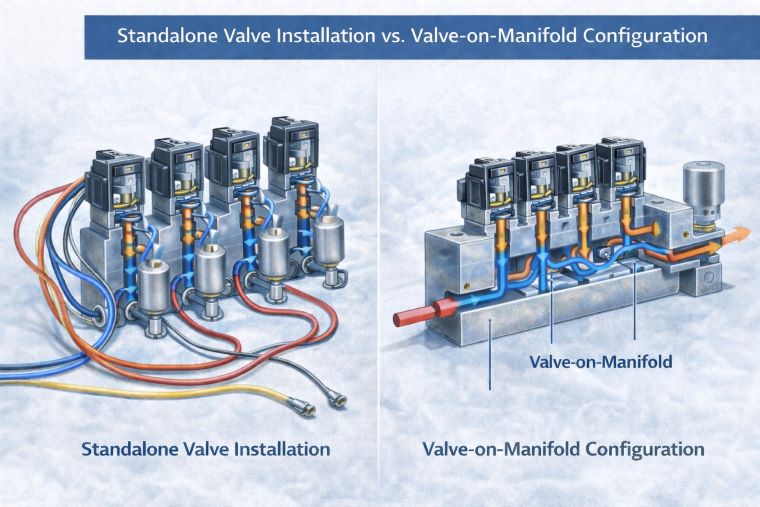
Modern pneumatic manifolds integrate electrical distribution alongside air channels. This integration goes beyond convenience. By using a common power bus and standardized signal interfaces, the manifold reduces wiring errors and shortens installation time. In systems controlled by PLCs or fieldbus networks, this architecture supports clean signal routing and easier diagnostics.
When a valve fails, technicians can isolate the issue quickly because electrical connections are standardized and localized. In contrast, dispersed wiring in traditional layouts often turns troubleshooting into a time-consuming tracing exercise. Over the life of a machine, this difference translates directly into reduced downtime.
Choosing a pneumatic manifold is not a purely dimensional decision. Operating pressure must match the system’s maximum requirements with an appropriate safety margin, but flow capacity is equally critical. Engineers should evaluate not only nominal port size but also internal channel design, especially for applications with high cycle frequency or simultaneous actuation.
Material selection plays a role in long-term stability. Aluminum manifolds are common due to their balance of strength, weight, and machinability. In corrosive or wash-down environments, stainless steel manifolds or engineered polymers may be more appropriate. Environmental factors such as vibration, temperature variation, and airborne contaminants should influence the choice as much as pressure specifications.
One of the most practical advantages of a modular pneumatic manifold is scalability. Multi-station designs allow unused positions to remain sealed until needed. When a machine is upgraded or a process changes, additional valves can be installed without redesigning the entire air circuit.
From a cost perspective, modular manifolds reduce both initial investment risk and long-term modification expenses. Instead of oversizing systems “just in case,” engineers can scale capacity incrementally while maintaining a clean and organized layout.
Despite their advantages, pneumatic manifolds can become bottlenecks if misapplied. One frequent issue is selecting a manifold based solely on valve compatibility while ignoring total airflow demand. Another is neglecting exhaust capacity, leading to increased back pressure during rapid cycling.
Poor labeling and unclear port identification also create problems during maintenance. In complex machines, technicians rely on visual clarity as much as schematics. A well-designed manifold should support intuitive maintenance, not require constant reference to documentation.
(FK9027)
 Pilot Pressure vs Working Pressure in Industrial Valves: Key Differences and Selection Guide
 Water Hammer Explained: Why Angle Seat Valves Are the Optimal Solution
 Valve Flow Rate Comparison: An Analysis of Four Common Valve Types
 The Temperature Limit of Valves: How Seal Material Affects Valve Body Performance
 Valve Flow Coefficients CV & KV: Differences Analysis and Selection Guide
You May Interest In
Sep 25, 2025 Blog
What is a 2-valve manifold?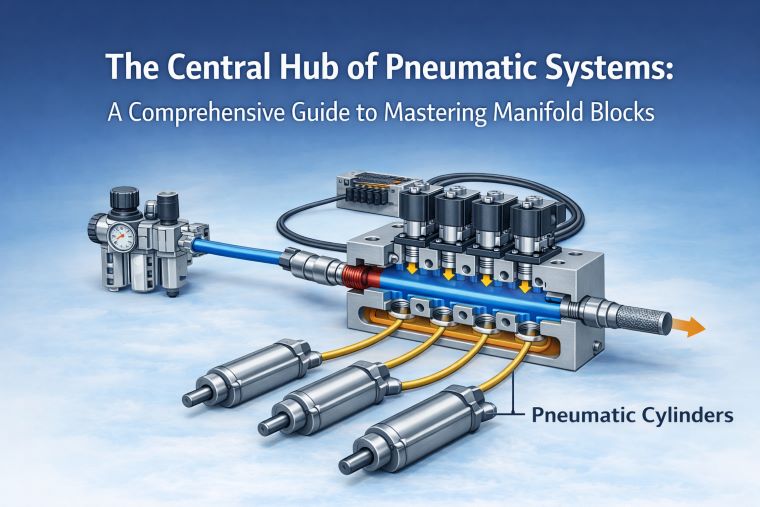
Get a free sample

Fokca is a brand of Ningbo Fokca Automation Co., Ltd.
Looking for custom pneumatic cylinder solutions? Visit our sister brand, Fescolo.→
© 2026 Ningbo Fokca Automation Co., Ltd. All rights reserved. Sitemap