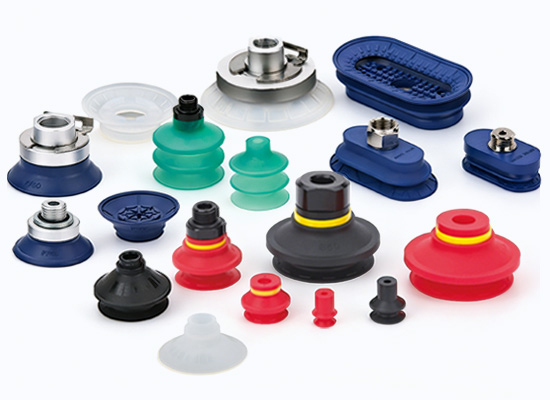
Fokca Vacuum suction cups are actuating components in pneumatic vacuum systems that directly contact workpieces. They achieve gripping, handling, and positioning through negative pressure, offering gentle handling, fast response, and no surface damage, making them widely used across industrial automation.
The essence of a vacuum suction cup lies in adsorption. Material, shape, and structure directly affect sealing — soft materials conform to irregular surfaces, while bellows compensate for height differences. Fokca offers bellows, flat, corrugated, and sponge series, plus NBR, silicone, conductive silicone, and FKM materials, meeting diverse needs from electronics to automotive sheet metal, normal to high temperatures, and general to anti-static/corrosive environments. Paired with vacuum generators and accessories, a complete reliable gripping system can be built.
A vacuum suction cup is an actuating component in pneumatic vacuum systems that directly contacts the workpiece. It uses negative pressure generated by a vacuum generator to adsorb, grip, transport, and position workpieces. Acting like a “gentle hand” for automated equipment, it performs various handling tasks without damaging the workpiece surface.
In automated production lines, vacuum suction cups are widely used in applications such as electronic component assembly, automotive parts handling, food packaging, and logistics sorting. Compared to mechanical grippers, vacuum suction cups offer distinct advantages: they do not damage workpiece surfaces, adapt to various materials, provide gentle gripping, and respond quickly.
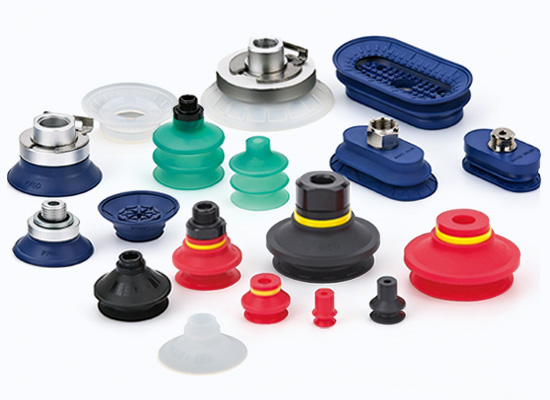
1. First, analyze workpiece characteristics to determine the surface condition, then choose the appropriate suction cup shape.
Fokca offers four series of suction cups – bellows, flat, corrugated, and sponge – to meet the full range of gripping needs, from precision electronic components to heavy workpieces, from smooth flat surfaces to rough curved ones, and from normal to high-temperature environments.
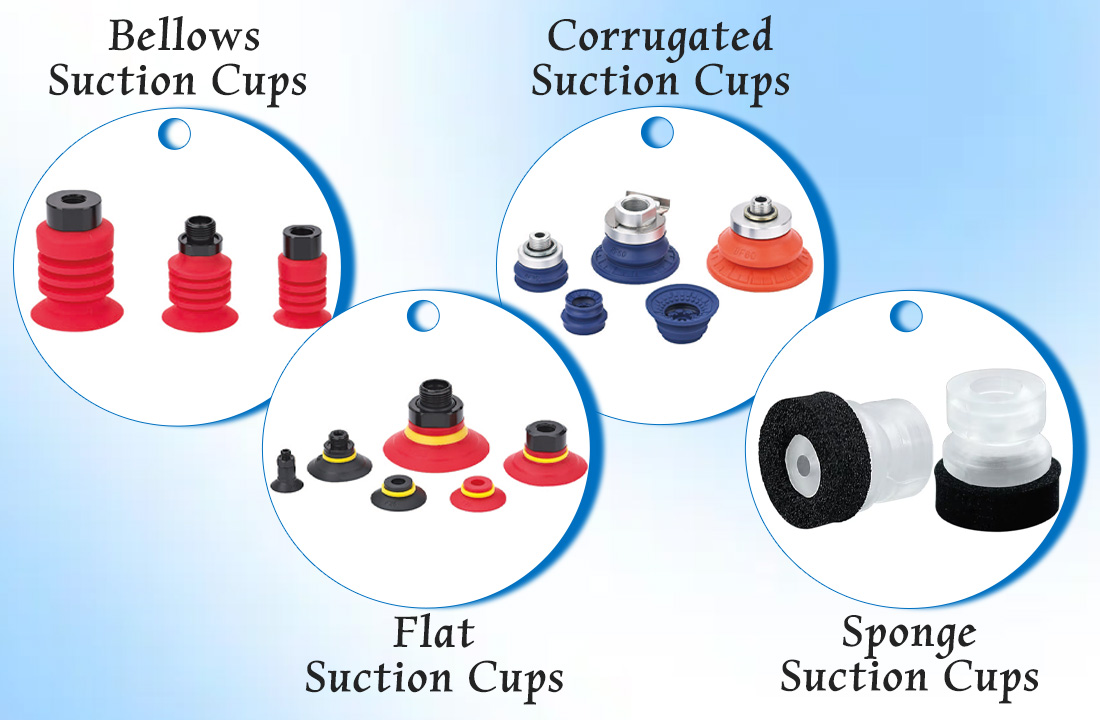
◆ Bellows Suction Cups – Feature a multi-layer bellows structure with excellent flexibility compensation. When the cup contacts the workpiece, the bellows compress to absorb height differences; when stretched, they adapt to angled or curved surfaces. Ideal for uneven surfaces, curved profiles, easily deformable parts, or applications requiring cushioning, such as automotive sheet metal, curved glass, and molded plastic parts.
◆ Flat Suction Cups – Have a thin lip and flat bottom for tight sealing on smooth surfaces. Vacuum builds quickly, enabling fast gripping and release. Suitable for flat, smooth, non-porous workpieces such as glass panels, steel plates, aluminum sheets, plastic sheets, and cardboard boxes.
◆ Corrugated Suction Cups – Deep profile for spherical or round workpieces such as fruit, balls, and cylinders. They provide better wrapping and stable gripping.
◆ Sponge Suction Cups – The working face is made of sponge material that conforms to the workpiece surface. Even with holes, gaps, or rough textures, they can form an effective seal. Suitable for porous or leaky workpieces such as cardboard packaging, wood products, stone, and uneven curved surfaces.
2. After selecting the cup shape, choose the appropriate material based on the operating environment. Refer to the table below for guidance.
| Material | Characteristics | Applications |
|---|---|---|
| Nitrile Rubber (NBR) | Oil-resistant, wear-resistant, heat-resistant, excellent overall performance | General industry, automotive manufacturing, oily environments |
| Silicone Rubber | High temperature resistance (-60°C to 250°C), soft, food-grade certified | High-temperature environments, food industry, medical equipment |
| Conductive Silicone | Electrically conductive (volume resistivity 5–15 Ω·cm), effectively prevents static buildup | Electronic component handling, semiconductor manufacturing, anti-static applications |
| Fluoro Rubber (FKM) | High temperature resistance (-10°C to 230°C), strong acid and alkali resistance, excellent chemical resistance | Chemical environments, high-temperature corrosive applications |
| Polyurethane (PU) | Wear-resistant, durable, high mechanical strength | High-wear applications, heavy-duty handling |
3. Calculate the required suction force based on workpiece weight to ensure the suction cup diameter provides sufficient holding power. The theoretical holding force of a single cup should be at least twice the calculated requirement.
4. Select appropriate vacuum accessories. If there are height differences or impact risks, choose a suction cup bracket with a spring buffer. When gripping leaky workpieces such as cardboard boxes or wood products, consider adding vacuum check valves to isolate failed cups and prevent vacuum loss.
Q1: How do I calculate the required suction cup diameter? How much weight can one cup hold?
A1: The theoretical holding force is calculated as: Holding Force = Vacuum Level × Effective Cup Area.
Example: With a vacuum level of -60 kPa (0.6 kgf/cm²) and a cup diameter of 20 mm (effective area ≈ 3.14 cm²), the theoretical holding force = 0.6 × 3.14 ≈ 1.88 kgf.
In practice, a safety factor must be applied. For a 1 kg workpiece, the theoretical holding force should be greater than 2 kgf for vertical gripping. Select a cup with sufficient diameter accordingly. Fokca offers a full range of suction cups with diameters from 2 mm to 150 mm to accommodate various workpiece weights and vacuum levels.
Q2: What should I do if the workpiece releases slowly after gripping?
A2: Slow release is usually caused by delayed vacuum break. Installing a vacuum release valve in the vacuum circuit allows rapid vacuum destruction and quick workpiece release.
Q3: How can I achieve proper vacuum when gripping leaky workpieces like cardboard or wood?
A3: Leaky workpieces require high flow rates to compensate for leakage. Recommendations:
Use sponge suction cups, which conform to the workpiece surface for better sealing
Use high-flow vacuum generators or multi-stage vacuum generators for greater suction flow
Deploy multiple suction cups in parallel to increase total gripping area
Install vacuum check valves before each cup to isolate non-sealed cups and prevent leakage from affecting system vacuum

Get a free sample

Links: www.fescolo.com(Pneumatic)
FOKCA ©1998-2025 All Rights Reserved Sitemap