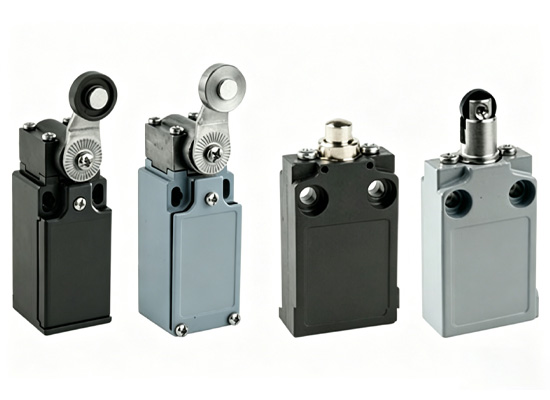
A limit switch is a sensor that detects the position of moving parts through physical contact. When a moving part reaches a set position, it touches the actuator, causing the internal contacts to change state and output an electrical signal to the control system.
It is one of the most fundamental and reliable position detector in industrial automation, requiring no power supply, offering strong anti-interference, and being low in cost. It is suitable for positioning, sequence control, safety protection, counting detection, and various other applications.
Fokca limit switches offer a variety of actuator types to flexibly suit different triggering methods. They feature high contact capacity and long mechanical life, with IP65/IP67 protection ratings. They are an ideal choice for low-cost, high-reliability position detection.
A limit switch is a sensor that detects the position of moving parts through mechanical contact. When a moving part (such as a cylinder slide, a workpiece on a conveyor belt, or a crane hook) reaches a set position, it physically contacts the switch actuator, causing the internal contacts to change state and output an electrical signal to the control system. The control system then determines that the position has been reached and issues commands to stop, reverse, or proceed to the next action.
Limit switches are among the most basic and reliable position detection components in industrial automation. They require no external power supply (dry contacts), offer strong anti-interference capability, are low in cost, and can operate in harsh environments.
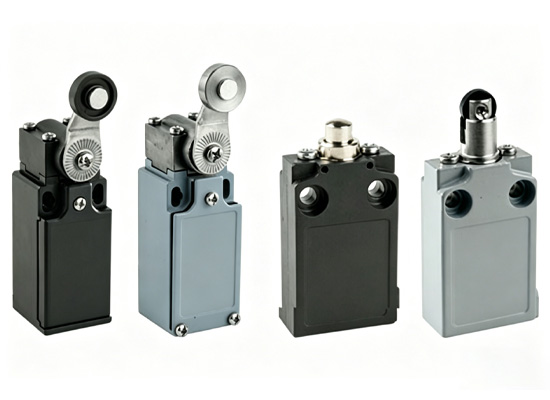
Any application that needs to know "has the motion reached here?" – end-of-travel limits, positioning, sequence control, safety protection, counting detection – relies on limit switches.
The core of a limit switch is a set of mechanical contacts. When external mechanical force pushes the actuator (such as a plunger or roller lever), the internal contacts change state. After the moving part leaves, a spring automatically resets the actuator, waiting for the next trigger.
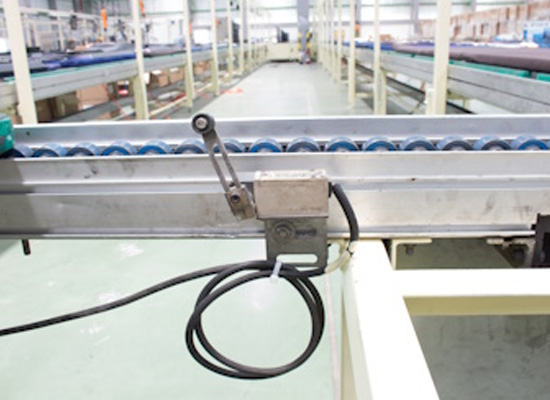
Non-actuated state: Actuator is free; Normally Open (NO) contacts are open; Normally Closed (NC) contacts are closed.
Actuated state: Actuator is pushed; NO contacts close; NC contacts open.
The control system determines whether the position has been reached based on the contact state.
This purely mechanical contact structure offers two major advantages: no power supply needed and strong anti-interference. However, it also has limitations: mechanical wear and relatively slow response speed.
Flexible Actuator Options – Plunger type for direct impact, simple and reliable; roller plunger type with roller reduces friction, suitable for high-speed impact; roller lever type can be triggered by cams or inclined surfaces with adjustable angle; adjustable lever type with variable lever length for flexible trigger positions; whisker type with a slender spring wire for light-touch triggering, ideal for small and lightweight object detection.
High Contact Capacity – Contact rating options of 10A/5A, capable of directly controlling contactors, relays, and PLC inputs. Silver alloy contact material provides excellent conductivity, arc resistance, and burn resistance. Mechanical life exceeds 10 million cycles; electrical life exceeds 500,000 cycles.
Durable – IP65/IP67 protection rating, dustproof and waterproof, suitable for damp, dusty, and harsh environments. Enclosure is made of high-strength engineering plastic or metal, impact-resistant and corrosion-resistant.
| Aspect | Limit Switch | Proximity Sensor |
|---|---|---|
| Detection Method | Mechanical contact | Non-contact |
| Power Supply Required | No | Yes |
| Sensing Distance | 1–5 mm | 1–20 mm |
| Response Speed | Slow | Very fast |
| Mechanical Life | Millions of cycles | No mechanical wear |
| Anti-Interference | Extremely strong | Inductive: strong; Capacitive: weak |
| Detectable Objects | Any object that can apply mechanical force | Metal only (inductive) / various materials (capacitive) |
| Cost | Low | High |
| Applications | Low speed, harsh environments, cost-sensitive | High speed, non-contact requirements, long life |
Selection Guide:
Harsh environment, cost-sensitive, low speed → Choose Limit Switch
High-speed response, non-contact requirement, long service life → Choose Proximity Sensor
Mounting position – Ensure the moving part reliably contacts the actuator when reaching the set position, avoiding missed contact or over-compression. Allow appropriate actuator stroke margin to prevent mechanical impact damage.
Actuator selection – Direct vertical impact: choose plunger type; cam or inclined surface triggering: choose roller lever type; flexible trigger position: choose adjustable lever type; small/light object detection: choose whisker type.
Wiring – Use NO contacts for "position reached" signals; use NC contacts for "position reached disconnect" signals (commonly used in safety circuits). Pay attention to contact ratings; never overload.
Protection rating – Damp/dusty environments: choose IP65/IP67 waterproof/dustproof type; explosion-proof requirements: choose explosion-proof type; general environments: IP54 is sufficient.
Regular inspection – Check for actuator deformation and smooth return; check contact continuity with a multimeter; check for loose mounting screws; listen for abnormal noise or sticking when the moving part reaches the position.
Replacement cycle – For high-frequency operation (>10 times/minute), inspect or replace every 6-12 months. For medium-low frequency, extend to 2-3 years. Replace immediately if unreliable operation occurs.
Q1: What is the difference between NO and NC contacts on a limit switch?
A1: NO (Normally Open) – Open when not actuated, closed when actuated. Used for "position reached" signals. NC (Normally Closed) – Closed when not actuated, open when actuated. Commonly used in safety circuits (can detect broken wires or damage). Some models offer NO+NC combinations for simultaneous output of both signals.
Q2: Can a limit switch directly control a motor?
A2: Yes, but pay attention to contact ratings. Small motors (<100W) can be controlled directly via limit switches. Large motors require control through contactors, with the limit switch serving as the control signal for the contactor.
Q3: How do you debug a limit switch after installation?
A3: Manually move the moving part to the set position and observe whether the switch triggers reliably (listen for the "click"). Use a multimeter to verify correct contact state changes. Confirm proper signal reception via PLC or indicator light. Adjust mounting position or actuator angle until reliable triggering is achieved.
Q4: How are limit switches used in safety circuits?
A4: For safety protection scenarios such as safety doors and protective covers, NC contacts are typically connected in series within the safety circuit. When any limit switch is actuated (door opened), the NC contact opens, cutting off the control power and stopping equipment operation. Using NC contacts has an additional benefit: if internal contacts weld together or wiring breaks, the circuit also opens, providing fail-safe protection.

Get a free sample

Links: www.fescolo.com(Pneumatic)
FOKCA ©1998-2025 All Rights Reserved Sitemap