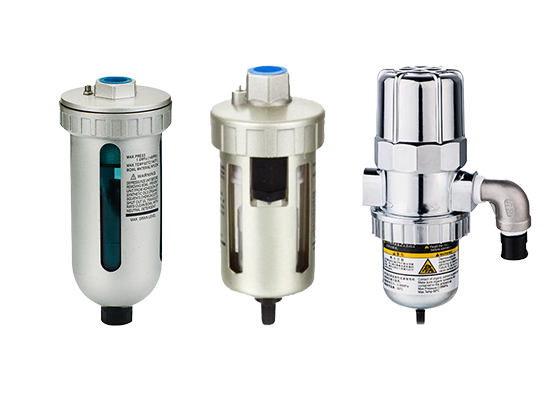
The auto drain is an essential component in pneumatic automation, effectively eliminating the “forgot to drain” issue, reducing manual inspection costs, improving upstream filter efficiency, and protecting downstream equipment. Fokca’s automatic drain features a mechanical design for stable and reliable operation. It automatically discharges water when the cup reaches the set level and closes when the level drops—no power required and unaffected by system pressure—truly enabling unattended operation, ideal for 24/7 continuous use.
An automatic drain is an auxiliary drainage device installed at the bottom of an air filter bowl. Its core function is to automatically remove the condensate that accumulates in the filter bowl, preventing overflow and ensuring the filter operates properly while keeping downstream pneumatic lines safe.
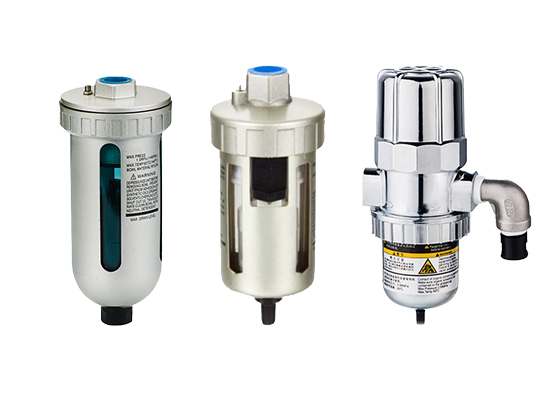
In pneumatic systems, air filters remove moisture and impurities from compressed air. During operation, condensate gradually accumulates in the filter bowl. If this water is not discharged in time, the bowl can overflow, allowing moisture to enter downstream components, reducing filtration efficiency and potentially damaging cylinders, valves, and other precision equipment. The automatic drain replaces manual draining, providing a solution that is automatic, timely, and reliable.
| Issue | Consequence | How the Automatic Drain Solves It |
|---|---|---|
| Forgetting to drain | Bowl overflows; filter loses function; moisture enters downstream | Automatically senses liquid level and drains at the set height |
| Delayed draining | Long-term water accumulation; bacteria growth; cup corrosion | Real-time level monitoring; discharges immediately with no residue |
| High manual inspection cost | Requires regular manual checking and draining | Fully automatic, unattended drainage |
| Manual draining causes leakage | Opening drain releases compressed air | Sealed drainage design minimizes air loss |
| Continuous production needs | Draining requires downtime | Drains under pressure; no need to stop production |
· Ensures filter function: Prevents overflow and maintains continuous filtration
· Protects downstream components: Keeps moisture out of cylinders and valves, extending equipment life
· Eliminates “forgot to drain” risk: Automatic operation without manual intervention
· Reduces maintenance costs: Less frequent manual inspections
| Feature | Manual Drain | Differential Pressure Drain | Automatic Drain |
|---|---|---|---|
| Working principle | Rotate knob to open drain | Closes under pressure; opens when system depressurizes | Float rises with liquid; drains at preset level |
| Manual operation required | Yes | No | No |
| Drain timing | User-controlled | During system depressurization (e.g., downtime) | When bowl reaches set liquid level |
| Can drain under pressure | Yes | No (requires shutdown) | Yes |
| Suitable applications | Periodic inspection environments | Single-shift production with daily shutdown | 24/7 continuous operation; unattended systems |
| Cost | Lowest | Medium | Medium |
| Reliability | Depends on user | Mechanical, reliable | Mechanical, reliable |
· Installation position: Mount directly on the filter bowl’s drain port thread.
· Installation orientation: Must be vertical to ensure float or piston operates correctly.
· First installation: After installation, pressurize the system, check for leaks, and verify drainage function.
· Periodic check: Inspect the automatic drain monthly to ensure proper operation and check for blockages or sticking.
· Cleaning and maintenance: Regularly clean internal debris to prevent clogging.

Get a free sample

Links: www.fescolo.com(Pneumatic)
FOKCA ©1998-2025 All Rights Reserved Sitemap