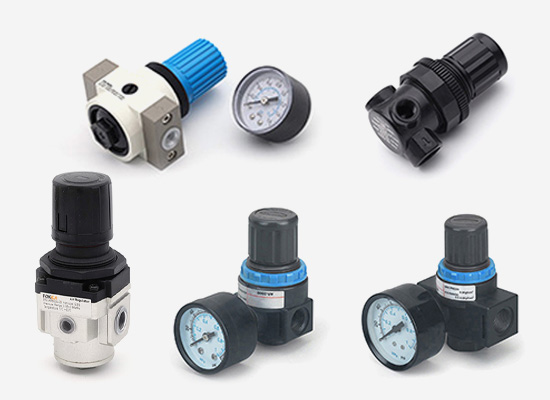
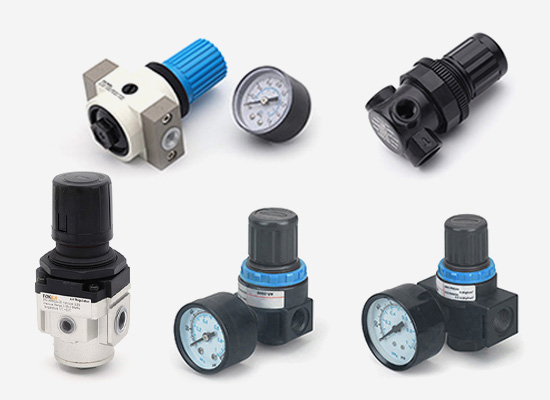
Precision, stability, and fine adjustment — the pressure regulator is a key component in pneumatic systems for maintaining constant pressure. With a pressure range of 0.15–0.9 MPa, it precisely stabilizes fluctuating inlet pressure to a set value, ensuring consistent operation and stable output of cylinders, valves, and other actuators—thereby improving product quality and extending equipment life. Fokca regulators are made from high-strength die-cast aluminum or zinc alloy with fully automated precision machining. The finely threaded screw delivers smooth, accurate adjustment, while the pull-to-lock knob prevents vibration-induced pressure drift. Sizes range from G1/8" to G1", supporting BSPP (G), BSPT (R), and NPT threads.
An air regulator, also known as a pressure regulator or pressure reducing valve, is a core component in pneumatic systems responsible for pressure stabilization and control. Its primary function is to precisely reduce fluctuating inlet pressure (typically from a compressor or main pipeline) and maintain it at a set value, providing a constant and controllable working pressure for downstream actuators such as cylinders, valves, and pneumatic tools.
In industrial automation, compressed air pressure often fluctuates due to factors such as compressor start/stop cycles and multiple devices consuming air simultaneously. If these fluctuations are directly transmitted to actuators, they can cause unstable cylinder force, inconsistent clamping force, and uneven operating speeds—seriously affecting product quality and equipment lifespan. The air regulator is the key solution to these issues.
| Problem | Source | Consequence | How the Regulator Solves It |
|---|---|---|---|
| Pressure fluctuation | Compressor cycling; multiple devices using air | Unstable cylinder force; inconsistent clamping; uneven speed | Stabilizes output pressure (fluctuation ≤ ±0.05 MPa) |
| Excessive pressure | Compressor output exceeds equipment requirements | Accelerated seal wear; higher energy use; possible damage | Reduces pressure to the required level |
| Different pressure needs | Different stations require different pressures | Cannot share the same air source | Enables staged pressure control for each station |
| Safety requirements | Equipment has maximum pressure limits | Overpressure may cause safety incidents | Limits maximum pressure to ensure safety |
| Energy saving | Excess pressure leads to unnecessary consumption | Energy waste and higher operating costs | Precisely controls pressure to reduce energy consumption |
The core working principle of an air regulator is based on a force balance mechanism, where precise pressure control is achieved through the dynamic equilibrium between spring force and air pressure. The relieving function is the key mechanism that enables automatic pressure balancing.
When you rotate the adjustment knob, the regulating spring is compressed, pushing the valve core open and allowing compressed air to flow from the inlet to the outlet. The outlet pressure simultaneously acts on the diaphragm, generating an upward force.
When the outlet pressure reaches the set value, the downward spring force and the upward air pressure reach equilibrium. The valve core stabilizes in position, maintaining constant output pressure.
Automatic Adjustment When Upstream Pressure Increases:
◆ Example: Upstream pressure rises from 0.7 MPa to 1.0 MPa
• Instant impact: Higher inlet pressure tends to push more air downstream, increasing outlet pressure
• Valve core closes automatically: Slight increase in outlet pressure pushes the diaphragm upward,
compressing the spring and moving the valve core toward the closed position, reducing airflow
• Dynamic balance: The valve closes just enough to block excess pressure, restoring and stabilizing the
outlet pressure at 0.7 MPa
Automatic Adjustment When Upstream Pressure Decreases:
◆ Example: Upstream pressure drops from 0.7 MPa to 0.4 MPa
• Instant shortage: Reduced inlet pressure decreases airflow, causing outlet pressure to drop
• Valve core opens automatically: The spring pushes the diaphragm downward, moving the valve
core toward the open position, increasing airflow
• Dynamic balance: The valve opens enough to compensate for the pressure drop, restoring and
stabilizing the outlet pressure at 0.4 MPa
This bidirectional automatic adjustment ensures that, regardless of downstream air consumption changes or upstream pressure fluctuations, the output pressure remains stable at the set value.
◆ Precision Fine-Thread Adjustment Screw:
High-precision fine-thread design ensures smooth rotation, uniform damping, and accurate pressure setting.
◆ Integrated Aluminum/Zinc Alloy Valve Body:
Made from high-strength aluminum or zinc alloy via integrated die-casting, offering excellent pressure resistance, leak-proof performance, and a refined industrial appearance.
◆ Wide Range of Models & Port Sizes:
Port sizes range from G1/8" to G1", supporting multiple thread standards including BSPP (G), BSPT (R), and NPT to meet global requirements.
◆ Custom Regulator Solutions:
Supports customization for special applications:
• Fixed Pressure Regulators: Preset output pressure, no on-site adjustment required, ideal for standardized equipment
• Precision Regulators: High-accuracy valve core and diaphragm design, with output pressure error as low as ±5 psi (approx. ±0.035 MPa), suitable for high-precision equipment
◆ One-Stop Full Brand Coverage:
Covers mainstream brands such as SMC, FESTO, and Airtac for fast selection and guaranteed authenticity.
• FESTO OR Series: German precision engineering, smooth and sensitive adjustment, excellent fine-tuning capability, high pressure resistance, ideal for high-end automation equipment
• SMC AR Series: Japanese quality, large flow capacity, wide application range, high interchangeability, equipped with a locking mechanism, and the most widely used in the market
• Airtac AR/BR Series: AR compact type for tight spaces; BR standard type with larger flow capacity; clean design with excellent cost performance

Get a free sample

Links: www.fescolo.com(Pneumatic)
FOKCA ©1998-2025 All Rights Reserved Sitemap