What Is a Pneumatic Turbine Vibrator ?
A pneumatic vibrator is a pneumatic device that using high-speed rotating assembly to convert compressed air energy into mechanical vibration. It features a metal housing that protects internal components from the effects of vibration while improving material handling efficiency. Suitable for harsh environments, it can function as a complete pneumatic machine and is widely used in applications such as promoting material flow, preventing blockages, and assisting material feeding.
Overview of fokca turbine pneumatic vibrator
Drive method: Compressed air.
Types: Ball type, roller type, piston type, turbine type, etc.
Advantages: Simple structure, quick start, high-temperature resistance, explosion-proof (no electric spark), suitable for dusty or hazardous environments.
Disadvantages: Requires a stable air supply, relatively high air consumption.
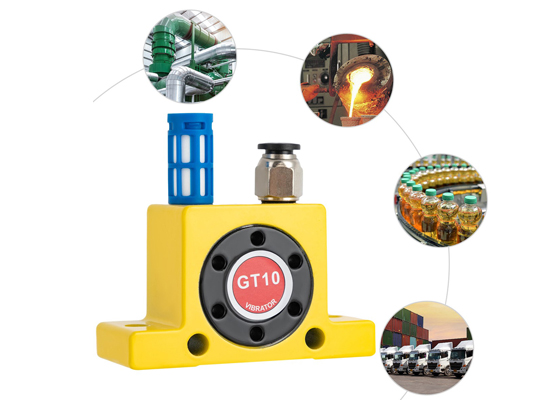
Applications: Preventing blockages in silos, screening equipment, powder conveying pipelines, etc.
Application of pneumatic turbine vibrator
Food processing industry:It is an ideal for powdered or hygroscopic materials such as milk powder, flour, grains, sugar, coffee powder, etc.The stable high-frequency vibration prevents bridging and ensures smooth discharge from silos and hoppers.
Pneumatic concrete vibrator:This turbine vibrator can be used to eliminate air bubbles in concrete, enhancing its density, strength, and durability. In the production of precast components such as pipe piles and utility tunnels, long-axis vibrators or external vibrators are used to ensure internal compaction of large tubular components.
Pneumatic vibrating table systems:It can be used for compacting materials placed on molds or pallets in concrete component factories, packaging lines, casting processes, and other scenarios.
Vibration isolation platforms:It can also be used to help isolate delicate instruments from external vibration sources,especially suitable for laboratory and precision production environments.
Pneumatic Turbine vs. Piston vs. Ball Type Vibrators
| Characteristics | Turbine | Piston | Ball |
| Working Principle | High-speed turbine rotation
| Piston reciprocation
| Steel ball rotation
|
| Vibration Type | High frequency, low amplitude, continuous | Low frequency, high amplitude, impact | High frequency, low amplitude |
| Noise Level | Very low | High
| Medium |
| Maintenance | Requires lubrication | Often lubrication-free | Maintenance-free |
| Best Use | Fine materials, small hoppers,quiet environments | Heavy/viscous materials,arch breaking | General flow aid |
Summary:
Compressed air turbine vibrators provide gentle, clean, quiet, high-frequency vibration, making them ideal for fine materials, small containers, and noise-sensitive workspaces. They are not suited for heavy-duty compaction or strongly adhered materials.
How does a pneumatic turbine vibrator work?
The vibration of a pneumatic & turbine vibrator comes from the rotation of the internal turbine.To understand the working principle, it is important to know the main components:
Main Components
Turbine Rotor: Contains an eccentric mass to generate centrifugal force.
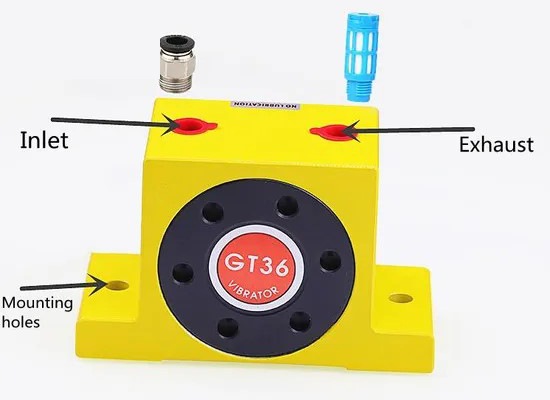
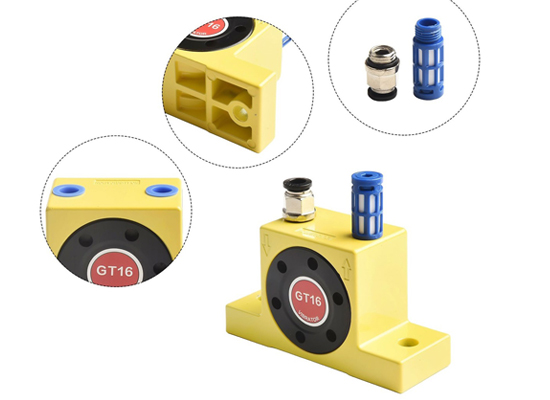
Housing: Strong metal structure with air inlet/outlet.
Compressed Air Supply System: Provides clean, dry air.
Working Process
Compressed Air Supply
Air enters the turbine chamber through the inlet port.
Turbine Acceleration
Air strikes the turbine blades, driving the rotor to spin at extremely high speed (thousands to tens of thousands RPM).
Centrifugal Force Generation
In a pneumatic & turbine vibrator, the internal turbine performs a rotary motion, causing an off-center (eccentric) mass to rotate. This rotation generates high-frequency centrifugal force, which is transmitted through the housing to produce vibration.
Vibration Output
Vibration is transmitted through bearings and the housing to the mounting surface, delivering strong and stable vibration energy.
How to use a turbine pneumatic vibrator?
(1)Install at the correct mounting location
(2)Ensure clean, dry compressed air supply
(3)Check all pipelines and fittings
(4)Lubricate regularly (important for turbine type)
(5)Perform routine maintenance and inspection
Proper installation and maintenance guarantee maximum vibration performance and service life.